@LuedtkeAllison Here's an email template I've sent out to undergrads after they finish the intro course to highlight research + get connected with PhD students.
I tried to highlight diversity w/ topics and authors
(and have succinct 1-line summaries @SayWhatYouFound)
https://t.co/vuumcVHl4L
@captgouda24 6. Randomize response incentives
Paper: Dutz et al '25 RESTUD
Idea: Like Behaghel, have a response instrument. Unlike them, have multiple! Monetary incentives + outreach effort. Tour de force reviewing various nonresponse correction methods.
@AlecStapp@captgouda24 FWIW I reviewed these and other related papers. I agree with the overall take of rent decreases, but it’s important to not sweep under the rug the overall take of price increases.
My overall takeaway is the cold take of needing to focus on increasing new supply.
@nealemahoney@mattyglesias@weakinstrument My read of the evidence is that prior should be rent decrease. (Caveat I missed Gurun et al that you cited).
The rent decrease mechanisms are (1) reallocate owner-occupied to rental and (2) more overall new supply. 1st principles is that 7-year BTR window disincentivizes (2).
@captgouda24 There were several other papers apart from these two that came out around the same time. My take was that all showed price increases to some degree, but the higher quality evidence showed rent decreases.
@jamespstratton and I put out a working paper a few days ago on exactly this question! We propose a way to answer it using a simple causal analogue of the R² ("Causal R²").🧵(1/12). Paper: https://t.co/FgD8fFIEYj
@paulnovosad It’d be nice to correct for pre-trends by instrumenting for an unaffected confound proxy (eg # of enrolled classes, behavioral issues, etc) with policy leads, rather than extrapolating a linear trend (Freyaldenhoven, Hansen, Shapiro ‘19 AER)
https://t.co/TzwhZDSF1r
@SashaGusevPosts@KelseyTuoc I’m curious to hear author @Econ_Geoff’s take.
Outcomes are selective school apps/enrollments. Clearly relevant to ed trajectories, less obviously sufficient stats for benefit.
(I get you’re making a broader policy point equating absence of evidence w/ evidence of absence.)
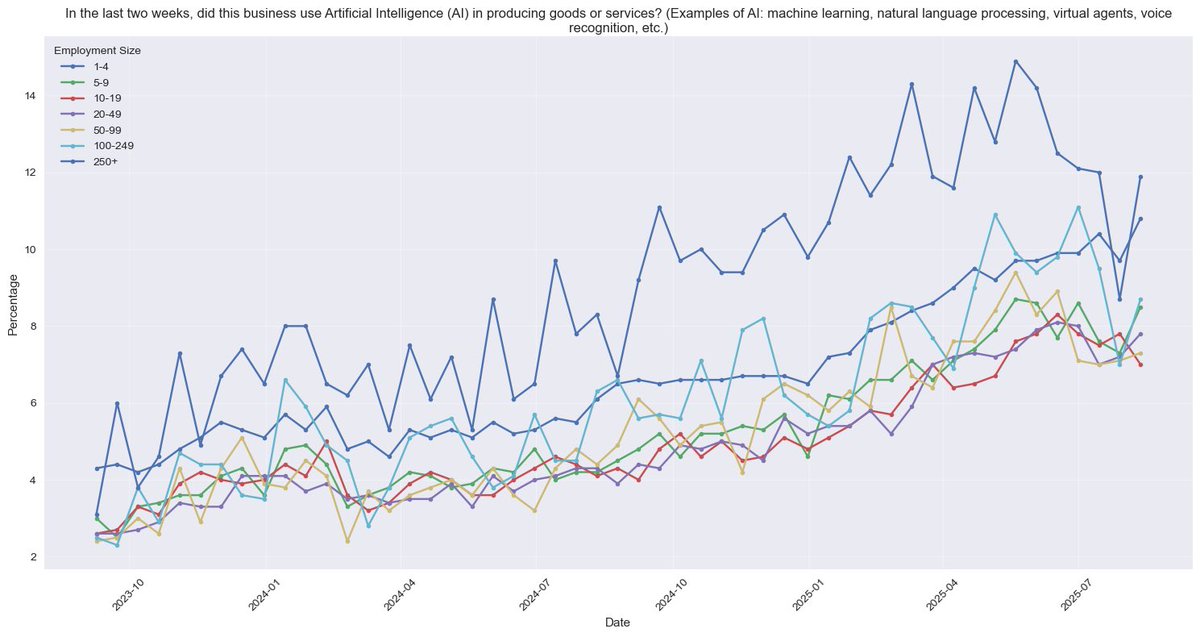
@arpitrage The biweekly survey is plotted as a 6-mth moving avg. A chunk of the drop off is from a late July outlier.
In addition to the past 2-wk Q, there’s a next 6-mth Q. That has less of a drop off. And its higher level suggests expectations of more adoption.
https://t.co/WUjiue9tty
@instrumenthull@tramir Does this also generalize to OLS with binary D?
Like IV w/ binary D gets complier X’s and (un)treated potential outcomes using appropriate interactions w/ D or 1-D.
Do those same interactions in the single OLS equation get “untreated effective sample” X’s and POs?
Forthcoming in AER: Insights: "Disemployment Effects of Unemployment Insurance: A Meta-Analysis" by Jonathan P. Cohen and Peter Ganong. https://t.co/1hQbIoEqsQ
Forthcoming in AEJ: Applied Economics: "Skill Depreciation during Unemployment: Evidence from Panel Data" by Jonathan Cohen, Andrew C. Johnston, and Attila Lindner. https://t.co/vmsqOp817w