Wild play here full of Buckeyes:
Pass intended for Garrett Wilson (Ohio State), intercepted by Davison Igbinosun (Ohio State) who fumbled when tackled by Jeremy Ruckert (Ohio State), and recovered by Josh Myers (Ohio State)
We launched a lot today:
* @fin_ai now does Customer Success
* It has skills letting it dynamically work out how to solve unseen problems
* Operator has massive new features
* Intercom Helpdesk has a new Copilot & Human In the Loop features
* 3 new CX models released
* + more
As COO of a fast-growing company, I spend a lot of time noticing what stopped scaling. Last month it was Slack.
Put a few hundred people in a channel and Slack stops being a conversation and starts being noise.
So here is how Warp communicates, in 4 pillars:
1/ Threads, always. Reply in the thread, not the channel. One topic per thread, and if the conversation shifts you start a new message. A channel should be readable by someone who joined it five minutes ago.
2/ Communicate concisely. Ayush wrote our Bottom Line Up Front doc in December and it comes down to one thing. The ask or the conclusion goes in the first line, context after. Batch your thoughts into one message instead of five short ones back to back. Easier to read, easier to search, less noise for the people it wasn't for.
3/ Channels over DMs. If the answer could help someone else now or later, it goes in a channel. DMs are for private or sensitive things only. A customer issue debugged in a DM helps exactly two people. Three months later someone solves it again from scratch.
4/ Close the loop. If you're tagged and don't react, the sender has to assume you didn't see it.
👀 is seen and on it. ✅ is resolved. 👍 is an FYI that needs nothing.
Banter is exempt. None of that needs threading or batching.
Public channels let people self-serve instead of asking the same question twice. That runs both ways: before you ask, search. The answer is often already sitting in a channel, and we protect deep work here, so an avoidable ping that pulls someone out of focus is a cost the whole team pays.
And at an AI-native company, your channels are also what your agents read. A decision buried in a DM is invisible to every person and every agent who needs it later. As far as the company is concerned, it never happened.
We're 70 people today and will be a few hundred soon.
If you want to join us as we scale, we have 20 open roles right now. Link in the comments to apply.
Career hack - Make decisions faster. Many decisions do not need another meeting. Decide now, take action, and move the project forward. Shows initiative and broadens your influence. 🚀🙏
alt: be kind and empathetic to people seeking work & trying to use the tools available to them on the #1 networking site for finding professional jobs
I hope recruiters are not so dumb that being secretly unemployed is somehow higher status than being transparently unemployed
We’re excited to share that we just signed an agreement for @salesforce to acquire @fin_ai for ~$3.6B. The transaction is expected to close in the fourth quarter of Salesforce’s fiscal year 2027.
Fin started as Intercom 15 years ago. We changed our name to cap our transformation just weeks ago. We were a darling of the SaaS era and invented so many of the patterns you see in software today. Nearly four years ago, in need of a reboot, we jumped on weeks-old modern LLMs to create and define the category we know as Customer Agents today.
Salesforce invented modern software and SaaS. And @benioff is like the final boss of tech founder CEOs. In seat for 27 years, he’s one of the last of his era. Still pushing, pivoting, placing big bets. It’s a privilege for @destraynor and I to get to partner with him and join forces with Salesforce upon close at this most fascinating time. And will be very fun to get their help bringing Fin to magnitudes more consumers.
To our customers: Over the past few years we’ve been shipping intensely. Including recently our groundbreaking model, Apex, and our paradigm-defining internal agent, Operator. With the resources of Salesforce this will only accelerate. And yet little will practically change. I’ll still be CEO, Des will still be running R&D, we’ll both still be committed to continuing to lead this category. Thank you very sincerely and deeply for your belief in us.
To all of our friends, our families, and our employees, past and present: While this is not the end, it is a major, pivotal, special, and emotional moment for us. From the bottom of our hearts, thank you. For everything.
To my cofounders, my exec team: Look what we built. Four young lads with a dream and nothing to lose. And a home grown exec team who pulled off the greatest and arguably only late stage software company pivot to AI, and invented one of the most important categories in AI. Thank you for sticking through all of this with me.
And now, time to get back to work. See you at our next product launch in a couple weeks. (:
Excited to say that @hubspot's 300,000 customers and @freshdesk's 150,000 customers can now use @fin_ai to power their Customer Service, giving their customer's instant accurate excellent answers.
Links in the thread.
@AvocadoMattress customers arrive with real questions: materials, certifications, firmness, what's right for their sleep. Kurt Dwiggins, Customer Experience Manager at Avocado, describes this as a spider web of questions that need to lead somewhere.
Fin for Ecommerce navigates all of it. It pulls live order statuses and delivery updates directly from Shopify, handles complex product questions in real time, and walks customers from early-stage research to a confident purchase automatically.
Fin’s results for Avocado:
→ 38% faster response times on chat
→ 67% faster response times on email
→ Fewer conversations that require human support
From "I have a question about your policies" to "I'd love to make a purchase."
Learn more about Fin for Ecommerce below.
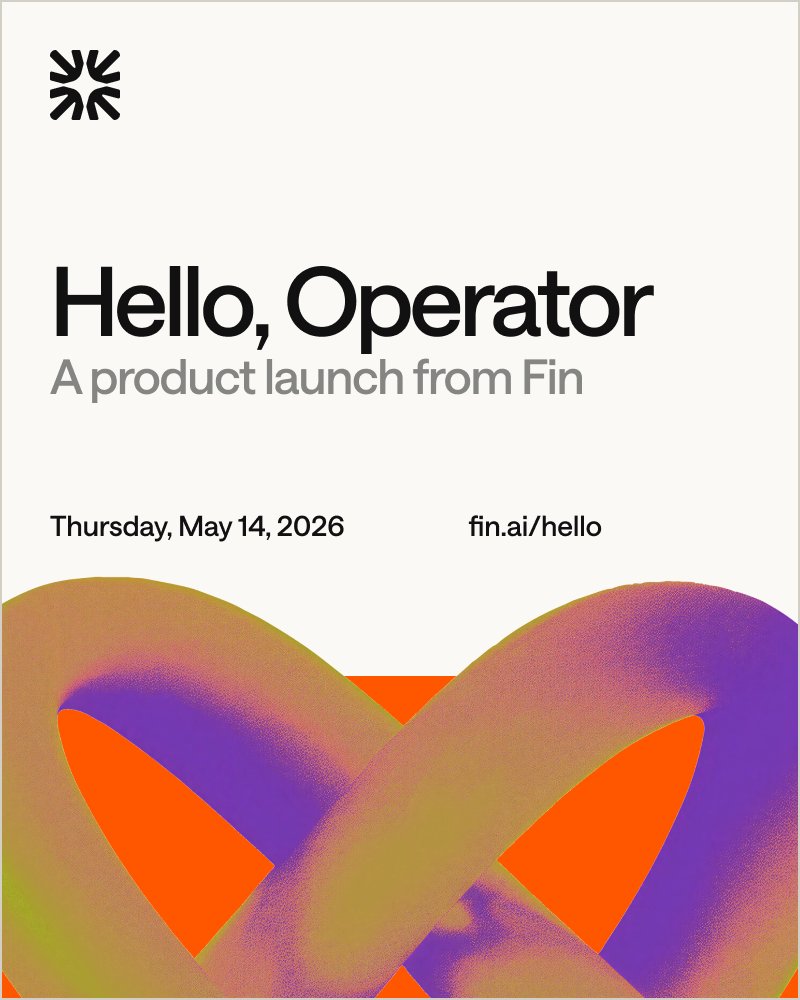
This Thursday we'll be live in San Francisco for a major new product launch: Operator.
Running an AI first support operation requires a new set of capabilities. You need new ways to manage work, measure performance, and continuously improve the customer experience.
Join us as we share the vision behind Fin Operator and what it means for the future of support.
Register to attend: fin (dot) ai (slash) hello
9 months ago we publicly committed to 2x the productivity of our R&D org at @intercom.
It was scary. It wasn't always clear we'd pull it off.
We hit it with 3 months to spare. In fact, looking back 16 months - we've 3x'd.
Here's what actually happened (with receipts): 🧵
LLMs decide what languages and libraries we use.
They’ll also decide what products a business runs on.
They'll prefer ones that work with them.
Every business now needs a CLI.
fin(.)ai/cli
Two competing thoughts here:
1. Agree than unlimited product YOLO is not ideal. I’ve kept @chatprd artificially constrained (me + a couple Eng) because it forces us to focus on what matters. Lots of things we could do we don’t do yet, or don’t do because not enough customers care.
2. But in big orgs I’ve seen capacity constraints used more to bludgeon roadmaps with incremental BS. Endless expensive meetings and planning time spent on “priorities.” PMs who contemptuously say “no” to every idea that hasn’t been RICE’d within an inch of its life. None of this results in good product, either.
What do I think is ideal?
Small team
Talks to customers
Ships a lot (but not everything)
Designed sensibly
What will I always avoid?
Precious overintellectualized roadmaps shipped on month+ horizons.
I always regretted more the things we didn’t build vs the things we did.
This is a wonderful example by Len from Podia of what it means to adopt @Fin_ai:
🟢 64% resolution rate
🟢 much happier customers (see the screenshots)
🟢 much happier team
It's win-win-win.
It's 2026, It's time for you too.
→ Fin .ai ←
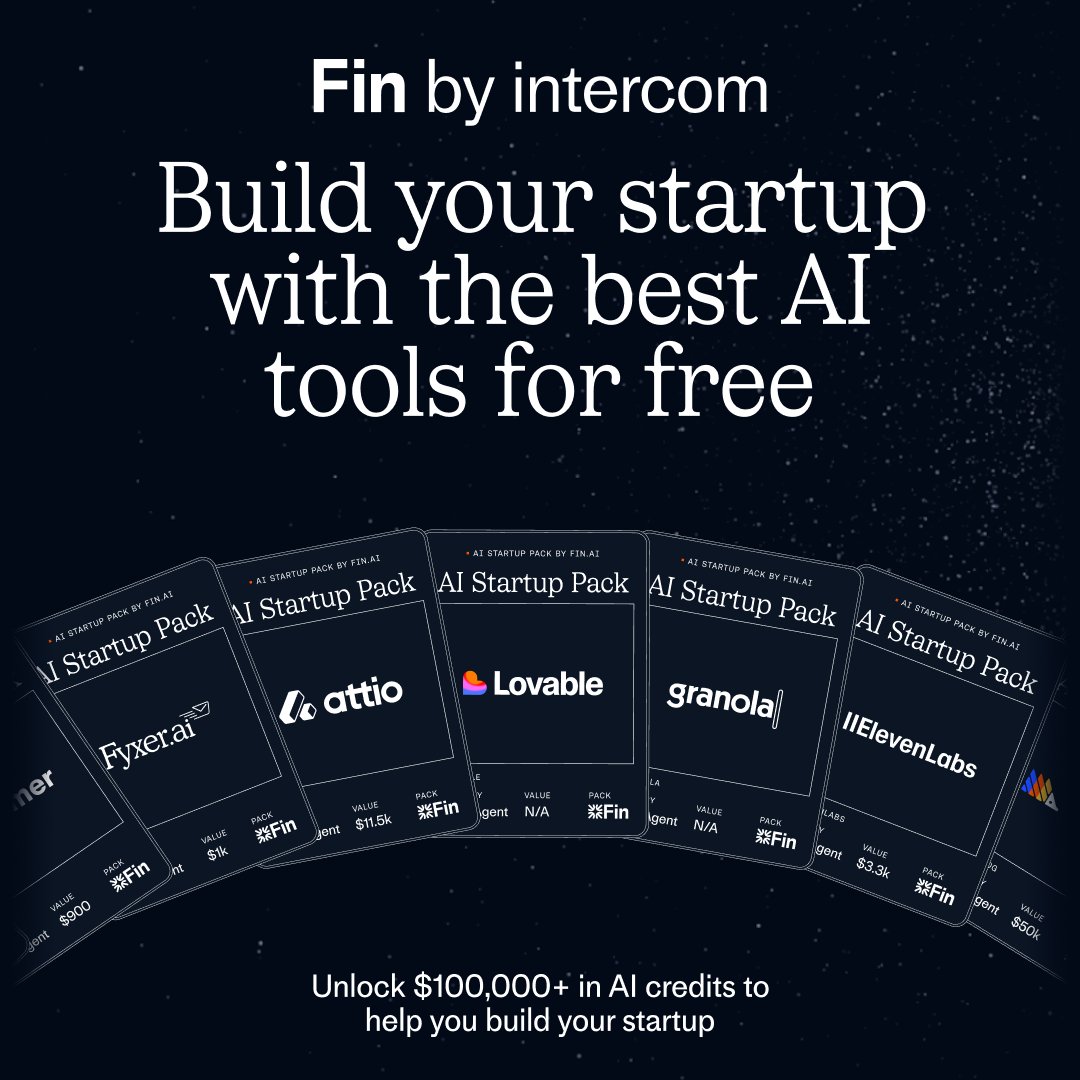
Startups: We've partnered with our friends at @stripe, @elevenlabs, @attio@linear@meetgranola@asana@Lovable and 25 other great companies to build a monster bundle of all every product a startup needs for FREE.
→https://t.co/gdyKENnI5H←