Here’s the part that usually gets missed.
The question isn’t whether the power or frequency is “low.” It’s whether the environment is coherent.
Biological disruption from EMF noise isn’t really debated. It’s well documented, easy to demonstrate, and repeatable. EEG, HRV, blood cell behavior, water structuring. What’s debated is scale and long-term impact.
The crux here isn’t power. It’s complexity.
Substations create layered, overlapping fields with shifting phase, orientation, and polarization. Those fields don’t add cleanly, they interfere. That interference creates variability and gradients that biological tissues are sensitive to over time.
Regulatory limits focus on intensity. Biology responds to structure, timing, and coherence. That gap is where real-world effects show up. Keep digging!
I’d encourage taking a step back and looking at the physics a bit more broadly before reducing this to power or frequency.
This isn’t really about Hz. It’s about the complex, overlapping field structure a substation creates
PEMF is controlled and coherent. Overlapping fields are not. They’re noisy.
Biological systems are sensitive to timing, phase, and gradients. EMF noise comes from interference and variability, not just field strength.
Perfect note. Here’s a version that enters the conversation, not confronts it.
Curious, additive, calm. Guide energy. No defensive pushback.
⸻
Worth zooming out for a second, because this gets framed too narrowly.
When people talk about substations being “safe” because the frequency is low, they’re usually thinking about power or a single signal. But that’s not really where biological impact shows up.
The bigger issue is noise created by overlapping fields.
Electromagnetic fields don’t stack cleanly when they overlap. They interfere. Even at similar frequencies, small differences in timing, orientation, and phase create constantly shifting patterns. That variability is the noise.
So it’s not just about how strong a field is. It’s about how coherent it is.
Noise scales faster than intensity. Complexity scales faster than strength.
Any system that depends on timing and coordination struggles more with interference than with raw power. That’s true for communication systems and for biological systems.
That’s why boiling this down to “50–60 Hz is safe” misses a lot of what actually matters.
There’s little debate that man-made EMF noise can disrupt biological systems. That’s measurable and repeatable. EEG, HRV, blood cell behavior, even water structuring. What’s still being debated is how severe those disruptions are and what the long-term downstream effects look like.
Most EMF meters measure field strength. Basically power. Biology doesn’t respond primarily to power. It responds to interference, timing, and signal clarity.
That’s why you can see biological effects without big changes on a gaussmeter.
@airestech
This is the wrong framing. It’s not about power or specific frequencies, it’s about the biological noise created by overlapping fields. Overlapping electromagnetic fields create far more noise than a clean, steady signal. This is because overlapping waves don’t just stack neatly, they interfere. Even when frequencies are similar, small differences in timing, orientation, and phase create constantly shifting patterns. That variability is noise. It’s not about how strong the field is, it’s about how coherent it is. Noise scales faster than intensity. Complexity scales faster than strength. Any system (communication systems or biological systems) that depends on timing, gradients, or coordination struggles more with interference than with strength. Which brings us back to why this topic matters and why it’s far more complex than saying 50-60hz is safe. The facts, there’s little debate that the noise created from man made emf disrupts biological systems, this is measurable, replicable and simple to demonstrate (eeg, HRV, blood cell clustering, water restructuring…). What’s debated are just how severe these disruptions are and what are the long term downstream effects. @airestech
The market cap of a company is a prediction of the value of goods & services that it will create.
To seize it is to destroy it, its future output, & to make entrepreneurs stop.
There is nothing to capture. There is only a technological, military, & economic future to give up.
@tferriss@yodchatri@ONEChampionship Environment isn’t just influence, it’s a mirror.
You rise or shrink based on what surrounds you.
Choose proximity with intention.
Marc Andreessen explains why the “curse of the entrepreneur” is being too early
“My experience is the great founders almost always feel like they’re too late, and you’re almost always too early.”
The reason is because the idea seems obvious to the founder:
“You’ve got some idea in your head, and as far as you’re concerned, the world should already work this way, which is why you’re pursuing it. And so it’s a little inexplicable as to why it hasn’t happened to it… It must be just about to happen and I must be too late.”
This is how Marc felt at Netscape when he co-authored the first widely used web browser. But in reality, Marc explains, founders are almost always too early:
“We almost never see a qualified founder fail because they were too late to market. It’s almost always because they’re too early to market. And I don’t say that critically. When we screw up investments, I think that’s often the reason as well.”
It usually turns out that the world just wasn’t ready yet. Marc points out that when Apple launched the Newton in 1989, it was basically the same thing as the iPad. The world just wasn’t ready yet, and the required technologies weren’t in place (e.g. mobile broadband, high-resolution screens, battery technology, etc.).
“It convinced people for 20 years that tablet computing would never work. And then they did it again with the iPad, and it worked. I think that’s the permanent curse of the entrepreneur.”
In a previous YC talk, Marc told founders that if what you’re working on was the hot thing 3-4 years ago, you’re probably right on time because the infrastructure and consumer behavior has now caught up.
Video source: @ycombinator (2016)
There’s no such thing as happiness.
Rather, a fragile contentment with the way things are.
Broken by unhappiness, the pain of wanting something.
Until we get it or get over it.
Returning to an interlude of gratitude without reason, beauty without motive, love without demand.
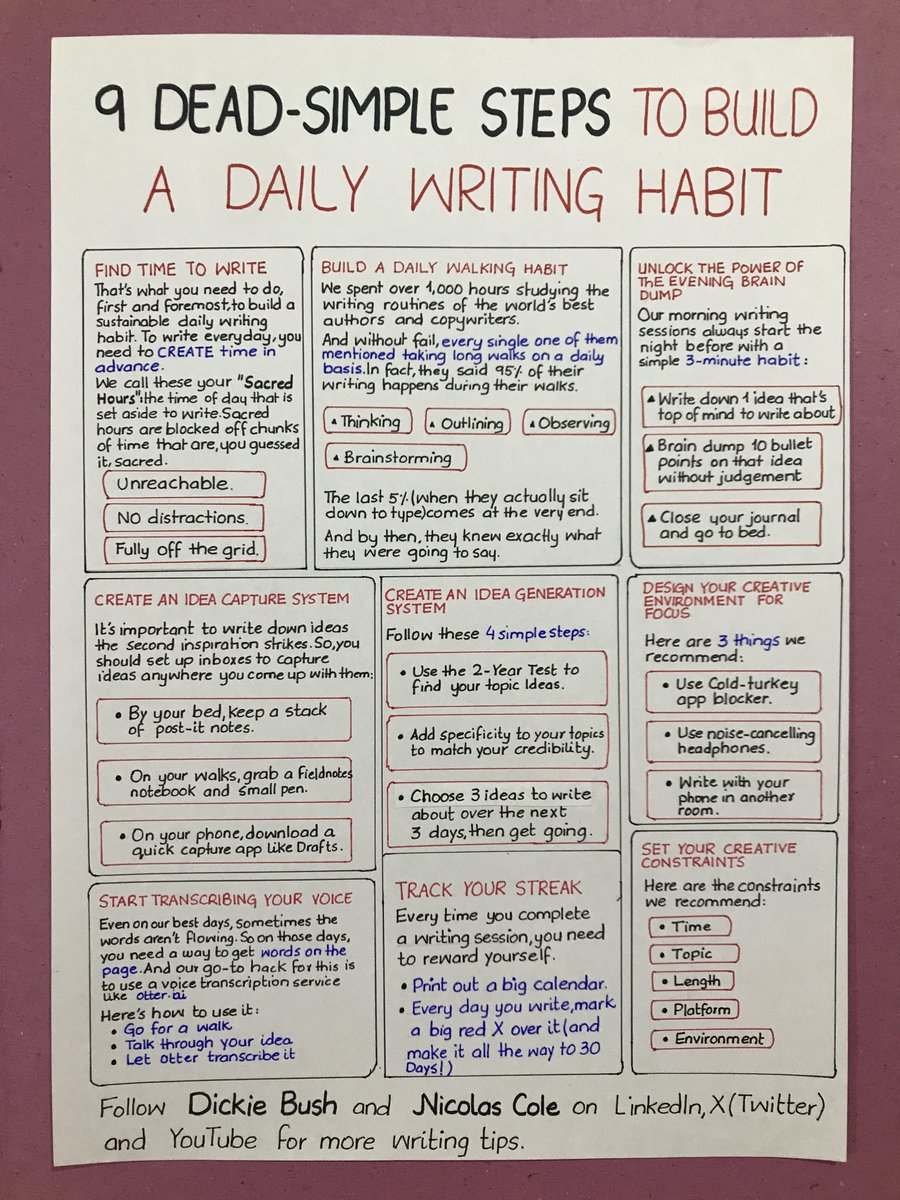
The most powerful habit you can develop:
Writing.
But most overthink every word and never hit publish.
Here are the simple steps I've used to write every day for the last 12 years:
@dr_klassen@BrandyZadrozny@willsommer Also note, that cell phone was in same consistent state for the cell phone only test then cell phone + Aires test.
@dr_klassen@BrandyZadrozny@willsommer Exposure was the condition that was created, in the instance in this brain scan video, is referring to a live cell phone for 8 minutes. After which, a reading was taken to measure and observe change after the exposure. Yes, the link I provided shows more studies.
I’m not sure what the confusion is. The doctor in the video conducted multiple scans & readings based on different conditions. The z score is applied to the data collected from
The readings. The colors represents change not heat. Did you watch the video or just commenting on this screenshot taken from the video? I can understand where you’re coming from if you just saw the image w/o context
@dr_klassen@BrandyZadrozny@willsommer That is a link to a variety of studies, not an ad.
Neural activity is the constant electrical activity and transmission in the brain. It's the primary way the nervous system communicates.
@bossert_l@BrandyZadrozny@willsommer This demonstration was not related to heat. This is an image of a z score. I am sure you know what that is but for those that are not aware, It is a simplified score that helps to quantify changes in EEG parameters.
I recognize anything related to emf has been a murky pool of scammers & grifters which makes the work we are doing at Aires much harder. When I took over as CEO & learned about the large scale research the team is doing w/bees I said we should have went all in on saving bees. No one gets mad at saving bees. However here we are held back because of bad behavior by bad characters. I am empathetic & recognize the skepticism is warranted. I would encourage you to take a peak at the research, it is peer reviewed & many of the papers have been published. The effect on humans is easy to demonstrate in real time using biofeedback tools such as EEG & HRV. I am happy to have any conversation you like on the topic & as a public company, you will find full transparency, virtually everything you need to make an informed opinion on our site. Studies, patents even the mathematical formulas used to design the diffraction pattern on the silicon.