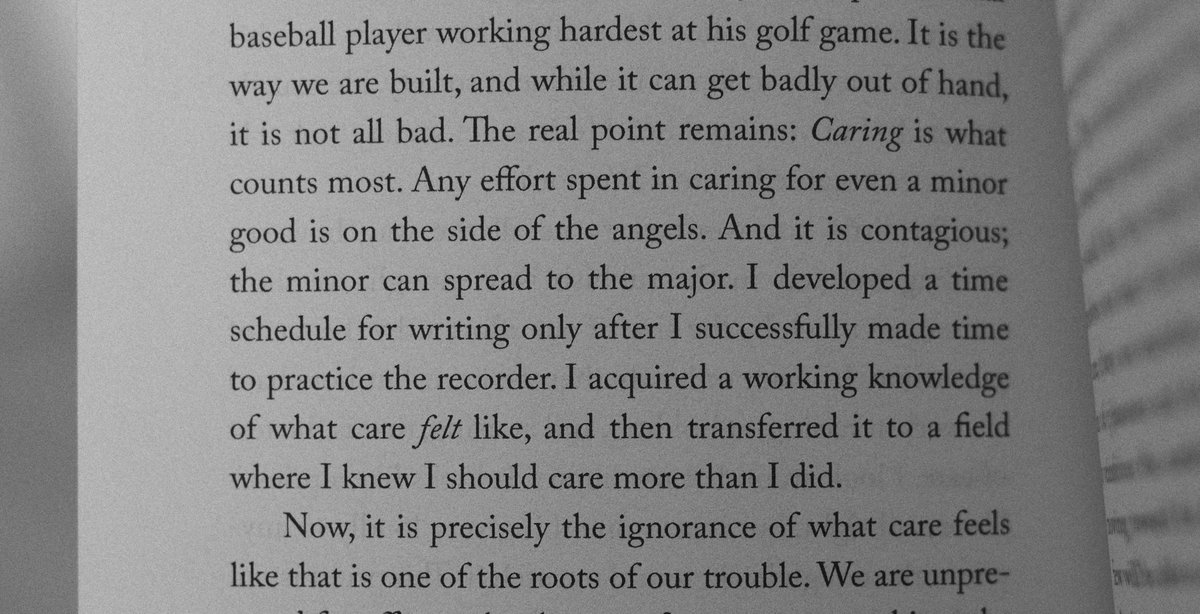
Capon: Caring is what counts most. Any effort spent in caring for even a minor good is on the side of the angels. And it is contagious; the minor can spread to the major. I developed a time schedule for writing only after I successfully made time to practice the recorder. I acquired a working knowledge of what care felt like, and then transferred it to a field where I knew I should care more than I did.
"Intelligence per-watt is one of my favorite metrics to watch"
Really enjoyed this conversation between @atiorh & @awnihannun. Great context on speech models and the history of MLX. Worth a listen.
I hosted @awnihannun on localhost, co-creator of MLX and member of the Deep Speech mafia. Enjoy!
Apple Podcasts: https://t.co/YmEqAuFQPd
Spotify: https://t.co/Wl3dDFk528
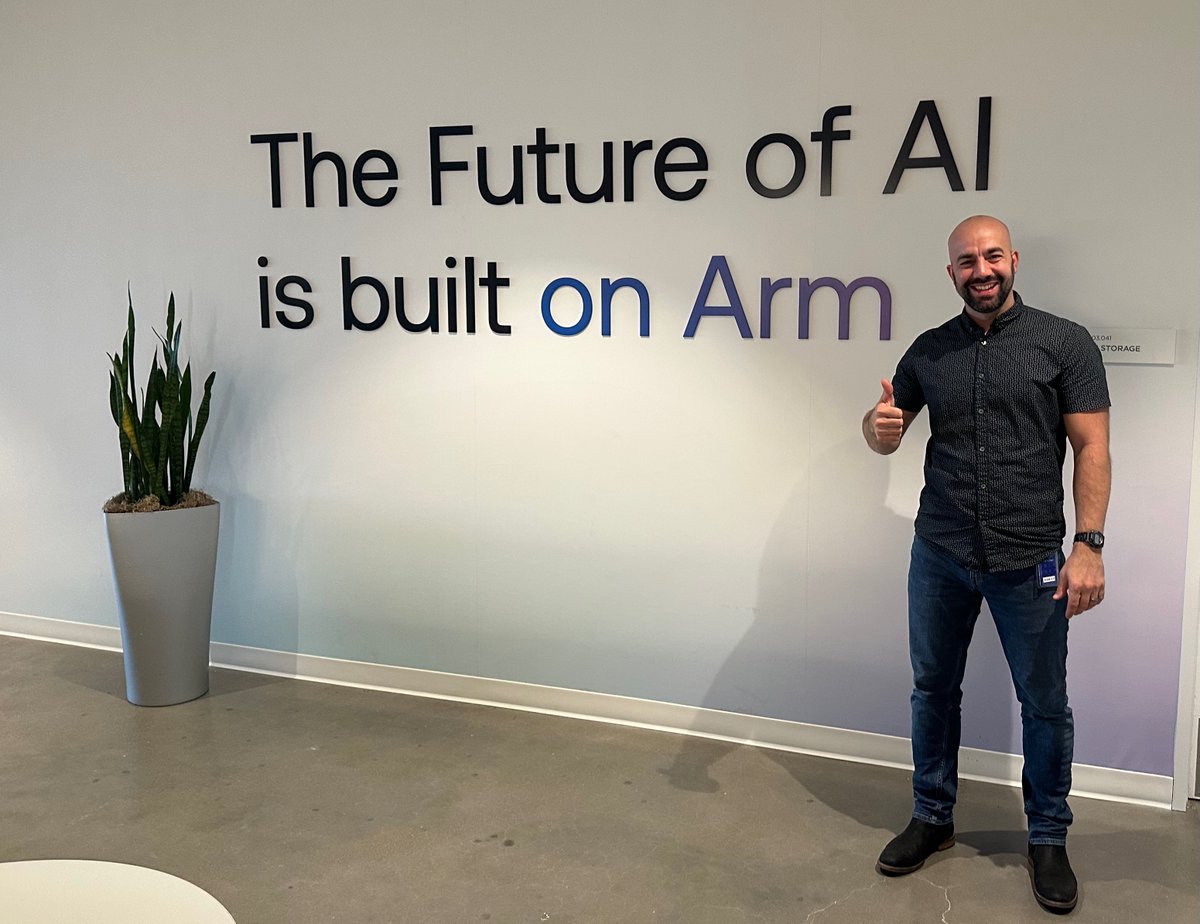
I'm excited to share that I'm starting a new role at Arm in the AI and Developer Platforms organization, focusing on AI/ML performance.
Looking forward to going deeper in the systems stack. If you're ever in the Austin area, I'd love to connect.
I have spent 4 years making LLMs generalize better without more data or compute. I'm looking for a Research role in industry. Here's what I've built:
1/ Early Weight Averaging → First paper (2023) to apply weight averaging during LM pre-training. Now widely used in many pre-training pipelines. https://t.co/tjVfBIlBHg
2/ Attention Collapse → Diagnosed attention collapse in LLMs and proposed a training fix.https://t.co/eTcmMzMYfd
3/ Curriculum Finetuning → Upweight easy samples and downweight hard ones during finetuning to reduce forgetting. https://t.co/tLhqzUh7nY
I am a PhD student at UT Austin. I have interned at DeepMind, LightningAI, and Amazon Alexa.
If you're hiring or know someone who is, please DM or email ([email protected]).
Web: https://t.co/S6UKjulcyW
#MachineLearning #LLM #NLP #PhD #AIJobs #OpenToWork
After 8.5 years of ML at Amazon across AWS, SCOT and Last Mile, I'm moving on to my next adventure.
Thank you to the many teammates and leaders I had the privilege to work with along the way.
I'm excited for what's next. Let's stay in touch!
New blogpost. I wanted to see how fast I can go with a 0.6B model on the RTX 5090 without quantization, and megakernels are perfect for this. Thanks to @elliotarledge for the initial Qwen Megakernel for the 3090. There's probably room for improvement, but I'm not sure where.
@ibnAmjid Really enjoyed this, thanks for sharing Sami. The architecture section stood out to me, especially the amount of responsibility the orchestrator is handling.
Today, we release SERA-32B, an approach to coding agents that matches Devstral 2 at just $9,000. It is fully open-source and you can train your own model easily - at 26x the efficiency of using RL.
Paper: https://t.co/aeD6T2WW3O
Here’s how 🧵
GPU MODE 2026: we’re post-training Kernel LLMs in public and are building all the infra we need to make GPU programming more accessible to all. We're doing this in close collaboration with some of my favorite communities @PrimeIntellect@modal and @LambdaAPI
2025 recap: 26K YouTube subs, 92 lectures, 24K Discord, 3x $100K+ kernel comps, 400K KernelBot submissions,3 events (NVIDIA / Jane Street / Accel) and 10 active working groups!
So for 2026 our concrete goal is to post-train a Kernel LLM and get kernels merged into real repos (PyTorch / vLLM). We plan to share our first results by GTC (San Jose, March 2026). second by ICML (Seoul, July 2026).
work-stream 1: de-slopify LLM kernels (with PyTorch / vLLM / NVIDIA). most generated kernels are verbose, fragile, and non-deterministic. the bar is “maintainer can review + merge”
work-stream 2: post-training Kernel LLM (with Prime Intellect / Modal / Lambda / MIT). We’re betting on two levers: profiler-guided optimization + memory
work-stream 3: competitions as evals. We want more end-to-end system optimizations, they're trickier to design good problems for but the results will be more interesting
work-stream 4: “from scratch” repos. Think: 80% of the performance with 10% of the code (teenygrad, penny ) starting with a minimal RL library optimized for B200
2026 is the year we turn Kernel LLMs from a meme into one of the most reliable ways of improving the performance of AI systems. So if you're interested please join our weekly meetings!
Some notes on what someone can do for building chops in ML x open source x modeling:
• Take a popular pre-trained model implementation, profile it, spot the bottlenecks, & try to improve its speed-memory trade-off -- it's a valuable skill that any sane hiring manager should understand and credit (they are probably not legit if they don't). https://t.co/bMr7UG8fVP is a good example of this.
• GPUs are in short supply. So, try reimplementing it in JAX, leveraging its strengths. Make it run on TPUs, blazing fast 🔥 -- this will help you establish that you care about performance and are comfortable switching stacks when needed. https://t.co/XCx5e4k0st is an amazing example of this.
• In the context of an organization, communication is the key. Make sure you document your experience in an easily digestible way so most folks would understand what you achieved. Provide numbers on benchmarks, mention assumptions, and whatever limitations you faced and how you approached them.
• Get a pro subscription to whatever AI coding assistant you think works the best for your stuff. Make it a part of your workflow, but DO NOT become overly reliant on it. Have enough juice in the process so that you can build muscle memory and objective evidence of your intellect over time.
• Have fun!
It gives me a sense of joy and relief to know that back in the days, we did all of it happily WITHOUT any AI coding assistance. Lots of fun, despair, and anxiety -- but all worth it; 10/10 -- would do it again!
@agihippo The ability to enjoy your life is a gift:
"when God gives someone wealth and possessions, and the ability to enjoy them, to accept their lot and be happy in their toil—this is a gift of God"
– Eccl 5:19
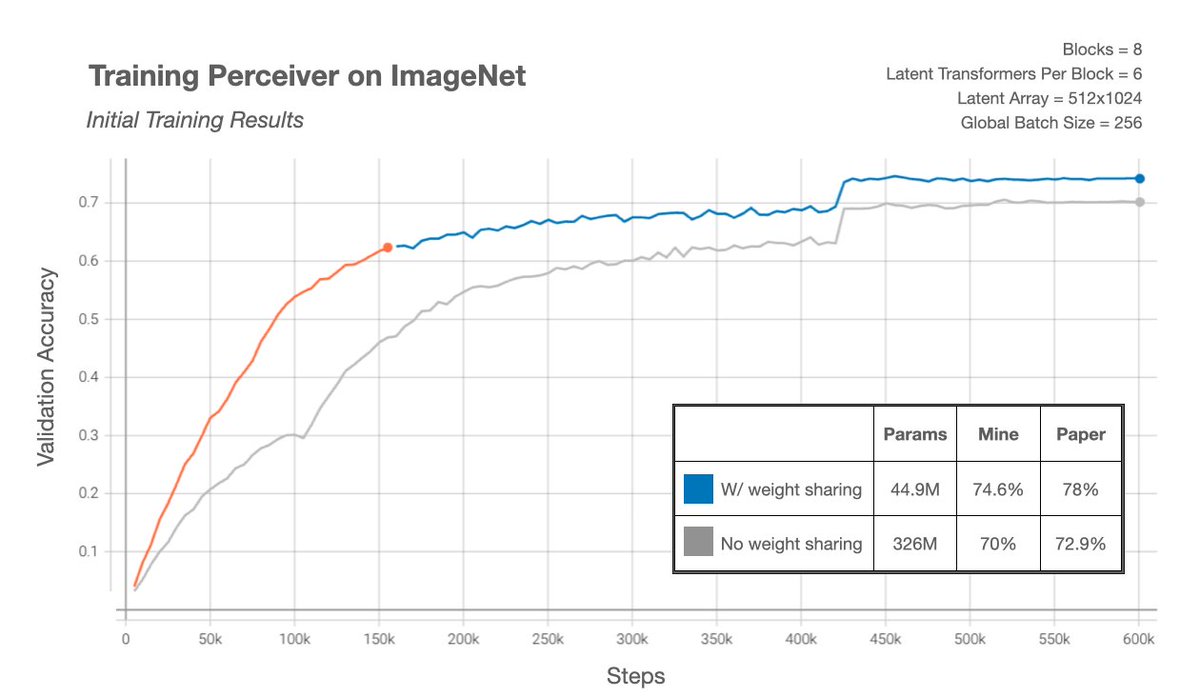
So my implementation is still missing something. Not sure what yet.
The first thing that comes to mind is weight initialization: Jax (which was used for their paper) uses different default than PyTorch.
https://t.co/T41kjwgHgY
I'm now able to re-implement/train the full Perceiver (@drew_jaegle et. al.,) end-to-end on ImageNet.
Getting very close to paper result, with a gap of about 3%.