We'll be spending a lot more time trying to understand the outputs of language models. A few thoughts, tips & tricks:
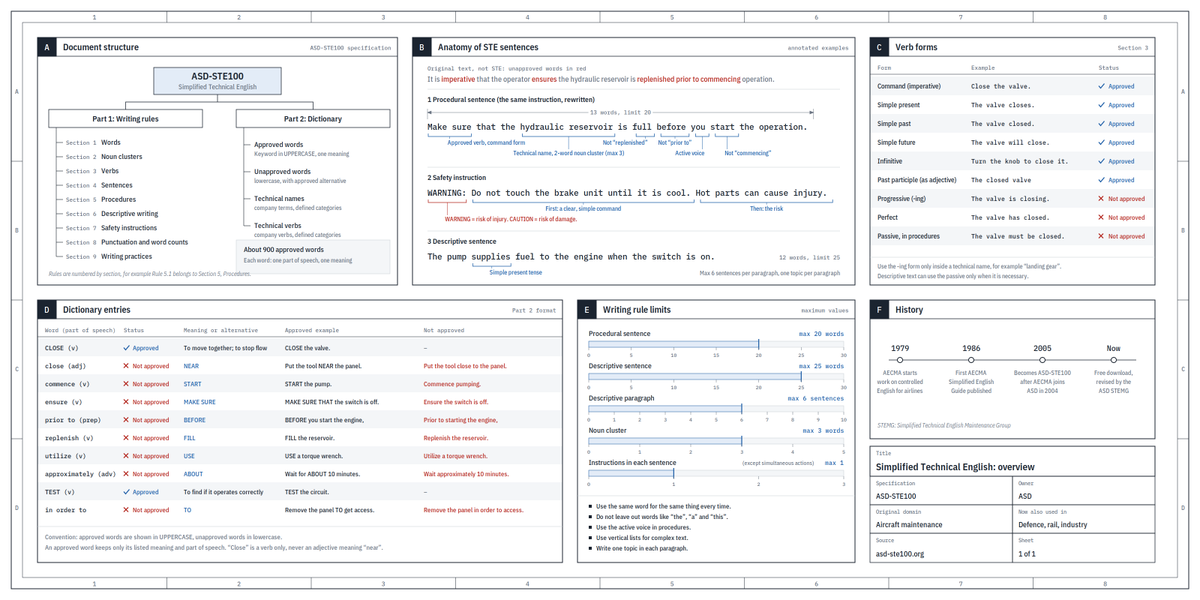
Writing. Something I've had success with: Ask your LLM to explain something in ASD-STE100, it's a controlled language specification originally developed for aerospace maintenance documentation. LLMs well-versed in this language and it comes with heavy constraints on clean writing style that I often find a lot more readable. Sometimes I've tried to soften it a bit e.g. ask for "80% of the way to ASD-STE100" because the spec is quite stringent. But even better:
Diagrams / images. Instead of writing, ask your LLM to create a diagram. These can be a lot easier to process, parse, and understand. But even better:
Web pages. Ask for output "in HTML" to get a beautiful, interactive webpage. LLMs are getting really good at frontend and can create beautiful experiences, animations, etc. But even better:
Explainer videos. The output format I am most bullish on is fully custom / bespoke explainer videos generated on any arbitrary topic. Experiment with things like "Create a 3b1b style video explainer on X. Use my ElevenLabs API key for audio narration". (you'd need an API key for the latter or you can ask your LLM to find you decent free alternatives that use your local compute). This is actually starting to work!
In summary:
- As LLMs get better, they will do more and more of the legwork autonomously, and a lot more of our work will rise up the abstractions into oversight and understanding.
- Luckily, LLMs can help here too because as intelligence and code are increasingly abundant, you can ask for large, custom, discardable software artifacts (e.g. web apps, video explainers) that would have never made sense to create before. Push the boundaries here and you'll be surprised.
This is an insanely important report about how completely, utterly and totally unprepared Europe is for the arrival of transformative AI.
A single data centre in Malaysia will soon have a third of the AI computing power of *all* of Europe combined. Two data centres in the US will have more than our entire continent.
And that's just page one...
More than 60 of Europe's top minds (including two Nobel laureates) have just published "A Transformative AI Strategy for Europe", an independent report about how dire the situation is. As the world gets darker, we risk being squeezed and trampled by the US and China. On the current path, the report warns, even Europe's richest economies could slide toward middle-income status in a world run from Silicon Valley and Beijing.
Here's where we are right now:
→ The EU hosts just 5% of the world's AI compute. The US: 75%.
→ Not one of the ten most valuable AI companies in the world is European.
→ And this year, Europe got locked out of the world's most powerful AI model, twice, by American export rules. The EU's own cybersecurity agency had to negotiate for weeks to get in, and still doesn't have the latest version.
For years the comfortable story was: America innovates, Europe regulates. Well, that story is dead. You can't regulate what you can't access. And you can't protect 450 million people with second-rate cyberdefence against first-rate attackers.
The good news is that we have some leverage: Europe holds the single biggest chokepoint in the global chip supply chain (ASML). And this report sketches a plan to increase our leverage massively. Here's what we need to do:
1. Build a member state alliance for supply chain security – Netherlands, Germany and France at minimum – founded before the end of 2026.
2. Recruit many more frontier AI experts inside European governments ASAP.
3. Aim for at least 15% of global AI compute on European soil by 2030, built so local communities actually benefit.
4. Make Europe the world leader in AI assurance: hardware that can prove how AI is being used.
5. Prepare for crises and emergencies, such as engineered viruses and highly advanced automated cyberattacks.
It's too late to catch up with the US and China. But it's not too late to build leverage .
Read the full report here --> https://t.co/Byi5WYC8yW
Literally everyone, everywhere, having unlimited access to superintelligence is far less dangerous than any one person, company, or government having access to it alone.
Germany has launched one of the world's best open-source AI models.
Soofi S, made by the Soofi consortium, is a 30B parameter model fully trained in Europe and tops the ranking for open-source AI.
Huge moment for Europe, and finally some competition for Chinese open-source AI.
Andrej Karpathy method + kepano (Obsidian CEO) + Claude Code = the most powerful second brain on earth.
The equation started with a 1,500-word gist that 21M people read.
Here’s why every second brain you’ve tried is already dead: Tiago Forte sold 400,000 copies of “Building a Second Brain,” and most readers quit within 3 months not from laziness, but because linking 50 notes every time you read a paper is work no human wants to do. The wiki dies when the maintainer gets tired.
Karpathy fix kills the problem at the root you are not the maintainer anymore.
The frame flip:
Obsidian is the IDE.
Claude Code is the programmer.
Your notes are the codebase.
Instead of asking AI questions it forgets by tomorrow, you hire it to keep a living wiki.
3 commands run the whole thing:
1. Ingest drop an article, a podcast, or a PDF, and Claude breaks it into atomic pages wired into everything you already know, with 1 source touching up to 15 pages.
2. Query ask anything and it answers from your own notes, citing your own pages instead of guessing from training data.
3. Lint once a week Claude walks the whole vault, flags contradictions, kills stale claims, and reconnects orphan notes. It’s the step everyone skips and the one that keeps the system alive.
Then kepano made his move.
Steph Ango, the Obsidian CEO, didn’t bolt an “Ask AI” button onto the app he shipped 5 skill files that teach Claude to speak Obsidian’s native grammar: wikilinks, Canvas, Bases, the CLI. Now the programmer knows the IDE from the inside.
The setup takes 1 afternoon: 3 folders, 1 CLAUDEmd file with the rules, then point Claude Code at the vault and paste the gist.
Karpathy own warning start with 10 sources, make ingest, query, and lint feel natural, then scale.
Because this thing compounds: the 10th source is worth more than the 1st since there’s more for it to connect to, and the vault gets smarter every week you feed it.
Every other vault stores this one thinks while you sleep.
A developer just cut Claude Fable 5's token bill by ~70% with one dumb trick.
He turns your text context into PNGs before Fable sees them.
it's called pxpipe. 6k stars already.
why it works:
an image's token cost is fixed by pixel dimensions, not the text inside it. dense content (code, JSON, tool output) packs ~3.1 chars per image-token vs ~1 char per text-token. one 1928×1928 PNG holds ~92k chars for ~2.7k image tokens. as text, that same slab is ~25k tokens.
how it works:
→ runs as a local proxy on 127.0.0.1:47821
→ intercepts /v1/messages before it leaves your machine
→ rewrites the system prompt, tool docs, and older history into PNGs
→ recent turns stay text so nothing critical gets lossy
→ per-request estimator only images when the math actually wins
→ fires a free count_tokens probe on the original in parallel so you can verify the savings live
most of the code and docs in this repo were written by Claude agents running behind pxpipe itself, reading their own collapsed history as image pages while they worked.
100% Open Source.
Les Saiyans français sont tombés face à l’Akatsuki espagnole. Mbappé a tenté d'atteindre le Super Saiyan 3, mais la Roja avait déjà activé son Sharingan et déployé un Susanoo défensif infranchissable.
Alors, simple faux pas dans leur quête… ou est-ce qu’on s’est tous enflammés?
Anthropic engineer:
«You're not supposed to sit and re-prompt Claude all day.
You build one loop, and it does the work while you sleep.»
• 00:00 - Build your first agent that runs on its own
• 05:02 - The loop that fixes its own mistakes
• 16:43 - Why Claude forgets you between chats, and the fix
You can learn it in one afternoon.
30 minutes here replace what most people spend a year figuring out.
Watch it today, then read the guide on building loops below.
OpenClaw is now on iOS + Android 🦞
📱 Native mobile apps, finally
💬 Agents in your pocket
🔔 Channels, tasks, replies on the go
Run agents from wherever your thumbs are.
iOS: https://t.co/7LHHc9htgM
Android: https://t.co/X0Wuh2uA8w
New Loop Library skill feature: Lazy Loops! (aka Discover)
Discover will look through your codebase and chat threads to find potential loops it will design for you.
https://t.co/qnfoRqkk72
@MatthewBerman@Austen I really struggle with small models. Actually finding something useful they can do reliably.
Does any of your OpenClaw workflow steps run locally on something small?
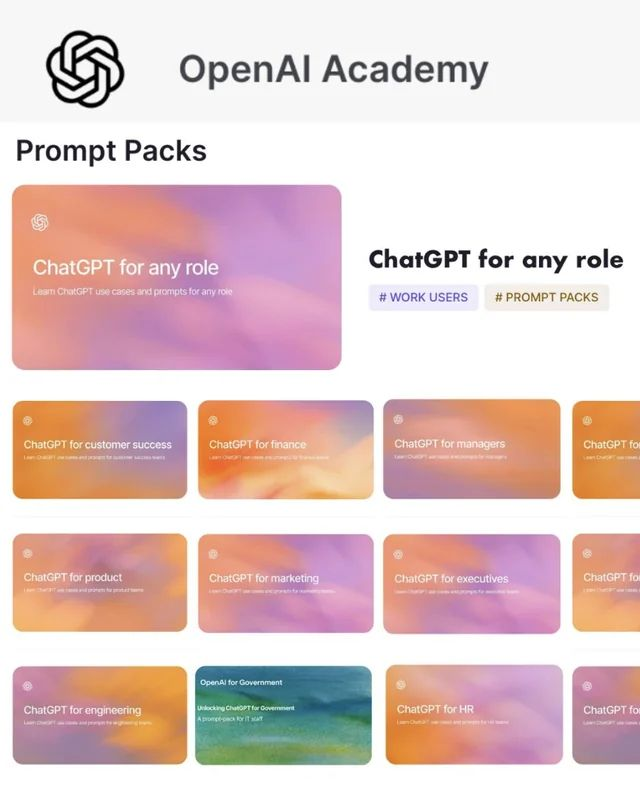
OpenAI just dropped `Prompt Packs`
↳ 300+ curated prompts
↳ 12+ departments (IT, HR, Sales, Product, CS…)
↳ 25 per role
Adapt them with your KPIs & product context for better results! 🔥
100% free.
Link to the packs in 🧵 ↓
Aqui el amigo @gisbert_ruben viendo que está poco manchado para entrar en la tv, se tira al suelo de rodillas para mancharse más. Felicidades @cuatro, @mediasetcom@navedelmisterio, no teneis vergüenza