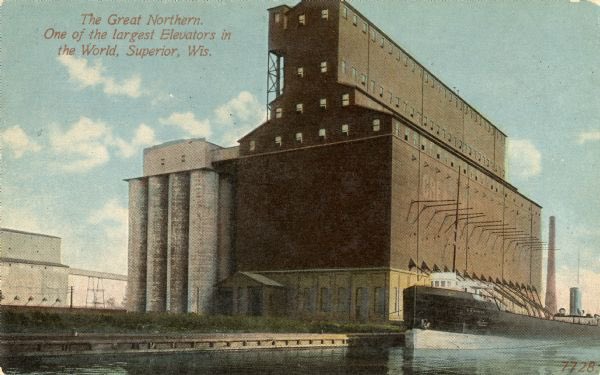
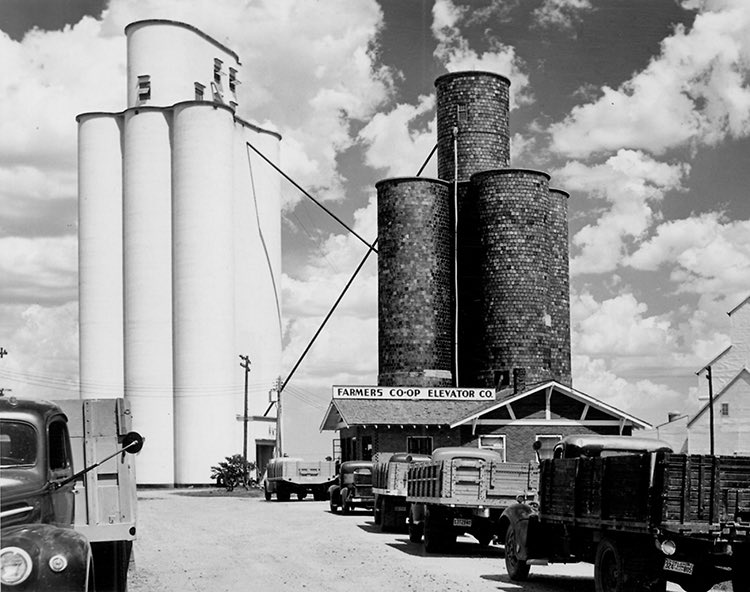
In much of the Midwest, the grain elevator functioned as a coordinating system, not a landmark.
Its operation set daily labor cycles. When the leg started, hauling began. When the pit backed up, everything downstream slowed. Truck lines, rail access, meal breaks, school pickups, even store hours adjusted to whether grain was moving or sitting.
Rail timing was not abstract. Elevators were built where sidings allowed loading, and trains responded to volume. Active elevators meant trains slowed, stopped, or waited. Once throughput dropped, rail behavior changed permanently. That shift alone altered how towns related to the outside world.
The elevator also operated as a financial intermediary. Grain wasn’t always sold immediately. It was stored, advanced against, or held until prices improved. Credit decisions were made locally, based on harvest history, land knowledge, and reputation. This created a feedback loop between agriculture, cash flow, and daily stability.
Weather knowledge concentrated there. Moisture levels, spoilage risk, and bin temperature were tracked continuously. People understood coming storms, heat waves, and storage failures through physical indicators, not forecasts. The elevator acted as an early-warning system tied directly to survival.
When an elevator closed, the impact was not just job loss. The town lost synchronization. Labor became asynchronous. Rail service decoupled. Businesses shifted from predictable hours to defensive ones. Time stopped being shared.
Most of these structures still stand because they were built to last. Their persistence isn’t symbolic. It’s infrastructural. They mark where coordination once existed and where it was removed.
The grain elevator mattered because it aligned people, capital, transport, and time into one system.
When it disappeared, those systems didn’t vanish. They fractured.
@jaesmail The structure of the modern, mainstream internet has killed agency in a lot of people our age. Going to take a lot of imagination to recover.
Yeah, I totally agree. I think of DeFi as “kinder” than TradFi, even though you can get rekt. At least you know the rules and can fit them to your life rather than hoping the rules don’t change and having to restructure your life around them anyways. Ditto with most of the institutions you listed. Current iterations are getting more feudal, brittle, anti-agency by the day.
To the point about emerging markets here, Blackrock had an interesting note where they pointed out that EMs are now perhaps more fiscally disciplined than developed markets
I support EIL. At its core, EIL is fundamentally _Cypherpunk_ because it restores user sovereignty at the interoperability layer. Users sign once & transact directly from their own wallets, _never_ delegate execution, custody, or intent to any intermediaries. It rejects _trusted_ relayers (guys, we need to cut out the centralised deps bloat that keeps getting reintroduced as "infra" every time UX is used as an excuse), opaque solvers & surveillance-heavy infra because trustlessness fucking matters. The execution is local, verifiable & enforced by Ethereum itself. EIL embodies the Cypherpunk ethos: minimise trust, maximise autonomy, and build infra that cannot be captured or censored. Make Ethereum Cypherpunk again!