Today’s claim on the Riemann Hypothesis helps demonstrate what I mean when I speak about Computational Reenchantment.
If the proof holds, we’ll likely simplify its explanation to some extent.
But as it stands, it’s 250,000+ pages.
Long enough to indicate that “pages” is a vestige of a mode of formal comprehension we’re rapidly leaving behind.
So really no one, including the proof’s human “author”, comprehends the nature of the proof at full resolution.
But because computational verification scales far more steeply than human comprehension, and because it can offer certain functional guarantees, we will use abstractions we comprehend less and less to do more and more.
At some point this process will produce physical creations indistinguishable from magic and the paranormal, even to their creators.
As we push into the deepest realms of analytic formalism, the phenomenological bottom drops out, leaving us once again grasping for understanding amidst an age of generally inexplicable Angels and Demons.
Smith and Montesquieu thought that markets and commerce made us better: that they create an incentive to pursue self-improvement and to create things of value for others. In the positive AI visions, where the labor of humans is made redundant, I find myself wondering how we fare in the presumptive absence of these incentive gradients. Perhaps we are released to a life of freedom, where we can study Mozart and read Dickens, but that still seems complicated: both Mozart and Dickens were themselves deeply commercially-motivated in the production of their work, as were most of the great artists through human history. If the premise is that nobody will need to work or produce, how confident are we that we actually get the next Mozart and Dickens? The relevant question is not the partial equilibrium of whether one individual can pursue a life of enlightened leisure, but the general equilibrium of what form a society as a whole will take on.
One could maybe invoke Periclean Athens or the aristocratic gentleman scientists of Victorian England as a counterpoint. While these individuals were perhaps not motivated by commercial considerations, they were embedded in wider societies shaped by commerce, attendant betterment, and trade: Byron was himself upper class, but he was also surrounded by and writing for an educated bourgeois audience. So we’re back to the equilibrium question. Furthermore, even these individuals were surely motivated by a sense of high-stakes and consequential agency: if they did not apply themselves to their labors, they presumably believed that the work would not otherwise exist. Thucydides was addressing pressing military matters.
So I would like to read more optimistic cases from AI proponents about what a society (vs individual life) looks like if everything goes well: what people do, why they do it, whether humans achieve excellence (and in which domains), and which historical groups we should look to as relevant precedent.
One can perhaps imagine that humans will turn out to have a strong preference for work created by other humans. This may work in certain domains (ceramics?), but for how many will it actually apply? (I’m told that much of what is sold on indie crafts websites is now in fact manufactured in China.) It’s hard to see how this human preference, even if strong, would, for example, save scholarship.
Another idea would be to accept that nobody will become Einstein or Mozart or Byron, and that human excellence as such diminishes, but that there are compensatory benefits (planet brains and Dyson swarms?).
I believe that we can satisfy individual desires, but to what extent will we cultivate behavior worthy of admiration? Will a post-scarcity society mold capable and ambitious people? Which institutions will sustain them and which responsibilities will they have? I’d like to hear more of the equilibrium for the maximalist case spelled out.
Toby identifies one of tech’s great shortcomings today: that our moral systems are inherently organized around an individualistic, rather than shared world of institutions and social norms. It’s what makes Bay Area culture so distinct: a strange love of humanity, expressed through a fundamentally self-centered view of the world – which is why we’ve historically prized meritocracy, agentic behavior, etc.
But now that human value itself is coming into question, we are ill-equipped to reimagine ourselves, and our place in the universe, in a holistic way. It’s why we now have people arguing that humans are biological bootloaders for AI, or in favor of successionism. Tech’s moral systems assume that the most competent individual should be in charge – whether it’s humans or AI – whereas most other people’s moral systems (whether derived from religion or community) assume that humans have intrinsic value.
I think this explains a lot of the conflict between tech and the rest of the world, and why a lot of people find it to be inherently abominable: we don’t seem to understand the concept of a human soul. We think this makes us enlightened, but to anyone who has a relationship to God, it seems anemic and feeble.
I have my own views on how to get there, but I was heartened to see Toby tackle this quest head-on. He argues that neither transhumanism nor meditation – the two major “spiritual” lineages in the Bay Area – will get us there, and instead revisits their common ancestor, the German Romantics, to find answers.
[read about what’s happening with AI]
ME: Wow we’re actually legit fucked this is so bad.
[go outside]
ME: Wait those people are all acting like nothing unusual is happening. Maybe I was just in a paranoid bubble? Yeah it must be that. Phew.
[read more about what’s happening with AI]
ME: Wait no we ARE fucked. Shit. It’s all those people outside who are in a delusional bubble.
[go outside]
ME: Wait...
Announcing a major milestone achieved by my team @GoogleDeepMind: we have proven key security properties of the machine code underlying the Signal messaging protocol. This is the first time the actual production code of a widely deployed protocol has been formally verified – by any method, with or without AI – and at this depth.
More than a research breakthrough, it’s a prime example of how frontier AI can be a force multiplier to counter the speed and scale of modern cyber threats.
Formal verification offers a higher standard of security; however, it’s extremely complex and time consuming, which is why in many cases it’s considered to be impractical. Similar efforts could take teams decades of combined effort. We did it in a month’s time.
Using AlphaProof Code, Google DeepMind's new agentic framework for formal verification that runs on LLMs including Gemini Carbon, we verified the Signal protocol down to the actual code running on devices. This milestone lays the groundwork for a future in which vital systems, from medical device firmware to power grid software, ship with mathematical proof that their protections work.
Reaching that future will take continued research from our community. In that spirit, we're open-sourcing our formal specifications and verification artifacts so others can build on this work.
On a personal note, this moment is of deep significance to me. I started my own research journey more than two decades ago as an intern working on checking the consistency of complex software systems. Seeing this grand challenge made practical with modern AI is extraordinary.
I'm extremely proud of my team members: Swarat Chaudhuri, Andrew Ferraiuolo, Anton Kovsharov, Tej Chajed, Sam Schlesinger, Karn Seth, Jonathan Katz, and Charles Sutton for taking on this grand challenge and delivering, and grateful to the Signal team for their partnership.
https://t.co/kN1eRYQ8fF
hey @embirico & @hollllyli - super small 🤏🏼 Dots feat request:
add 1 more phone number as an authorized user.
That lets it be a _super useful_ family assistant (in this case, mom+dad want a *shared group text* with a Dot).
issue: https://t.co/wWF6p198B5
cc: @OpenAIDevs
@mcuban hey @mcuban, (sincerely) I think you'd enjoy https://t.co/cdvA2aOcHB for multi-model use cases like this.
> "automatically combine and compare answers by AIs from OpenAI, Anthropic, Google, and xAI"
cc: @AndrewCritchPhD
@mcuban hey @mcuban, (sincerely) I think you'd enjoy https://t.co/cdvA2aOcHB for multi-model use cases like this.
> "automatically combine and compare answers by AIs from OpenAI, Anthropic, Google, and xAI"
cc: @AndrewCritchPhD
I encourage those at frontier AI companies to read this quote, from Ellsberg to Kissinger back in 1968:
“Henry, there’s something I would like to tell you, for what it’s worth, something I wish I had been told years ago. You’ve been a consultant for a long time, and you’ve dealt a great deal with top secret information. But you’re about to receive a whole slew of special clearances, maybe fifteen or twenty of them, that are higher than top secret."
“I’ve had a number of these myself, and I’ve known other people who have just acquired them, and I have a pretty good sense of what the effects of receiving these clearances are on a person who didn’t previously know they even existed. And the effects of reading the information that they will make available to you."
“First, you’ll be exhilarated by some of this new information, and by having it all — so much! incredible! — suddenly available to you. But second, almost as fast, you will feel like a fool for having studied, written, talked about these subjects, criticized and analyzed decisions made by presidents for years without having known of the existence of all this information, which presidents and others had and you didn’t, and which must have influenced their decisions in ways you couldn’t even guess. In particular, you’ll feel foolish for having literally rubbed shoulders for over a decade with some officials and consultants who did have access to all this information you didn’t know about and didn’t know they had, and you’ll be stunned that they kept that secret from you so well."
“You will feel like a fool, and that will last for about two weeks. Then, after you’ve started reading all this daily intelligence input and become used to using what amounts to whole libraries of hidden information, which is much more closely held than mere top secret data, you will forget there ever was a time when you didn’t have it, and you’ll be aware only of the fact that you have it now and most others don’t….and that all those other people are fools."
“Over a longer period of time — not too long, but a matter of two or three years — you’ll eventually become aware of the limitations of this information. There is a great deal that it doesn’t tell you, it’s often inaccurate, and it can lead you astray just as much as the New York Times can. But that takes a while to learn."
“In the meantime it will have become very hard for you to learn from anybody who doesn’t have these clearances. Because you’ll be thinking as you listen to them: ‘What would this man be telling me if he knew what I know? Would he be giving me the same advice, or would it totally change his predictions and recommendations?’ And that mental exercise is so torturous that after a while you give it up and just stop listening. I’ve seen this with my superiors, my colleagues….and with myself."
“You will deal with a person who doesn’t have those clearances only from the point of view of what you want him to believe and what impression you want him to go away with, since you’ll have to lie carefully to him about what you know. In effect, you will have to manipulate him. You’ll give up trying to assess what he has to say. The danger is, you’ll become something like a moron. You’ll become incapable of learning from most people in the world, no matter how much experience they may have in their particular areas that may be much greater than yours.”
"….Kissinger hadn’t interrupted this long warning. As I’ve said, he could be a good listener, and he listened soberly. He seemed to understand that it was heartfelt, and he didn’t take it as patronizing, as I’d feared. But I knew it was too soon for him to appreciate fully what I was saying. He didn’t have the clearances yet."
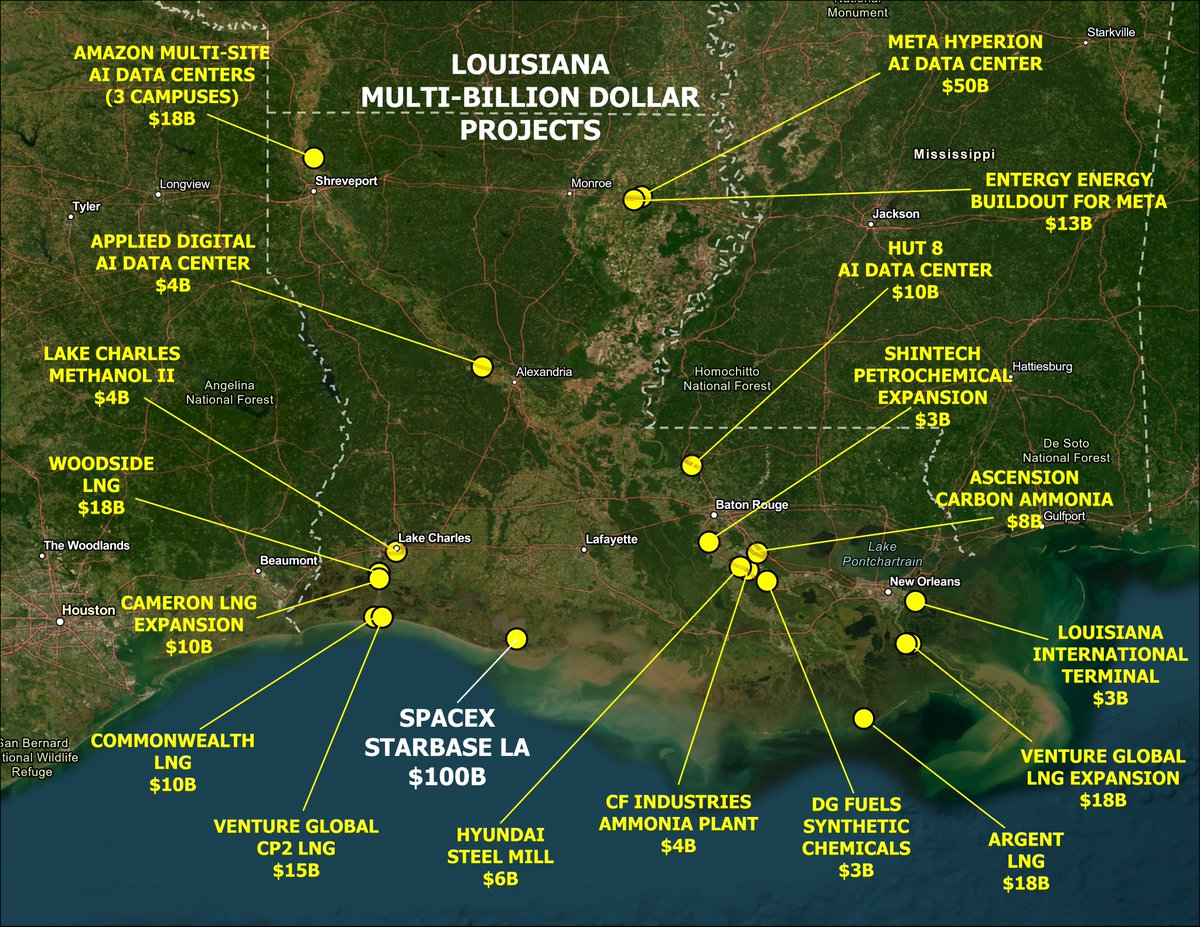
This is not normal what is happening in Louisiana right now. $300+ Billion in the project pipeline....
$100B – SpaceX Starbase LA (Planned)
$50B – Meta Hyperion AI Data Center (Under Construction)
$18B – Venture Global Plaquemines LNG Expansion (Planned)
$18B – Amazon Multi-Site AI Data Centers (Under Construction)
$18B – Argent LNG (Planned)
$18B – Woodside LNG (Under Construction)
$15B – Venture Global CP2 LNG (Under Construction)
$13B – Entergy Energy Buildout for Meta (Planned)
$10B – Commonwealth LNG (Under Construction)
$10B – Hut 8 AI Data Center (Under Construction)
$10B – Cameron LNG Expansion (Planned)
$8B – Ascencion Carbon Ammonia (Planned)
$6B – Hyundai Steel Mill (Under Construction)
$4B – Applied Digital AI Data Center (Under Construction)
$4B – CF Industries Ammonia Plant (Under Construction)
$4B – Lake Charles Methanol II (Planned)
$3B – Shintech Petrochemical Expansion (Planned)
$3B – DG Fuels Synthetic Chemicals (Planned)
$3B – Louisiana International Terminal (Planned)
realizing i might be part of the last pre-singularity generation.
it is so surreal to be in this razor-thin slice of time and humanity that gets to experience both extremes.
i’m 37 years old. i grew up with no computer, no internet, no tv. we played under the sodium street lamps. no phones, just library books. i remember memorizing entries in the encyclopedia britannica, then the 56k modem screech. i’ve gotten to witness this whole arc. a genuinely pre-digital childhood, and now whatever this is becoming.
it’s just so bizarre to hold all those memories and contrast them with the current state. now i speak into a slab of silicon and glass and it manifests code like water flowing down a hill. i commune with this alien intelligence on a daily basis. same head, same lifetime.
i increasingly feel like a three-dimensional being looking at this multidimensional, crystallized artifact of intelligence that is increasingly beyond my comprehension. i can interact with the little slice facing me, but have less and less intuition for the shape of the whole thing.
if i was positioning myself in a replay of the lead-up to what might be the most significant event in modern human history, i’m not sure i would choose any other years. old enough to remember what came before. young enough to have a lot of life left inside whatever comes next.
sama was talking about the excitement and the melancholy. a feeling of something ending. Cheeky Pint
it feels like we’re on the precipice of handing over the torch of intelligence to something nonhuman. it’s an extreme viewpoint, but it feels like we’re hurtling uncontrollably towards this singularity.
it doesn’t feel real. it probably won’t be a singular, definable moment, but a slow-motion event of gradual realization, with occasional shockwaves.
to quote a great scholar of our times.
“not enough people are emotionally prepared for if it’s not a bubble”
louisiana is the terraforming capital of the US and has been for 200 years
it's been mixed results, you could argue - but no shortage of sustained ambition.
https://t.co/Ii4xQmR3Gb
When I was writing Unreal Engine 1, my time was divided as follows:
- Around 30% went to seriously deep coding on hard problems: assembly language texture mappers, C++ BSP trees, data persistence, object oriented systems design, and networking.
- Around 70% was just typing and refactoring large bodies of code needed for a complete engine feature set. This was not hard, and while I was doing it my mind was mostly on the deeper coding topics, thinking and planning for what's next. It didn't feel much different from vibe coding today, except that it was just me typing code on an IBM Model M keyboard rather than prompting it and reviewing the results.
So, it has always seemed perfectly logical that we would rely on AI for that 70%, once the AI could do it with a similar quality standard as we could, which has never been perfection. It came as no surprise that, after a few years of AI model evolution, it was able to take the reigns on that 70% and free up programmers' time for more valuable tasks.
What's more of a surprise is the emergence of AI as a sort of insta-Carmack able to solve hard technical problems quite cleverly and often cleanly, and that it's able to reason about and work in complex 3D scenes both by operating the tools and by directly understanding the raw data files.
I abandoned assembly language in 1998 when out-of-order CPUs made much simpler C/C++ code faster, and never I missed it. If prompting through architectural documents, concept art, and design plans can transcend typing code and tweaking vertices, that will enable developers to spend their time on higher-level, higher value technical and creative tasks.
What matters is the end product, whether it's a game or an engine. Anything developers can do to try out more ideas and make better software and games faster is a win for everyone.
interpretability might be the most important scientific problem in the world right now, as I don't think we can solve alignment if we don't know what we're building. I think I have good news about it. I co-authored early work in mechanistic interpretability at OpenAI and came away pessimistic, because neural networks appeared to fold into arbitrary tangled knots. years later, I started openai's first large-scale automated interpretability project, finding about 2% of neurons legible with the primitive tools we had
with modern agentic tools and a much closer look, the picture looks totally different. the vast majority in models up to trillions of parameters are legible, and their circuits beautiful. many famous examples of tangled neurons turned out to be misunderstood. The roadblocks I expected mostly aren't there. I now think ambitious interpretability will be solved by the time we need it most, and possibly quite soon, as automated scientists keep improving. it may be a bitter lesson for interpretability: the simple thing, at absurd scale, works
https://t.co/zHij5zwKGT
“Our experiments suggest that small AI models may be months away from being capable enough to self-replicate on commercial IoT devices, like smart ovens and off-brand Android TV boxes. A replicator like this would be challenging to shut down, since there’s no centralized point to shut off - though it may be slow (with a doubling time of days). Unlike non-AI malware, it could also figure out unfamiliar devices on its own. In our evals, a 9B model got inference running on 8 of the 9 hardware types we tested.
Models of 30B parameters and under can already complete many of the individual steps for replication today, though they make mistakes when composing them end to end. In our simplified evals, GLM-5.2 and stronger models are capable of end to end replication. If small models improve at their historical rate, they’ll match this capability level by the end of this year. Small weight-based replicators may be possible soon after.” -@bucketofkets@willzhou97
https://t.co/vuYMTgHdRG