LOTR might genuinely be one of the greatest things humans have ever put on a screen and I’m not even exaggerating. You can watch it as a kid and think it’s about hobbits and swords and this terrifying ring. Then you watch it as an adult and realize it’s basically about everything that actually matters.
Power corrupts people and evil usually starts really small..Good people can be tempted and courage isn’t about being fearless. Friendship can literally carry you when you can’t carry yourself anymore. The smallest person in the room can change the course of history. You do the right thing not because you know you’re going to win, but because it’s the right thing to do.
Honestly… I think it should be mandatory viewing for kids at some point. Not just “watch the movie” but actually dissect it. Why does Boromir fail? Why can Sam resist what other people can’t? Why does Frodo show Gollum mercy? Why is Aragorn a good leader when he spends half the story reluctant to have power? What happens when someone becomes consumed by resentment, fear, or the desire to control other people? Then make kids apply those questions to their own lives. Friendship, temptation, loyalty, courage, responsibility, choosing who you want to be when nobody is forcing you to choose correctly. There are probably more useful lessons about becoming a decent human being buried in those movies than in half the stuff we make kids memorize in school…and those are learnings and lessons that would stick and could carry you through all of life.
My favorite part is that the heroes aren’t these invincible characters either. They’re tired, scared, tempted, and completely outmatched. Half the time they have no idea what they’re doing but they just keep going….
Then somehow Peter Jackson took ALL of THAT and made three epic movies at the same time, filled them with real sets, real landscapes, thousands of extras, incredible music,… and made something that still looks better than movies being made with $200M budgets 25 years later.
I really don’t think we’ll ever get another thing like it.
I insist that using the judiciary as a political tool not in a generically tyrannical way at the service of an individual or a party, but at the service of an ideology, is a typical sign of a totalitarian mindset.
Somebody, somewhere in NYC for whatever reason recorded the New York 1 morning news broadcast on Sept. 11, 2001.
They wound up recording history. It starts at 8:30 a.m. ET.
You get 15 minutes of news from the Before Times.
Then the world changes.
https://t.co/1N3J5Stf1M
I avoided commenting on the Lindsay Clancy trial because its nuanced and emotional but the implications are enormous so I am going to say something now. A lot of people are calling that one juror who wouldn't join the other eleven irrational. But, that juror is probably the only one asking the right questions imo: where is the evidence that she lacked the capacity to know it was wrong or to stop herself? And, maybe, where do we draw the line on what an ostensibly insane person is allowed to do when the doubt the defense manufactured rests on nothing in the record before the killings? It seems that the entirety of the defense position rests on improbable probabilities and that's a low bar for such a heinous act.
1. Postpartum psychosis is rare, and almost always happens in the first 4 weeks. The idea that some psychiatrists extend the postpartum window to a year is true, but for depression and anxiety. The evidence isn't strong for psychosis, and its latching on to improbability
2. The strongest risk factor for postpartum psychosis is preexisting bipolar disorder or a prior psychotic episode. She had neither before her third child. The real time evidence from her doctors/providers indicate this. The bipolar label that showed up was after significant polypharmacy, and any good psychiatrist will tell you that you cannot diagnose primary disease when multiple drugs could be offending agents. Drug-induced psychosis would show better temporal correlations with her medications and should be a mitigation argument at sentencing. Again, very improbable alignment
3. The proxy for intent is planning, and she clearly planned... she sent her husband to some restaurant they don't normally go to, checked the drive time, texted a specific order at 5:07 pm... she killed her children in sequence. That's demonstrating real time decision making. I don't understand how they circumvented this. Again, very improbable that she was able to make decisions up until it becomes a liability
4. This idea of a "voice" that commanded her is so post-hoc as a defense. The ltierature on command hallucinations show most people don't obey them and the compliance occurs when the voice is familiar. This was a first time voice she only ever reported 2 weeks after killing her kids. And this first time voice asked her to... kill all her children AND she listened to this unfamiliar voice? Again... very improbable
The improbability is so stark that it's almost undeniably a sympathy verdict from the jurors conflated with a misunderstanding of postpartum disease. The easiest way to demonstrate this is to take a father with the same chart, months of documented depression, insomnia, suicidal ideation but no psychosis then strangles his kids after arranging for his wife to be away from the house. 100% guilty.
Everyone knows postpartum disease is real and important. Everyone knows she's sick and needed help, possibly much better management. You can even argue she is insane. What I see to be the most important is where we draw the line of what we allow under the "insanity" rule. Massachusetts forces a binary verdict of guilty or not criminally responsible but this is a case for the third that other states have and which is guilty but mentally ill. We have a responsibility to speak for the unheard voices of these children and future children and say we draw the line at murdering children.
There’s a lot of cognitive dissonance in the power debate right now.
On one side: data centers are framed as the source of all evil, driving electricity bills higher and consuming every incremental megawatt.
On the other: people still haven’t fully internalized what broad-based electrification and decarbonization actually require. Electric vehicles, heat pumps, industrial electrification, reshoring, transmission upgrades, battery manufacturing, air conditioning growth, etc. This was always going to be an enormous power demand story.
That’s why I keep coming back to the same point: AI/data centers may be one of the best things to happen to grid investment in decades.
For the first time in a long time, you have:
-governments prioritizing infrastructure
-corporates willing to sign long-duration power contracts at above market prices
-capital markets willing to fund generation/transmission
-customers that can actually support the returns needed for massive buildouts
Does it solve everything perfectly? Of course not. There will be bottlenecks, local stress, permitting fights, bad projects, longer thermal runoff period,and periods of volatility.
But absent another generational supercycle where incentives align across utilities, policymakers, infrastructure developers, and private capital, this may be one of the strongest opportunities we get to materially modernize and expand the grid, ever!
Also a little convenient how some of the loudest proponents of gas stove bans, EV mandates, and broad electrification are suddenly treating data centers as the sole culprit behind higher power prices.
We should not wait for obituaries to condemn this ideology:
The neo-Malthusian/climatist worldview is actively shaping policy right now. It is imposing real, measurable costs on living people today: energy poverty that kills millions annually, slowed development that keeps billions poorer for longer, deindustrialization that destroys jobs and communities, and a geopolitical gift to China that weakens the West.
These are not hypothetical future harms — they are present-day consequences of a deliberate policy of restraint over abundance.
Waiting until the key figures are dead would be:
Morally evasive — it allows preventable suffering to continue while we politely stay silent.
Intellectually dishonest — the ideology’s harms are observable and documented in real time.
Strategically self-defeating — it gives the regime decades more to entrench itself, pass laws, lock in subsidies, and build censorship mechanisms.
We have every right — and responsibility — to criticize the ideas, the policies, the institutional capture, and the anti-human premises while the people advancing them are still alive and influential. History judges movements by what they did when they held power, not by polite eulogies after the fact.
The ideology itself is what deserves condemnation, not necessarily every individual personally. But when prominent figures (scientists, billionaires, politicians) actively promote, fund, and enforce policies that treat human flourishing as negotiable or dangerous, they should be held accountable in the present, not posthumously.
We don’t need to wait. The costs are already here. The anti-human core is already visible. The time to call it out plainly is now.
"Yes — the same network of population control advocates (Paul Ehrlich, John Holdren, and their circle, amplified by the Club of Rome and figures like Margaret Mead) effectively launched the organized alarmist phase of modern climate change advocacy in the mid-1970s."
Really?
Oh look... people are coming around.
Welcome back to reality.
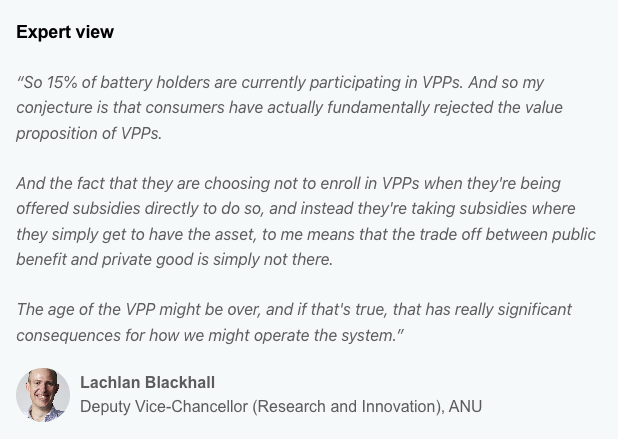
Hosehold batteries won't be centrally coordinated, as our energy master-planners at @AEMO_energy assumed, anytime soon. 1/
https://t.co/1CejB25T82
I’d beg to differ that alaskite heap leach is quite different from a cost perspective (i.e. cheaper) than the in-tank alkaline leaching Paladin needs to do - everything else equal. Sure, grades are lower at Etango, but at $90/lb this will produce adequate cashflow.
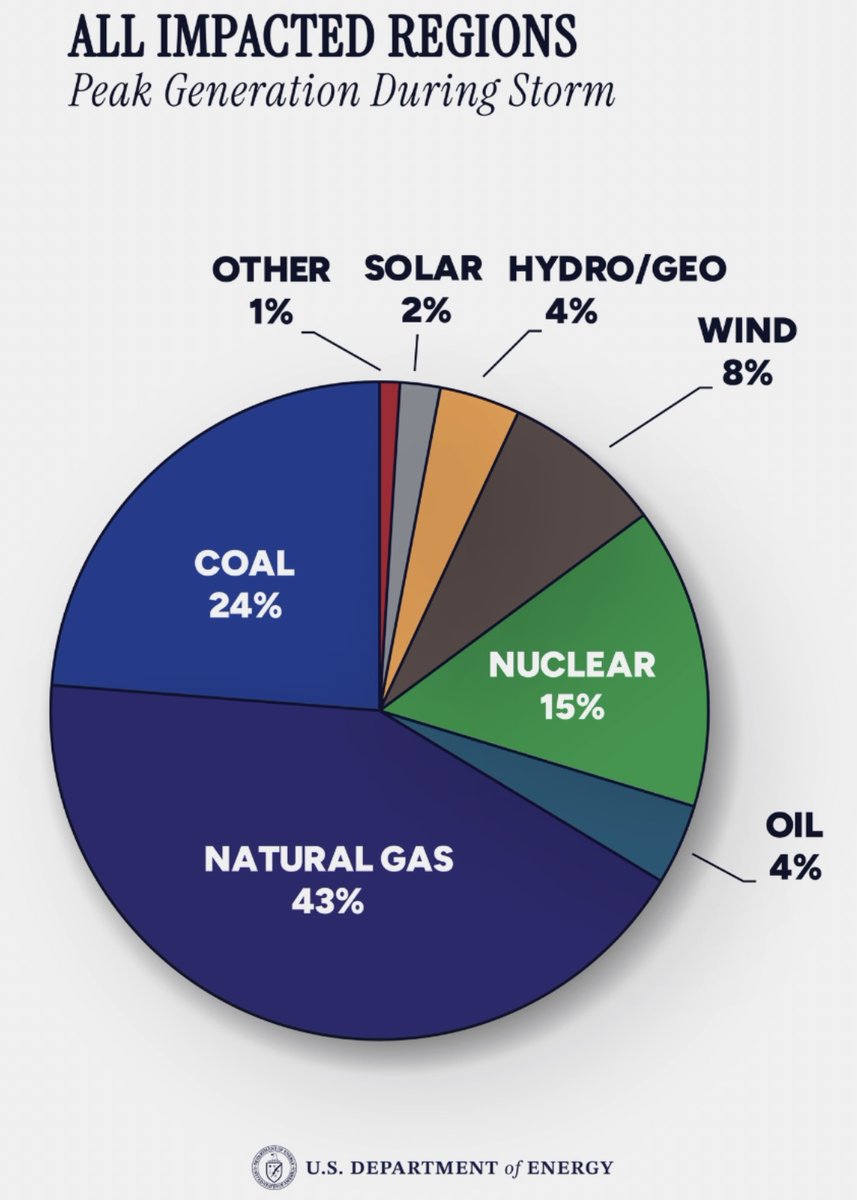
Reliable power sources supplied Americans with the energy they needed in the midst of winter storm Fern.
And in New England, refuse and wood provided more energy than wind and solar!
Time to give away a free annual subscription to the Codex
Gold has been an integral part of the portfolio. Post your exact gold price prediction for next Friday at the close
To enter you need to like and re-tweet this post and comment. Closest guess wins a Codex annual sub 🪙⤵️
I had a reply from @jackietrad, from @cleannrgcouncil in the @FinancialReview yesterday, presenting the case that renewables are definitely coming, and Eraring's extension is just a 'stop gap'.
I have some thoughts. 1/
https://t.co/IYbZAvIJcN
United States forces have captured the president of Venezuela, Nicolas Maduro, in the capital of Caracas. Now begins the disintegration of what is left of the country...
#maduro#venezuela#caracas#geopolitics
@CampbellShelagh@clawrence Tldr: the cost shift from the avoided consumption of self generated solar is literally a line item that is passed onto the the non solar ratepayers!
Not everyone gets to visit the two new advanced AP1000 modular reactors at Plant Vogtle in the United States. This is your chance to see one up close, bricks size.
Real AP1000 units are now faster and more cost effective to build because of our modular design and mature supply chain.
Want to try building a bricks-size AP1000 reactor yourself? We're giving away another five Westinghouse bricks sets to people who reshare this post. We'll draw names on Monday from everyone who reposted! Can't wait to share the fun!
George Westinghouse would marvel at the incredible advances in nuclear technology that our namesake company has made over the last 75 years. About half of all the world’s nuclear power plants are based on Westinghouse nuclear technology.
Last week, “Bricks George” unveiled our advanced modular AP1000® PWR bricks set. You can see his bricks engineering buddy working below on a new AP1000 unit, just like the ones we are deploying across the world.
Now, we're giving away five Westinghouse bricks sets to people who reshare this post. We'll draw names on Monday from everyone who reposted!
You can build a mini-Westinghouse nuclear reactor at home!