$INTC Foundry has its first customer to officially announce EMIB, and it's $MSFT. @Microsoft will use @Intel_Foundry EMIB advanced packaging for Azure first-party silicon. To be clear, it's EMIB, not EMIB-T. There was some confusion. And the packaging piece is separate from the Xeon piece, even though both sit under one long-term agreement.
What was announced:
- EMIB packaging for Microsoft's own custom Azure silicon (Cobalt and or Maia)
- Multi-year Xeon supply capacity, including next-gen Diamond Rapids
- Xeon work in Azure on CXL memory, QuickAssist and TDX confidential computing
- No terms, volumes or timing
Some thoughts:
-Packaging is the door into foundry. It's a smaller commitment than wafers and it goes straight at a real bottleneck. I've been saying the transistor isn't what limits AI anymore. Power, memory and packaging are.
-Somebody had to go first. No one wants to be the first company to put its name on non TSMC, and now someone has. I'll be honest: I had Google and AWS as the likely first packaging announcements. Microsoft got there first.
-This is the follow-through I was looking for. @LipBuTan1 has said he won't spend capex without a customer commitment, and on the October call he said a couple of packaging customers would be ready to announce in the next two quarters. Less than three weeks later, here's the first one.
-The Xeon piece matters on its own. Agents need CPUs, and Intel says supply stays tight into 2028. Locking in multi-year capacity, Diamond Rapids included, is Microsoft buying supply insurance.
-What's missing: terms, volumes and which chips exactly. Packaging gets Intel in the door. Wafers, 14A above all, are where foundry makes its money, and I still think that's 2029 or 2030.
Congrats to the Intel Foundry folks.
👀 What's that I spy with my little eyes? Intel Foundry providing advanced packaging for purpose-built silicon with EMIB for Microsoft Azure👀
https://t.co/ez406fBfrv
👀 What's that I spy with my little eyes? Intel Foundry providing advanced packaging for purpose-built silicon with EMIB for Microsoft Azure👀
https://t.co/ez406fBfrv
Intel shares first benchmarks of its next-gen Crescent Island "D270" GPU, claiming a 5.9x throughput over RTX PRO 6000 as Xe3P goes big on FP64. 🔗 https://t.co/gi6wYPy6wB
Intel CEO Lip-Bu Tan sat down with @BrianSozzi of @YahooFinance to discuss Intel’s transformation, the importance of rebuilding a culture of execution and putting customers first, and the opportunity ahead for the company.
Watch the conversation: https://t.co/NcvO4afkoO
.@Intel announced plans to acquire Classiq this week, in a move to more fully enable commercialization of its quantum computing technology after more than a decade of research and development as an Intel Labs initiative. The acquisition adds a critical software layer to Intel's Quantum portfolio, with the goal of bringing its technology to a broader commercial market.
I had a chance to sit down with Intel and Classiq executives to learn more about the technology combination, Intel's roadmap, and where the companies see opportunities ahead. Sharing my latest HotTech Takeaways from that discussion here.
And by the way, the hype right now might be on GPUs and other AI accelerators, but don't sleep on quantum computing's huge potential. $INTC
https://t.co/HutY3uEAwr
Great EMIB conversation between @austinsemis and Ravi Mahajan. Favorite quote:
"This was almost science fiction because the bridge I was talking about is roughly half the thickness of an A4 sheet of paper. So imagine being able to manipulate tiny strips of silicon like that."
Intel announced it has entered into an agreement to acquire @ClassiqTech to advance scalable quantum computing.
Combining Intel’s quantum software platform, silicon spin-qubit technology and advanced manufacturing expertise with Classiq’s automated quantum algorithm synthesis platform to help create a full-stack quantum computing platform, while continuing to support a modality-and hardware-agnostic software solution that enables an open and collaborative quantum software ecosystem - https://t.co/0hn4IaHydb
$INTC is buying @classiqtech, Intel's first acquisition under Lip-Bu Tan. Not an AI deal. Quantum software. Terms weren't disclosed, and Intel expects to close in the first half of 2027. Thanks to Intel CTO @magicsilicon Pushkar Ranade and Classiq CEO Nir Minerbi for the brief.
I'll be honest. When @LipBuTan1 came on board, I had no idea how long Intel quantum would be around. This answers it. Intel is doubling down and turning a research program into a business.
Some thoughts:
-This is a business buy, not a technology buy. Intel has spin qubits, Horse Ridge cryo-control chips and its own quantum SDK, but never built a business around them. Classiq brings 50-plus enterprise customers like AT&T, BMW and Comcast, 10-plus national programs and about 130 people. Pushkar told me that's twice the size of Intel's internal quantum team.
-Intel bought the layer that wins regardless of which qubit wins. Classiq targets 50-plus systems and simulators across superconducting, trapped-ion, neutral-atom and spin. Smart, and a hedge on Intel's own spin bet.
-Neutrality is everything. Classiq's investors include the venture arms of $AMD and $QCOM, plus $IONQ. Lip-Bu has called Classiq the Cadence of quantum. Cadence works because competing chip companies trust it with their designs. Intel says it will keep Classiq modality- and hardware-agnostic. Like I said about IonQ and SkyWater, it can't become viewed as captive.
-IBM's Qiskit and NVIDIA's CUDA-Q mostly work at the circuit level. Classiq pitches itself as the design-automation layer above them, and it plugs into CUDA-Q instead of fighting it.
-My colleague @Moor_Quantum says quantum no longer has a physics problem, it has a manufacturing problem. Hitachi plans to design 100-plus-qubit chips with Intel on an 18A-based quantum process. Nir's pitch to other qubit makers is Intel's foundry, simulation and controllers. IBM's Anderon is going after the foundry piece.
-Intel's datacenter AI chip acquisitions, Nervana and Habana, didn't work out. This time, Pushkar told me he wants Nir to lead Intel's quantum business. Right call.
I've said quantum is 5-7 years out for 15 years, and I'm sticking with it. That's why software matters now. Developers, apps and customers have to be in place before the hardware is ready. Intel missed mobile and this wave of DC GPU build out.. Lip-Bu doesn't want to miss quantum.
Spin qubits, cryo-CMOS control, an 18A-based quantum process, its own SDK and now Classiq. Once this closes, Intel has a full quantum stack. Now it has to sell it.
Intel to Acquire Classiq to Create a Full-stack Quantum Computing Platform
Acquisition combines Classiq's synthesis platform with Intel’s spin-qubit manufacturing and software expertise—enabling Intel to become a full-stack quantum computing provider
https://t.co/fAUeRIWIiQ
I spent two days touring Intel’s most advanced fab and talking to its technical leadership to understand what the chips of the future will look like.
A lot of what's coming next – gate-all-around transistors, backside power, CFET, hybrid bonding – is hard to follow without actually seeing it, so we made all the awesome animated explainers that I wish I had while I was prepping.
I also asked Intel’s leadership how the semiconductor industry will cope with the enormous shock in demand from AI.
AI compute has grown 3x a year for the last decade, but according to Intel's CTO, Intel could only double leading-edge wafer production with today’s global stock of chipmaking tools.
What kinds of tricks can foundries pull to extend this crossover point where demand surges way ahead of supply?
This was a totally new format for us - hope you enjoy!
0:00:00 – Intro
0:00:47 – How Intel brings up a new process node
0:03:22 – What Intel learned from 10nm
0:06:28 – From planar transistors to gate-all-around
0:13:13 – Why High-NA EUV pays off for Intel but not TSMC
0:19:20 – Could chips have evolved completely differently?
0:23:33 – Inside Intel's "Hot Topics" meeting
0:29:30 – Replacing copper wires with ruthenium
0:32:41 – Why stacked transistors take a decade to ship
0:39:45 – Hybrid bonding and the chip-to-chip bottleneck
0:48:00 – There aren't enough tools to 10x chip production
0:53:14 – Can Intel catch up to TSMC?
1:01:02 – Terafab, and rethinking the fab from scratch
Building semiconductor leadership requires both innovation and the manufacturing capacity to bring it to scale.
In his latest piece, Naga Chandrasekaran highlights Intel Foundry’s growing U.S. footprint, including progress on our Ohio site.
Read more: https://t.co/q0nTRJeQIf
#IntelFoundry
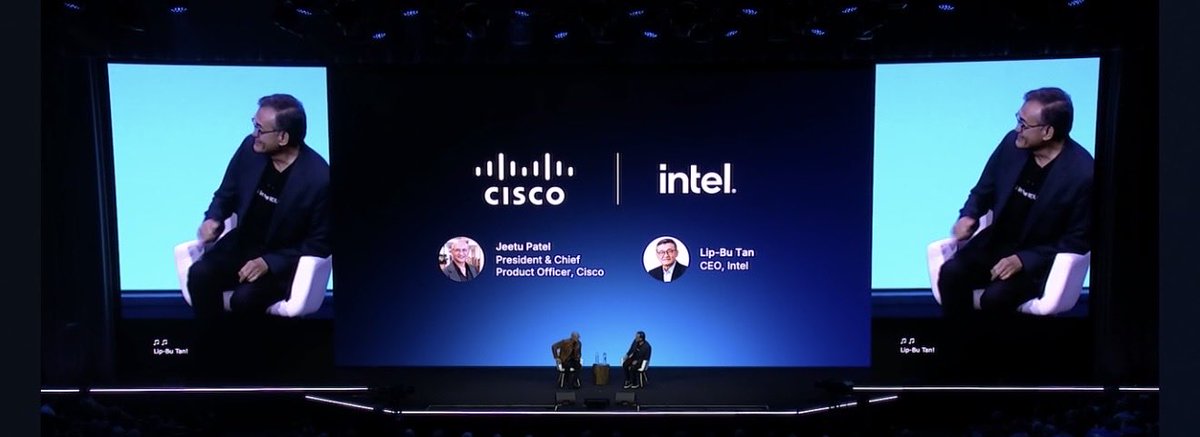
Live from #SplunkConf26 Wide ranging conversation yesterday between @jpatel41 and @LipBuTan1 covering everything from transformation underway at @intel, to capitalizing on new markets, relevance of CPU, agents, security. Worth a listen!
Right here at @intel's Ocotillo campus, some of the most precise, high-stakes manufacturing on the planet is happening. Intel is building the chips that power our computers, our hospitals, and our national defense.
Arizona has become the center of American semiconductor manufacturing, and that didn't happen by accident. It happened because we fought to bring this industry back to American soil.