@MrBusinge I think the minister @CHRISBARYOMUNS1 should just stick to saying there is no money for paying medical interns rather than downplaying their role or impact. This trend reveals him as a hypocrite.
For many Freshers at Makerere, finding lecture rooms, Admin offices, understanding the College structure and knowing where to get support can feel overwhelming.
This orientation video by @JocomMakerere students Moureen Nabadda and Tiffany Uwimana (@TiffanyUwi81670) offers a student-led walkthrough of @MakerereCHUSS and key campus landmarks. Shared from a finalist’s perspective, it blends practical tips with real experience.
It also features short interviews with Principal @NkabalaH and Deputy Principal @Prof_Eric_Awich, highlighting the college’s commitment to excellence, support and holistic growth.
Watch, explore confidently, seek help when needed and embrace the journey ahead!
Drowning is preventable. Yet across Uganda, recurring tragedies continue to expose gaps in water safety, regulation, public awareness and emergency response.
Tomorrow at 7:00 PM, join the 61st #CEPAConvo for 𝐔𝐧𝐢𝐭𝐞 𝐭𝐨 𝐓𝐮𝐫𝐧 𝐭𝐡𝐞 𝐓𝐢𝐝𝐞: 𝐅𝐫𝐨𝐦 𝐄𝐯𝐢𝐝𝐞𝐧𝐜𝐞 𝐭𝐨 𝐀𝐜𝐭𝐢𝐨𝐧 as the panelists give context to drowning as a preventable public health and water-safety issue.
Ahead of the 11th August working commemoration, we ask: What must change for Uganda to move from recurring drowning tragedies to sustained prevention?
🎙️ 𝐒𝐩𝐞𝐚𝐤𝐞𝐫𝐬: @centre4policy | @adaam_uganda | @MakSPH | @PoliceUg | @DwB_Africa | @reachahand
🎧 𝐌𝐨𝐝𝐞𝐫𝐚𝐭𝐨𝐫: @advocen29313
📍Join us 👉 https://t.co/FnvlDudsts
#WDPD2026 #DrowningPreventionUG #UniteToTurnTheTide #CEPAProgramming
Drowning is preventable. Yet across Uganda, recurring tragedies continue to expose gaps in water safety, regulation, public awareness and emergency response.
Tomorrow at 7:00 PM, join the 61st #CEPAConvo for 𝐔𝐧𝐢𝐭𝐞 𝐭𝐨 𝐓𝐮𝐫𝐧 𝐭𝐡𝐞 𝐓𝐢𝐝𝐞: 𝐅𝐫𝐨𝐦 𝐄𝐯𝐢𝐝𝐞𝐧𝐜𝐞 𝐭𝐨 𝐀𝐜𝐭𝐢𝐨𝐧 as the panelists give context to drowning as a preventable public health and water-safety issue.
Ahead of the 11th August working commemoration, we ask: What must change for Uganda to move from recurring drowning tragedies to sustained prevention?
🎙️ 𝐒𝐩𝐞𝐚𝐤𝐞𝐫𝐬: @centre4policy | @adaam_uganda | @MakSPH | @PoliceUg | @DwB_Africa | @reachahand
🎧 𝐌𝐨𝐝𝐞𝐫𝐚𝐭𝐨𝐫: @advocen29313
📍Join us 👉 https://t.co/FnvlDudsts
#WDPD2026 #DrowningPreventionUG #UniteToTurnTheTide #CEPAProgramming
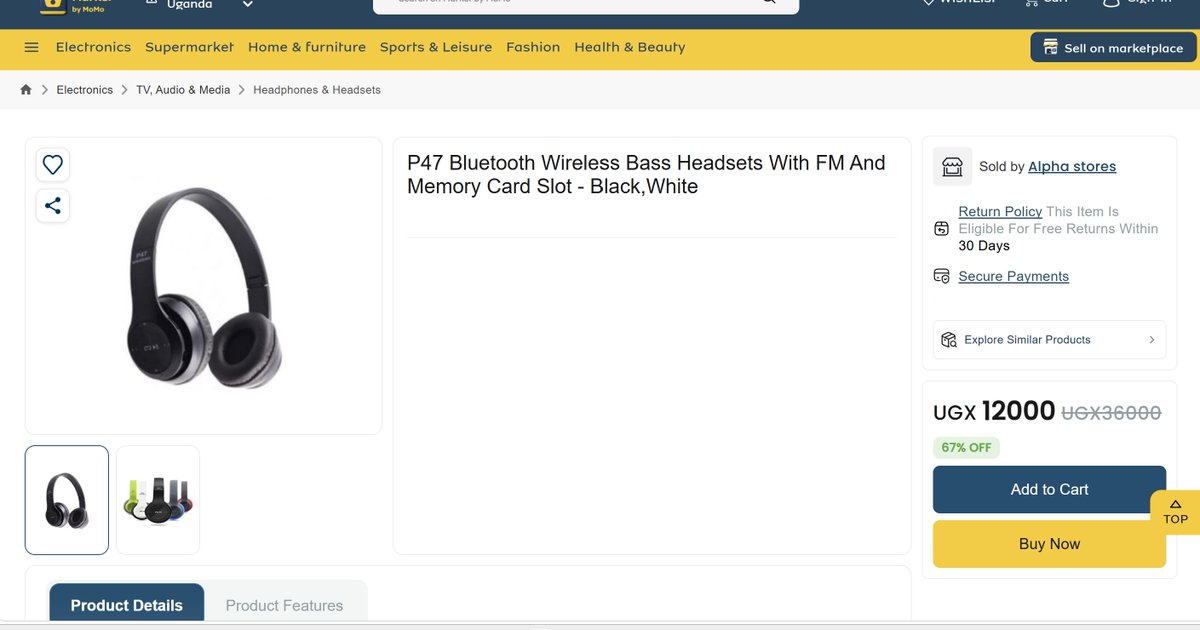
This brings to mind something I saw recently on the @mtnug Momo Market @. In the Ad, the product costs UGX 7,600 (Frame 1) but when you click on it, the product is actually UGX 12,000 on the website (Frame 2). Is this a Ugandan way of doing things?
Dr. Ian Clarke took no prisoners:
"While it is good that Ugandans have their own identity, it is not good that they think they are a special case and that finding loopholes and gaming the system is normal, or that internationally accepted standards don’t apply to Uganda.
This behaviour becomes a self-fulfilling prophecy in which Uganda is taken as a special case, but ‘special’ is applied in the way we would refer to a child with an intellectual disability. It is not a compliment, and Kampala is falling further and further behind its neighbours such as Nairobi, Kigali and Dar es Salaam because we accept this behaviour as normal."
Now imagine couples who had set Church weddings at 10 AM, Adventists who pray on Saturday, business people etc 🤷🏽♂️
Why couldn’t this policy be communicated with enough prior time? Also what’s with the forcing?
Can’t we inspire people into doing rather than enforcing?
In Parliament, I made a simple point. Once a Barbadian has done the work, the money they have earned must be paid on time and must not be taken from their pay packet without proper authority.
A wage packet is not an accounting entry. It is rent, bus fare, school lunch, food, medicine and dignity. We cannot control every global shock or tell the shipping lines what price to charge Barbados. We can ensure that working people receive and keep what they have earned, backed by a remedy with teeth.
That is what the Protection of Wages Bill is about.
Confirmed: Former Nigerian Neurosurgeon, Dr. Salamat Ahuoiza Aliu-Ibrahim explains why she left Nigeria.
“I left because I wanted better opportunities and professional growth. I wanted to practice Neurosurgery in U.S. but I didn’t match. So I decided to go for Pediatrics, a field I also love.
After my pediatric residency training, I needed to find a job in an area designated medically underserved due to my visa type. Joplin, Missouri, fits that description, and that is how I found my way to Freeman Health System. This is my home now.”
PS: She’s not currently practicing pediatric neurosurgery.
Pediatric neurosurgery is a subspecialty of neurosurgery, not pediatrics. To become a pediatric neurosurgeon in the U.S., she would first have needed to complete a neurosurgery residency and then undertake additional fellowship training in pediatric neurosurgery. Which she didn’t.
She now lives in Missouri with her husband and three kids.
Follow @TrendingEx for dailies..
Imagine the investment made to train someone in SSA to a Consultant Neurosurgeon and then losing all of it to the U.S. for the person to become a paediatric resident. This not brain-drain but brain-robbery. Why can't governments complete the circle from education to employment?
TRENDING: Nigeria lost its first-ever female neurosurgeon, Dr. Salamat Ahuoiza Aliu, to the U.S. where she retrained as a pediatric resident, and now works at a Children Clinic in Missouri. She was a Senior Consultant Neurosurgeon at the University of Ilorin Teaching Hospital 🏥
TRENDING: Nigeria lost its first-ever female neurosurgeon, Dr. Salamat Ahuoiza Aliu, to the U.S. where she retrained as a pediatric resident, and now works at a Children Clinic in Missouri. She was a Senior Consultant Neurosurgeon at the University of Ilorin Teaching Hospital 🏥
MakSPH 2025 Annual Report: A Defining Year of Growth, Partnership and Public Health Impact
The @Makerere University School of Public Health 2025 Annual Report captures a year of significant institutional progress and public health contribution. In January 2025, MakSPH attained stand-alone status within Makerere University, recognising seven decades of growth in training, research, policy engagement and community service.
During the 2024/2025 academic year, the School had more than 1,000 students across 12 degree programmes, presented 269 graduands at Makerere University’s 75th Graduation Ceremony and continued to connect training with practice through outbreak response, disease surveillance and community-based public health action.
MakSPH also produced more than 350 peer-reviewed publications, contributed to evidence informing national and global health action, and sustained research and training partnerships across more than 35 African countries. These achievements were made possible by the commitment of faculty, staff and students, and by the continued trust and support of government, communities, funders, universities, and implementation partners.
MakSPH extends its sincere appreciation to all who contributed to this progress and remains committed to its mission of improving health in Uganda and beyond through public health training, research, and community service.
For more details: https://t.co/FknHKOMCYX
#MakSPH #PublicHealth #ResearchForImpact #PublicHealthEducation #PartnershipsForImpact @DrCWCBKiyonga@ProfNawangwe@RhodaWanyenze
Webinar Invitation | Improving Cause-of-Death Data Using ICD-11: Focus on Drowning and Other Injuries
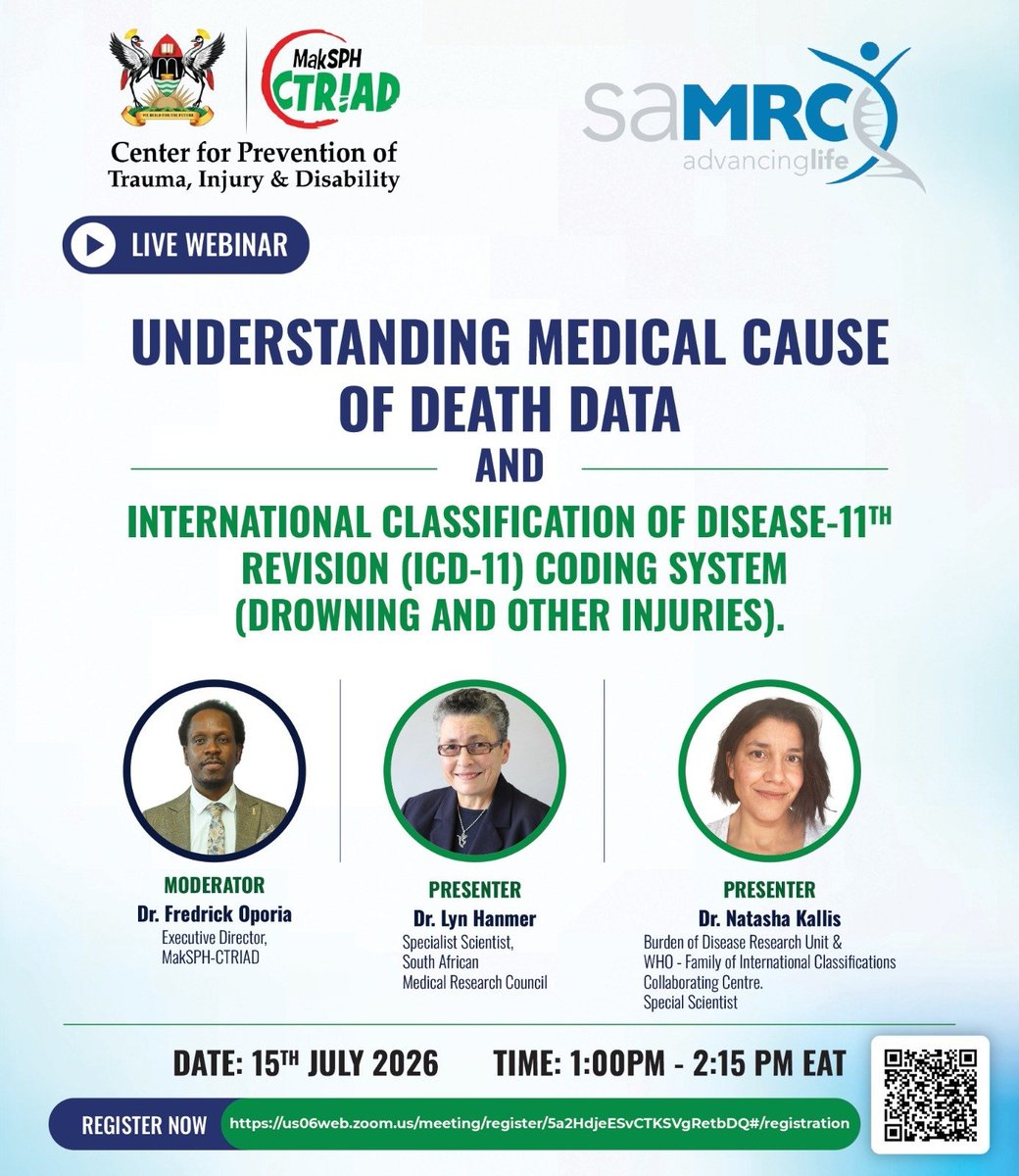
@Makerere University School of Public Health, through the Center for Prevention of Trauma, Injury and Disability (@TRIADUnit), in collaboration with the South African Medical Research Council (SAMRC), invites you to a research webinar on: Understanding Medical Cause of Death Data and ICD-11 Coding Systems: Drowning and Other Injuries
The International Classification of Diseases has guided global documentation of diseases, injuries and causes of death for more than 150 years. This session will explore how ICD-11 can strengthen medical cause of death data, improve injury and disease burden estimation, and support better health planning in Uganda and across Africa, with specific attention to drowning and other injuries.
Presenters:
Dr. Lyn Hanmer, Specialist Scientist, SAMRC
Dr. Natasha Kallis, Specialist Scientist, Burden of Disease Research Unit and WHO Family of International Classifications Collaborating Centre, SAMRC
Moderator:
Dr. @Oporiah, Executive Director, MakSPH-CTRIAD
Date: Tuesday, 15 July 2026
Time: 1:00–2:15 PM EAT
Platform: Zoom
Register and join here:
https://t.co/4LrPCj2nSL
📢 Call for Proposals
UNDP Uganda, with support from the European Union, invites qualified Firms to submit proposals to undertake a policy and regulatory framework diagnostic and market assessment of the Movable Asset-Based Lending (MABL) ecosystem in Uganda’s tourism industry.
🗓️Deadline: 14 July 2026 @ 11:00 AM (New York time)
🔗For more information: https://t.co/HjQt7LBs7C
"You are fired for using AI in your job hence performing better than everyone. But before you go, please share all your prompts that you have been using."
New Study Highlights Uganda's Progress Towards Cholera Elimination
A new study by MakSPH researchers and colleagues, including Godfrey Bwire, David A. Sack, Allan Muruta, Charles Olaro, Jane Ruth Aceng Ocero, Diana Atwine, Henry G. Mwebesa, Francis Ongole, Bonny Kintu, Anne Nakinsige, Ampaire Immaculate, Buyinza Ambrose Wabwire, Rhoda K. Wanyenze, Amanda K. Debes, and Christopher Garimoi Orach, reports that Uganda appears to have eliminated endogenous cholera, although the country remains vulnerable to outbreaks linked to cross-border transmission.
Published on 21 May 2026in PLOS Global Public Health, the study, Uganda's Cholera Elimination Journey in a Cholera Endemic Region of Africa, analysed national cholera surveillance data from 2018–2024, reviewed cholera prevention and control policies, assessed oral cholera vaccine campaigns implemented between 2018 and 2021, and examined cholera trends across the East African Community.
The authors found that the number of cholera-endemic districts declined from 36 in 2018 to six in 2024 following 16 oral cholera vaccine campaigns that targeted more than 2.26 million people in high-risk subcounties. Since 2021, all cholera outbreaks reported in Uganda have been epidemiologically linked to cross-border spread from neighbouring countries. The study suggests that targeted vaccination, strengthened surveillance, rapid outbreak response, and the use of single-dose doxycycline for cholera patients and their household contacts may have contributed to Uganda's progress towards cholera elimination.
The authors recommend sustaining enhanced surveillance and rapid response systems, considering a small national oral cholera vaccine stockpile, and strengthening regional collaboration to safeguard gains made towards cholera elimination.
Read the full study: https://t.co/wVmiBmro9M
MakSPH Launches Study on Lead Contamination in Domestic Cookware Used in Kampala's Informal Settlements
@Makerere University School of Public Health, on 11 June 2026, convened a stakeholder inception workshop to launch a year-long study on lead contamination, supply chains, and exposure pathways associated with domestic cookware used in Kampala's informal settlements. Supported through @LeadElimination with funding from @BloombergDotOrg, the study is led by Mr. @bulafudouglas, Mr. @okadetom, and Dr. @rawleng.
#LeadExposure #LeadPoisoning #CookwareSafety #EnvironmentalHealth #PublicHealth #HealthyHomes #MakSPH #ResearchForImpact