Lukewarm take: we need to stop using mental health/therapy buzzwords in day to day life. Not everyone you dislike is a narcissist. Being sad doesn’t mean you’re depressed. There’s a resounding difference between being nervous and having anxiety. You’re not ADHD because you don’t like to sit still. You’re not autistic because you’re quirky. OCD doesn’t mean you’re organized. And for the love of all that is holy, not every situation that made you uncomfortable is “trauma”.
Imagine walking into a Chipotle and realizing the building is older than the United States.
Boston’s Old Corner Bookstore, built in 1718, now houses a Chipotle on School Street.
@OnlyInBOS I came out of a party in Brighton once in the 90's and there was a poster-sized sheet folded in four under my wiper. When I unfurled it, it read "DONT EVER FUCKING PARK HERE AGAIN!" The Boston parking nuts are hilarious.
Robert Sapolsky is a Stanford neuroscientist who proved chronic stress is the silent killer doctors ignore.
On Chris Williamson's podcast, he revealed 10 "normal" habits you do every day that wreck your sleep, mood, and nervous system:
1) Replay conversations in your head
Once you experience, at least once in your life, being very right when the rest of the world was telling you that you were very wrong, then you become immune to groupthink and herd mentality, as you've learned firsthand that most people don't know what they are talking about:
When you’re five years old, a single year represents 20% of your entire life, but at fifty, it accounts for just 2%, which helps explain why time feels like it speeds up as we age.
This idea, often referred to as Janet’s Law, suggests that by the age of twenty, you’ve already lived roughly half of your perceived life.
In other words, a summer holiday at five can feel as long as the entire decade from forty to fifty.
However, this acceleration of time isn’t inevitable—having agency and seeking new experiences can slow it down by creating richer, more lasting memories.
If you live on autopilot, life may feel short and compressed, but if you actively pursue growth and novelty, your eighty years can feel like two hundred.
Ok I didn’t expect to write a Star Wars essay today but here goes.
I think “only what you take with you,” when Luke asks waiting for him in the dark side cave, is basically the thesis of the original trilogy and why most everything else in the franchise has missed.
What Yoda is essentially saying is that the force is not some monolithic, all-powerful entity with definable rules or limits. Yoda obviously suspects Darth Vader will be waiting for him in that cave… but he doesn’t “know” it, because Vader wouldn’t be waiting for just anyone in there. He’s a reflection of Luke’s baggage, his fears and flaws and temptations. THAT is what the dark side is, and more broadly, what the force is. It’s not a god, but an intentionally vague “force” meant to reflect what’s inside of those who can connect to it. When Luke blows up the Death Star, it’s not just because he has a special power, but because he gives himself over to it, his connection to Obi Wan makes him BELIEVE he can use the force, and that’s what allows him to do it.
I don’t think this message is meant just for Luke, but for the audience as well. We’re not supposed to understand the force, we’re supposed to project ourselves onto it. We’re supposed to wonder what we’d take into that cave, if we could summon the faith Luke needed to destroy the Death Star, how we’d respond to the tyranny of the empire, The story isn’t about magic powers or laser swords. It’s about the people who use them. By accepting and embracing the mystery, by trusting in the force, we allow ourselves to occupy the same mental space as the characters, to walk in their shoes, to connect with the people trying to save the galaxy as we root them on. That’s immersion. It’s a big reason the original trilogy is such a masterpiece. And it’s what the series, and so much of modern sci fi, lost in basically everything that followed.
The Phantom Menace gave us midichlorians and the Chosen One prophecy. Every minor lore question now gets answered. There’s no mystery anymore, nothing to project ourselves onto because the world is suddenly so full. Of course Luke isn’t just any random teenager from Tatooine, he was always special, but it becomes a whole lot harder to project yourself onto him when you understand that he’s more of a pawn in the galactic destiny than any random kid who decided to fight for what was right. One is easier for any of us to connect to than the other.
Most franchises are like this now. They don’t understand that less can be more. We have so much less patience than we used to. We see one episode of a show and there are immediately 1,000 theories about what every little thing means, how every bit of magic or technology works, and so much of our enjoyment of the story is wrapped up in whether those explanations are satisfying. We don’t give ourselves over to story anymore. We don’t trust artists. We don’t take anything with us, we demand the story give us everything. And as a result we don’t connect to the characters in the same way. It’s never really “about” the characters anymore, it’s about whether that thing the set up in episode two paid off in episode seven, about whether all of our questions were answered, about whether the magic system makes sense.
In short, I miss when The Force was a mystery, something vague enough to tailor itself not only to every individual character, but every individual viewer as well. That was Star Wars at its best. And Yoda encapsulates it in one line.
Most people will read this and think optimists live longer because they eat better and exercise more. The study says something wilder.
Lee et al. controlled for smoking, diet, exercise, alcohol, depression, BMI, and socioeconomic status. The longevity effect still held. The most optimistic quartile lived 11 to 15% longer and had 1.5 to 1.7x odds of reaching 85 even after removing every behavioral difference.
Which means something is happening at the level of biology, not just habits.
Rozanski’s meta-analysis across 229,391 participants found optimists carry 35% lower cardiovascular event risk. Blackburn’s Nobel Prize-winning lab at UCSF found pessimistic attitudes are associated with accelerated telomere shortening. Cortisol suppresses telomerase, the enzyme that rebuilds the protective caps on your chromosomes. So chronic negative expectation literally erodes the structures that keep your cells from aging.
The loop runs: pessimistic cognitive style → sustained HPA axis activation → elevated cortisol → telomere degradation → accelerated cellular senescence. Optimists interrupt that loop at the top. They show less emotional reactivity to stressors, faster recovery from acute stress, and they default to reframing threats as challenges rather than catastrophizing.
The part nobody talks about from this paper: the authors explicitly state optimism is modifiable. This isn’t a personality trait you’re born with. Cognitive reappraisal training, morning sunlight for cortisol rhythm regulation, deliberate breathing protocols for vagal tone, structured gratitude practices. All of these shift the prefrontal cortex patterns that determine where you sit on the optimism spectrum.
A 35% reduction in cardiac events from a trainable psychological variable is a bigger effect size than most supplements on the market. That’s the real story buried in this abstract.
I love remembering I’m not actually living in the worst time ever or the most unprecedented time ever or any other catastrophic narcissistic drama.
It’s almost always yet another version of the same old human problems, but this time it’s just my turn.
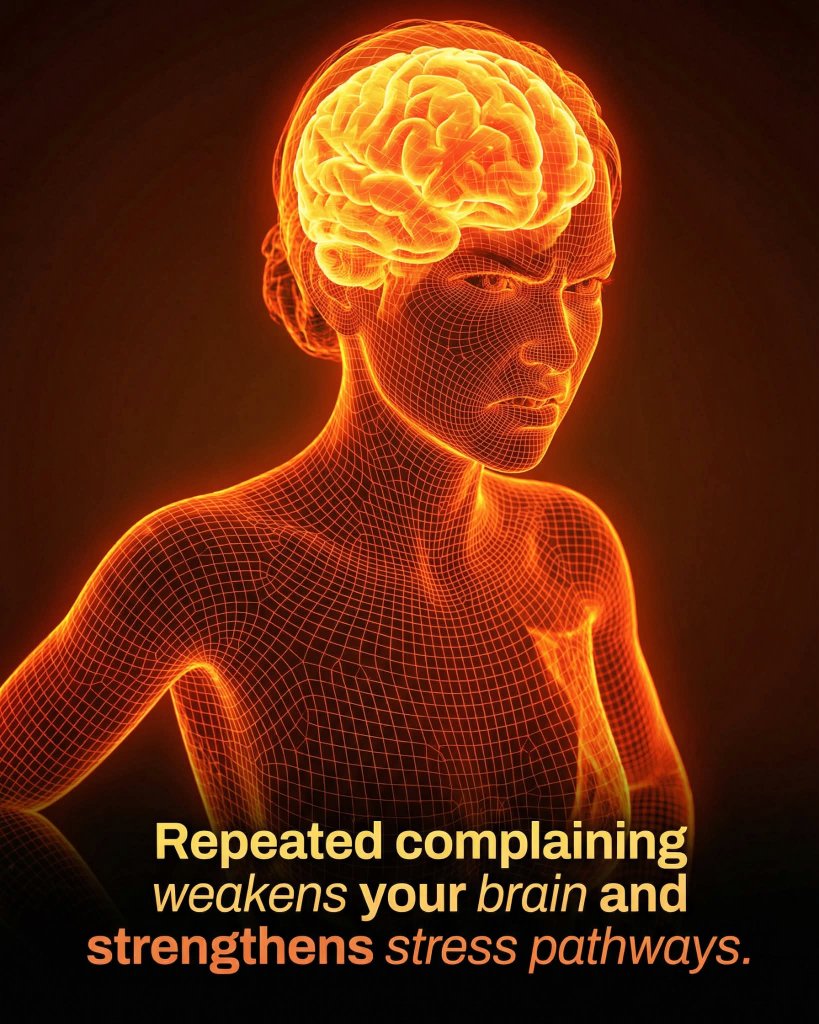
🚨 Research shows repeated complaining physically rewires your brain to prioritize stress and negativity.
The way we speak about our daily challenges does more than just vent frustration; it physically alters the architecture of the brain.
When we engage in chronic complaining, we repeatedly activate neural networks responsible for detecting threats and processing stress.
Through the biological process of neuroplasticity, these circuits become stronger and more efficient every time they are used. Essentially, the brain learns to become more adept at finding things to be unhappy about, turning a temporary mood into a permanent biological predisposition toward negativity and fear-based thinking.
As these negative pathways become the brain's default setting, individuals often experience a measurable increase in baseline stress levels and emotional volatility. This heightened sensitivity means that even minor inconveniences can trigger an intense stress response because the brain has been conditioned to interpret the world through a lens of threat. Findings discussed by the Stanford University School of Medicine emphasize that while this mechanism is powerful, understanding the science of affective neuroscience is the first step in consciously redirecting those pathways toward more resilient emotional patterns.
Source: Stanford University School of Medicine. (2023). Neural Plasticity and the Impact of Negative Thought Patterns on Emotional Regulation. Stanford Medicine News.
Anthony Hopkins: "50 years ago today I was nearly killed. I drove my car in a drunken blackout. That's the way it was but I realized at that point I was having too much fun. It was called alcoholism."
Bonehead move on my part - I entered my Spotify Premium year subscription code into the wrong account; some old, forgotten one I set up for my boys. Contacted @spotify customer support and they were amazing and efficient at getting it switched to the correct one. Love @spotify