Our latest FEDS Note offers a new lens for focusing on the tradeoffs involved in setting the size of central bank balance sheets:
The central bank balance-sheet trilemma
What does this mean for QT? In my JMP with Cristoforo Pizzimenti, we model how foreign banks hold reserves for both IORB arbitrage and dollar liquidity. As they expand global dollar lending, their reserve demand can constrain the Fed’s QT. Check it out!
https://t.co/XjBbFLXEjR
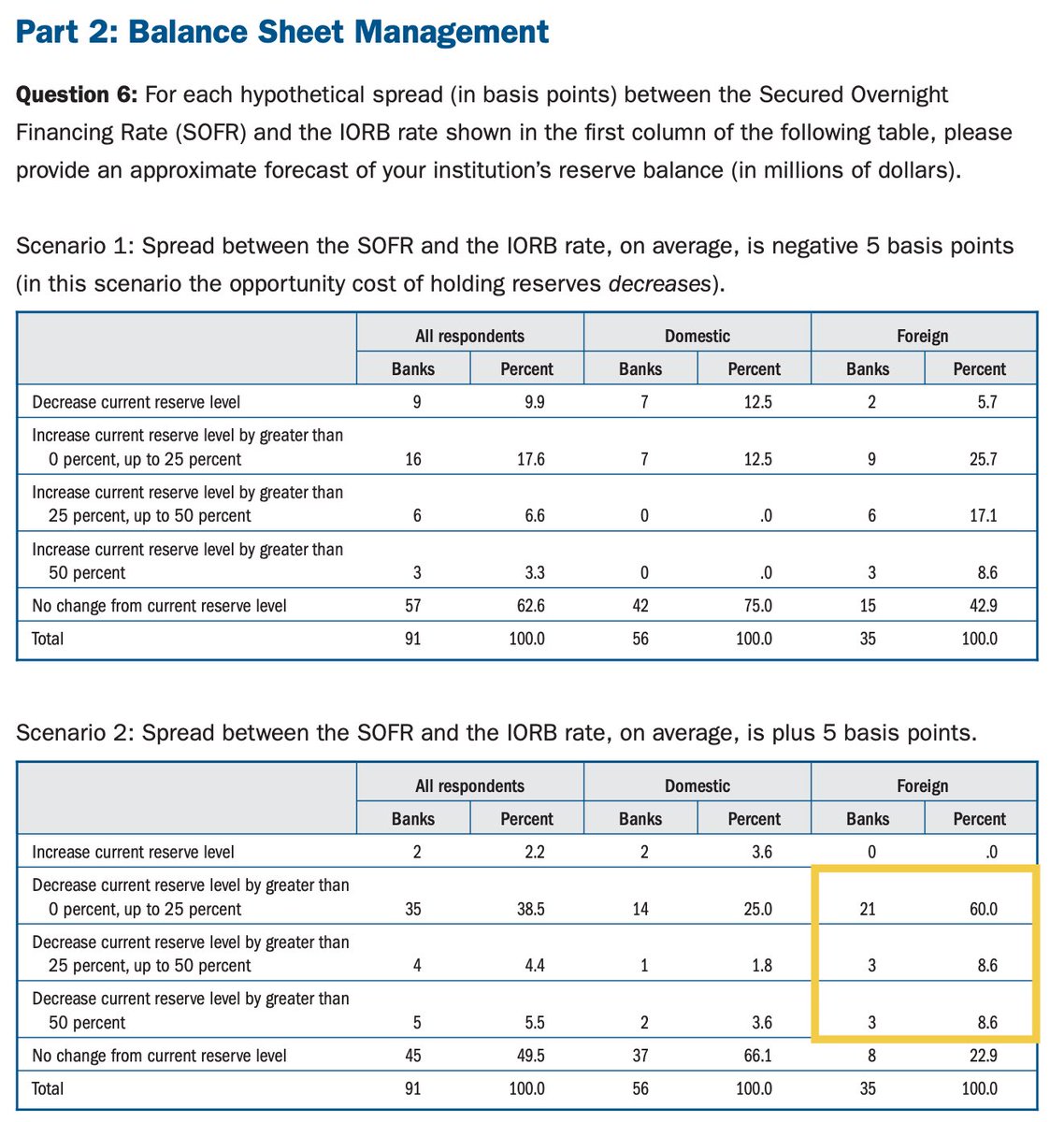
One takeaway from the Fed’s latest SFOS: 20 of 35 foreign banks ranked preparing for cash outflows under stress first when setting reserve levels. 27 said they’d cut reserves if SOFR averaged 5 bps above IORB. At least 12 gave both answers. 1/3
As @EtraAlex points out, this roughly coincides with the rise of the basis trade. But it also coincides with the general path of rates, so I don’t think we can conclude much from public data alone. An interesting subject for future research!
What’s behind the saw-tooth in Canadian Treasury holdings and money-fund repo to Canadian banks? Mostly the well-known window-dressing by dealers around reporting dates. But I think it masks the bigger takeaway.
First, while I do note the increase in the holdings of LT UST & Agency bonds by Canadian residents in TIC, I also have previously shown that the month to month variation in these holdings is a function of US MMF repo lending to Canadian residents...2/n
https://t.co/hM5zCs23Va
So the saw-tooth has a well-known explanation. What’s more interesting is the trend underneath: money-fund repo to Canadian, French and Spanish banks has climbed steadily since late 2022, much of it against Treasury collateral, alongside these countries’ TIC holdings.
My first Anne Carson was her Sappho, "If Not, Winter." The translations were affecting, what struck me was how she kept the gaps where the words are now lost.
Maybe that’s not for everyone? But to me it says something true about memory, and how the past keeps slipping away.
2026 Nobel Edebiyat Ödülü’nü kazanan Anne Carson’ın Nobel Komitesi’yle yaptığı telefon görüşmesi:
“Reykjavik’teki evimde çay içip London Review of Books okuyordum. Yerleri süpürmeye kalktığımda telefonlar çalmaya başladı. Hepsini kapattım. Eşim zorla geri arattı. Eşim “Aç şu telefonu artık. Belki de Nobel’dir” dedi.”
Şu anda nasıl hissediyorsunuz?
— Sadece kraker yiyip çay içiyorum. Pek dramatik bir durum yok.
Nobel’i bekliyor muydunuz?
— Tanrı aşkına, tabii ki beklemiyordum. Bence hepiniz çıldırmışsınız.
Nobel sizin için ne anlama geliyor?
— Hiç düşünmedim. Sadece parayı nasıl bağışlayacağımızı düşünüyoruz. Evi olmayan bir arkadaşımız var. Bir de Sınır Tanımayan Doktorlar’a bağış yapıyoruz.
Nasıl kutlayacaksınız?
— Telefonlara cevap vermek zorunda kalmamak için ormanda yürüyüşe çıkacağız. Sonra sessizliği dinleyeceğiz.
Yazarlığınızı nasıl tanımlarsınız?
— İstemsizce. Hep başka bir şey yapmaya çalışırken oluyor.
Kitaplarınızı okumaya nereden başlamalı?
— Herhangi bir yerden. Ben hep ortadan başlayın derim.
Yeni bir kitaba nasıl başlarsınız?
— Ortadan. Tek kuralım bu.
İlham kaynağınız?
— Homeros.
Antik hikâyelerin bugün hâlâ geçerli olmasının nedeni ne?
— Geçerli değiller. Onların bizim için geçerli olmasıyla ilgilenmiyorum. Bizim onlara layık olmamızla ilgileniyorum.
Sıkılmaktan kaçınmak neden önemli?
— Kim sıkılmayı sever ki? Uyumak mı, Homeros okumak mı? Günün geri kalanında ne yapacağıma böyle karar veriyorum. Hayat sıkıcı.
Genç yazarlara tavsiyeniz?
— Ortadan başlayın.
In today's post, the authors show that trading in U.S. Treasury securities is becoming more concentrated around the designated pricing, or “strike,” times for fixed-income indexes. The concentration is especially pronounced on month-end trading days. https://t.co/rH2UNR6rTr
Agree the doom and gloom on the basis trade goes too far, BUT:
1) The basis trade is NOT the swap spread trade. April 2025 was mostly about swap spreads.
2) Demand for leveraged duration IS how growing Treasury supply gets absorbed. So the two are intimately related.