hook up @townai and it auto-generates that karpathy-style instruction manual for your life AND acts on it. it mapped my preferences & priorities faster than I could ever prompt it. roasted by what its inbox synthesis revealed about my communication style, but the accuracy is 🙌
You have noticed it. ChatGPT feels dumber than it used to. Your prompts that worked six months ago produce worse results now. The writing sounds flatter. The ideas sound safer. The internet itself feels like it is shrinking. Every article reads the same. Every email sounds the same. Every answer sounds like it was written by the same voice.
You thought it was you. It is not you.
Researchers at Oxford and Cambridge published a paper in Nature proving what is happening. They call it Model Collapse.
Here is the mechanism in one sentence. AI trained on AI-generated data gets dumber every generation until it forgets what real human data looked like.
The internet is filling with AI-generated content. Blog posts. Articles. Reviews. Comments. Social media. AI companies scrape the internet to train the next generation of models. Which means the next generation of AI is being trained on the output of the current generation.
Each cycle loses information. Not randomly. It loses the rarest, most unusual, most creative parts first. The researchers call these the "tails of the distribution." The weird ideas. The unexpected perspectives. The things that made the internet feel human. Those disappear first.
What remains is the average. The safe. The expected. The bland.
Then the next generation trains on that. And loses more. And the next generation trains on that. And loses more. The researchers proved this is not a slow decline. Major degradation happens within just a few iterations. Even when some of the original human data is preserved.
They tested it on large language models. On image generators. On statistical models. The pattern was the same every time. The output converges toward a narrow, flattened version of reality that looks nothing like the original data.
The lead researcher put it plainly. "Large language models are like fire. A useful tool. But one that pollutes the environment."
The pollution is invisible. You cannot see which sentence on the internet was written by a human and which was written by AI. Neither can the AI that is about to train on it. And once the tails are gone, they do not come back. The damage is irreversible.
This is not a prediction anymore. It is a diagnosis.
The internet you grew up on was built by humans writing things no algorithm would have written. Strange, personal, imperfect, alive. That internet is being diluted. One generation of AI at a time. And the models trained on what remains are learning a smaller and smaller version of the world.
Model Collapse is not a technical problem. It is a cultural one. The thing that made the internet worth reading is the thing that disappears first.
Introducing @PoeticHQ: a new AI system that executes complex multi-hour tasks with 99%+ accuracy and 10x fewer tokens than agents.
We raised $50M at $500M from Kleiner Perkins, Founders Fund, First Harmonic, and Genius Ventures to build AI that does complex work inside Fortune 500 companies without hallucination.
While code is too brittle, agents are too unpredictable. The work that runs the global economy - anti-money laundering, fraud investigations, underwriting - needs extreme accuracy.
So we built a new kind of software that pairs the flexibility of AI with the predictability of code.
When the world stays the same, Poetic runs fixed code: fast, cheap, identical every time. When the world changes, Poetic uses AI to regenerate its approach and find its way back to the objective.
In one year, we went from zero to an eight-figure run rate as a team of four.
Since then, we���ve scaled the team and executed the highest-stakes processes at AIG, SoFi, and Chime. At SoFi, a large US bank, Poetic reached 99%+ quality on fraud investigations in five weeks.
lol what: Researchers found that repeating the exact same prompt twice dramatically improves LLM performance (one model improved from 21% to 97% accuracy on a name-search task) without longer outputs, slower responses, fine-tuning, or fancy prompt engineering.
Because models process text left to right, duplicating the input gives every token a second chance to “see” the full context, leading to measurable gains across 7 benchmarks and 7 major models.
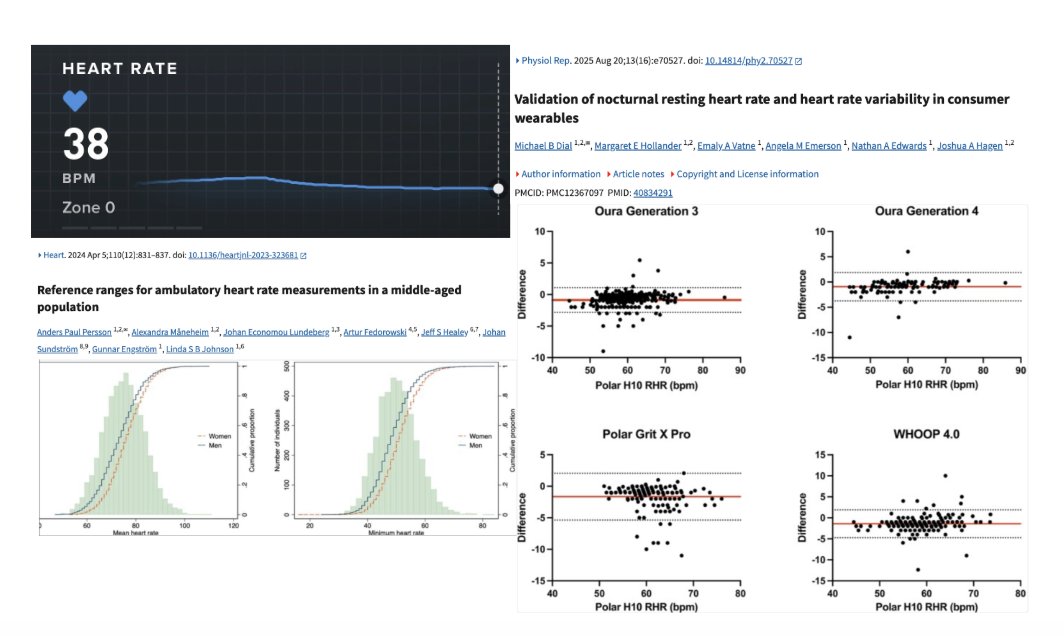
My heart rate before bed last night: 38 bpm
In the 99.9th percentile.
The 40 hour social media fast dropped it by around 10%. Seems social media could be a 10% tax on my nervous system.
RHR is the most important marker I track. It's a tell-all of health and habits. This single number reveals stress, food, screens, fitness, relationships and more. Show me your RHR and I'll see your soul.
Lowing your RHR before bed is the #1 thing you can do to improve your health. A low RHR will boost sleep quality.
High quality sleep:
> Mental acuity up 15%
> Insulin sensitivity + glucose control better by 25%
> Self control up by 20%
> Mood enhanced by 15–30%
> Physical performance improvement by 10%
> Lower injury risk by 20–60%
My suggestions for you:
+ final meal four hours before bed
+ screens off one hour before bed
+ read a book 10 min before bed
+ in bed at the same time every single night
Master these and then you can add on more layers to get even better.
@jonnym1ller Interested! I hacked a version of this together to move memory context from ChatGPT to Gemini and Claude. Would love for this to exist more formally in the world, especially with @jonnym1ller fine tuning
“spend a thousand lifetimes of effort creating a generational product”
Great dive into future of apps as content in the age of ai, and where monetization will come from (the sale of attention or physical goods)
.@gokulr is one of the most prolific product builders and investors of the last 20 years.
He helped build the core ads and product businesses at Google, Facebook, Square, and DoorDash, working directly with many of this generation's best founders and CEOs. He's also invested in more than 700 companies giving him an unusually broad view into how products are built and scaled.
Gokul has an incredible ability to give precise and prescriptive advice on how to build products, particularly in AI, and he explains his thinking so clearly that you come away knowing exactly how to apply it.
We talk about why judgment is the only thing he believes is truly AI-proof, why Zendesk and Slack are more exposed than Salesforce and NetSuite, and what AI-native startups must do to move customers and their data off legacy systems.
We cover everything he's learned from building the most important ads businesses, including the only three ways an ad business can make money, and why ChatGPT may be even more powerful than Google or Facebook for highly targeted ads.
He also shares inside stories from Larry and Sergey, Zuck, Jack Dorsey, and Tony Xu, about how each of them approaches product, design, and communication.
Enjoy!
Timestamps:
0:00 Intro
0:35 The Changing Nature of Product Development 4:09 The Merger of Product and Design
4:54 Managing Non-Deterministic Software
9:06 Judgment: The Future-Proof Human Skill
10:41 Building Durable AI Applications
16:43 The Risk to Legacy Software Companies
21:20 Sources of Stickiness in the Age of AI
23:43 Leadership Lessons from Google
27:41 Learning from Mark Zuckerberg
31:16 Jack Dorsey and the Philosophy of Great Design
35:48 The Product Manager as Editor
40:44 Three Pillars of a Successful Ads Business
49:03 Selecting North Star and Check Metrics
56:04 Hiring Functional Experts for the AI Era
1:00:06 Advice for Managing a Career
1:01:33 Evaluating Founder Authenticity
1:05:20 Best Practices for Board Management
1:11:15 The Kindest Thing
@maxmarchione the health application for this is wild. moving from manual health navigation to autonomous agents coordinating our biology in the background. no more logistics or context loss, just a system-led pursuit of uptime ✨
fascinating read. tenacity v gen alpha entering the workforce. homo deus is here and we’re live-updating in the age of dataism. we’re officially moving from building to orchestrating. the 80% agent-led workflow is the new baseline and this non-eng is v excited
A few random notes from claude coding quite a bit last few weeks.
Coding workflow. Given the latest lift in LLM coding capability, like many others I rapidly went from about 80% manual+autocomplete coding and 20% agents in November to 80% agent coding and 20% edits+touchups in December. i.e. I really am mostly programming in English now, a bit sheepishly telling the LLM what code to write... in words. It hurts the ego a bit but the power to operate over software in large "code actions" is just too net useful, especially once you adapt to it, configure it, learn to use it, and wrap your head around what it can and cannot do. This is easily the biggest change to my basic coding workflow in ~2 decades of programming and it happened over the course of a few weeks. I'd expect something similar to be happening to well into double digit percent of engineers out there, while the awareness of it in the general population feels well into low single digit percent.
IDEs/agent swarms/fallability. Both the "no need for IDE anymore" hype and the "agent swarm" hype is imo too much for right now. The models definitely still make mistakes and if you have any code you actually care about I would watch them like a hawk, in a nice large IDE on the side. The mistakes have changed a lot - they are not simple syntax errors anymore, they are subtle conceptual errors that a slightly sloppy, hasty junior dev might do. The most common category is that the models make wrong assumptions on your behalf and just run along with them without checking. They also don't manage their confusion, they don't seek clarifications, they don't surface inconsistencies, they don't present tradeoffs, they don't push back when they should, and they are still a little too sycophantic. Things get better in plan mode, but there is some need for a lightweight inline plan mode. They also really like to overcomplicate code and APIs, they bloat abstractions, they don't clean up dead code after themselves, etc. They will implement an inefficient, bloated, brittle construction over 1000 lines of code and it's up to you to be like "umm couldn't you just do this instead?" and they will be like "of course!" and immediately cut it down to 100 lines. They still sometimes change/remove comments and code they don't like or don't sufficiently understand as side effects, even if it is orthogonal to the task at hand. All of this happens despite a few simple attempts to fix it via instructions in CLAUDE . md. Despite all these issues, it is still a net huge improvement and it's very difficult to imagine going back to manual coding. TLDR everyone has their developing flow, my current is a small few CC sessions on the left in ghostty windows/tabs and an IDE on the right for viewing the code + manual edits.
Tenacity. It's so interesting to watch an agent relentlessly work at something. They never get tired, they never get demoralized, they just keep going and trying things where a person would have given up long ago to fight another day. It's a "feel the AGI" moment to watch it struggle with something for a long time just to come out victorious 30 minutes later. You realize that stamina is a core bottleneck to work and that with LLMs in hand it has been dramatically increased.
Speedups. It's not clear how to measure the "speedup" of LLM assistance. Certainly I feel net way faster at what I was going to do, but the main effect is that I do a lot more than I was going to do because 1) I can code up all kinds of things that just wouldn't have been worth coding before and 2) I can approach code that I couldn't work on before because of knowledge/skill issue. So certainly it's speedup, but it's possibly a lot more an expansion.
Leverage. LLMs are exceptionally good at looping until they meet specific goals and this is where most of the "feel the AGI" magic is to be found. Don't tell it what to do, give it success criteria and watch it go. Get it to write tests first and then pass them. Put it in the loop with a browser MCP. Write the naive algorithm that is very likely correct first, then ask it to optimize it while preserving correctness. Change your approach from imperative to declarative to get the agents looping longer and gain leverage.
Fun. I didn't anticipate that with agents programming feels *more* fun because a lot of the fill in the blanks drudgery is removed and what remains is the creative part. I also feel less blocked/stuck (which is not fun) and I experience a lot more courage because there's almost always a way to work hand in hand with it to make some positive progress. I have seen the opposite sentiment from other people too; LLM coding will split up engineers based on those who primarily liked coding and those who primarily liked building.
Atrophy. I've already noticed that I am slowly starting to atrophy my ability to write code manually. Generation (writing code) and discrimination (reading code) are different capabilities in the brain. Largely due to all the little mostly syntactic details involved in programming, you can review code just fine even if you struggle to write it.
Slopacolypse. I am bracing for 2026 as the year of the slopacolypse across all of github, substack, arxiv, X/instagram, and generally all digital media. We're also going to see a lot more AI hype productivity theater (is that even possible?), on the side of actual, real improvements.
Questions. A few of the questions on my mind:
- What happens to the "10X engineer" - the ratio of productivity between the mean and the max engineer? It's quite possible that this grows *a lot*.
- Armed with LLMs, do generalists increasingly outperform specialists? LLMs are a lot better at fill in the blanks (the micro) than grand strategy (the macro).
- What does LLM coding feel like in the future? Is it like playing StarCraft? Playing Factorio? Playing music?
- How much of society is bottlenecked by digital knowledge work?
TLDR Where does this leave us? LLM agent capabilities (Claude & Codex especially) have crossed some kind of threshold of coherence around December 2025 and caused a phase shift in software engineering and closely related. The intelligence part suddenly feels quite a bit ahead of all the rest of it - integrations (tools, knowledge), the necessity for new organizational workflows, processes, diffusion more generally. 2026 is going to be a high energy year as the industry metabolizes the new capability.
@chamath@bryan_johnson Fascinating. I eat and train like an athlete but I wasn't able to get certain genetic biomarkers in line, like cholesterol. Both my meat-eating and vegan brothers struggle similarly. Feeling reaffirmed in sticking to the basics