Flight Paramedic | POCUS & Airway nerd | Trauma resuscitation & Tac Med nerd | Tweets & views are my own & not the views of my employers. #FOAMed#MEDtwitter
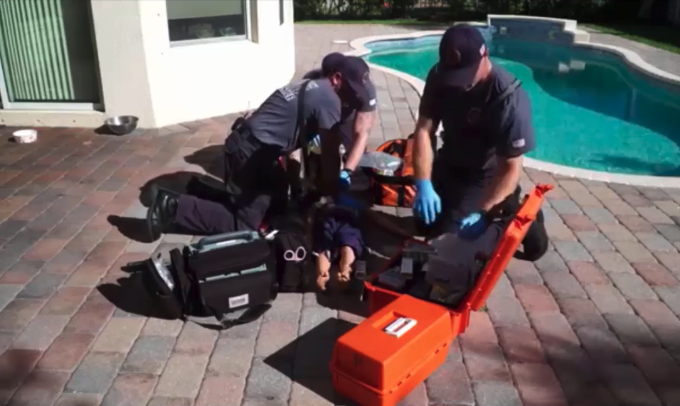
Today we regained pulses on a 2-year-old drowning at @PBCFR. 🙏
On scene: 21 minutes
‣ HP-CPR
‣ iGel placed
‣ Femoral IO placed
‣ NS bolus
‣ Push dose epinephrine (10 mcg) x 5 post ROSC
‣ Ketamine & Fentanyl post ROSC
Time from scene to hospital: 18 minutes
Stable vitals upon arrival.
I couldn't be more proud of my team and all the work they've put into mastering the care of pediatric patients in the field.
We are all praying for a full recovery. 🙏
Note: Photo is from a simulation, not the actual patient
Today we regained pulses on a 2-year-old drowning at @PBCFR. 🙏
On scene: 21 minutes
‣ HP-CPR
‣ iGel placed
‣ Femoral IO placed
‣ NS bolus
‣ Push dose epinephrine (10 mcg) x 5 post ROSC
‣ Ketamine & Fentanyl post ROSC
Time from scene to hospital: 18 minutes
Stable vitals upon arrival.
I couldn't be more proud of my team and all the work they've put into mastering the care of pediatric patients in the field.
We are all praying for a full recovery. 🙏
Note: Photo is from a simulation, not the actual patient
In my 25 years of practice, I had never written a letter to the editor of a peer-reviewed medical journal.
In the past three months, my colleagues and I have written two.
Why? Because we felt the content of these two publications was significantly off course, and we felt compelled to offer a different perspective.
To my surprise, one of our submissions was relegated to the comment section of the journal, rather than being formally published.
The other was placed behind a paywall, despite the original article being open access.
Both letters address topics that I’ve dedicated many years to:
1. Management of Pre-hospital Pediatric Cardiac Arrest
2. Pre-hospital Whole Blood
I would value your thoughts on these editorials.
On a deeper level, innovation in medicine is difficult and it requires open and honest discourse. Everyone, including those of us not in the ivory tower, should feel safe speaking truth to power, as long as it can backed up with data.
Here are the links to the editorials:
JAMA Network Open Letter (scroll to the bottom)
https://t.co/NRcqaNaD0J
Academic Emergency Medicine Letter
https://t.co/fmcZHOhceZ
For context here is the open access whole blood publication which states that pre-hospital transfusion does not have a 1-month mortality benefit.
https://t.co/Xi033B3RyD
If you’d like a PDF of the Whole Blood letter, feel free to DM me, as it's not permitted to be shared on social media.
@markpiehl@SPARC2024@RandiSchaefer8@NAEMSP@FL_NAEMSP@LifeFlow__@QinfloWarrior@dcfireems@noemsf
for patients who are legit trying to die from bradycardia, I advocate using epinephrine 1st
epinephrine is more reliably effective & honestly just a better anti-death medication
I've seen patients arrest while folks were messing around w/ atropine
more:
https://t.co/mTdFs2TzwI
I love this method for RSI we use on flight: the 3 stop-cock IV method.
Closest to patient: sedative
Middle: paralytic
Farthest: push-dose pressor
Streamlines your med delivery for rapid, efficient, and safe intubation. #EMS#RSI#emergencymedicine
We are rolling out finger thoracostomy at @PBGFire, further expanding the footprint of this procedure across the S.Fla EMS landscape.
We’ll be using the @NARescue kits (shown below).
I don’t think Rob Mac Sweeney gets enough plaudits for @CritCareReviews - his visionary approach to presenting, discussing, and disseminating new knowledge from critical care trials is ann incredible gift to humankind. Thanks Rob! #ccr24
[With permission]
Stab heart #Trauma LV stab
in shock BP 60/40
With cardiac tamponade
LAL Thoracotomy
Difficult repair (prolene cutting through,Teflon pledget not available so I used a piece of pericardium)
Did well
☆5th Stab ♥ in 2 yrs same Trauma Center(same Trauma Surgeon)
I can accept the difficulty of on-scene pediatric termination.
It takes skill and a keen situational awareness.
What I won't accept is the "scoop and run" with pediatric arrest.
We owe it to the children.
We owe it to their families.
We must do better.
TY @armyemdoc for spotlighting an age-old pediatric issue....treating kids differently than adults.
Delaying blood transfusion in hemorrhaging pediatric patients could have dire consequences. Evidence from both military and civilian studies now robustly supports the safety and efficacy of LTOWB in children. We must prioritize their lives with informed action. 🩸👶
#TakeAction #LTOWBforKids #EMS #Hospitals
Drs. @CatherineCounts & @SayreMR are co-authors of a study in @JAHA_AHA titled, "Pediatric Out‐of‐Hospital Cardiac Arrest: The Role of the Telecommunicator in Recognition of Cardiac Arrest and Delivery of Bystander Cardiopulmonary Resuscitation."
More:
https://t.co/0tsQ2ZwGCb