@rauchg Hi folks, doing this for trading math. 43 canonical test vectors, every tool result signed with ECDSA P-256, and a daily record of the pass/fail state anchored on Solana. The agent only has to pick the right tool, the number is checked, not generated. https://t.co/kctOfRHqOX
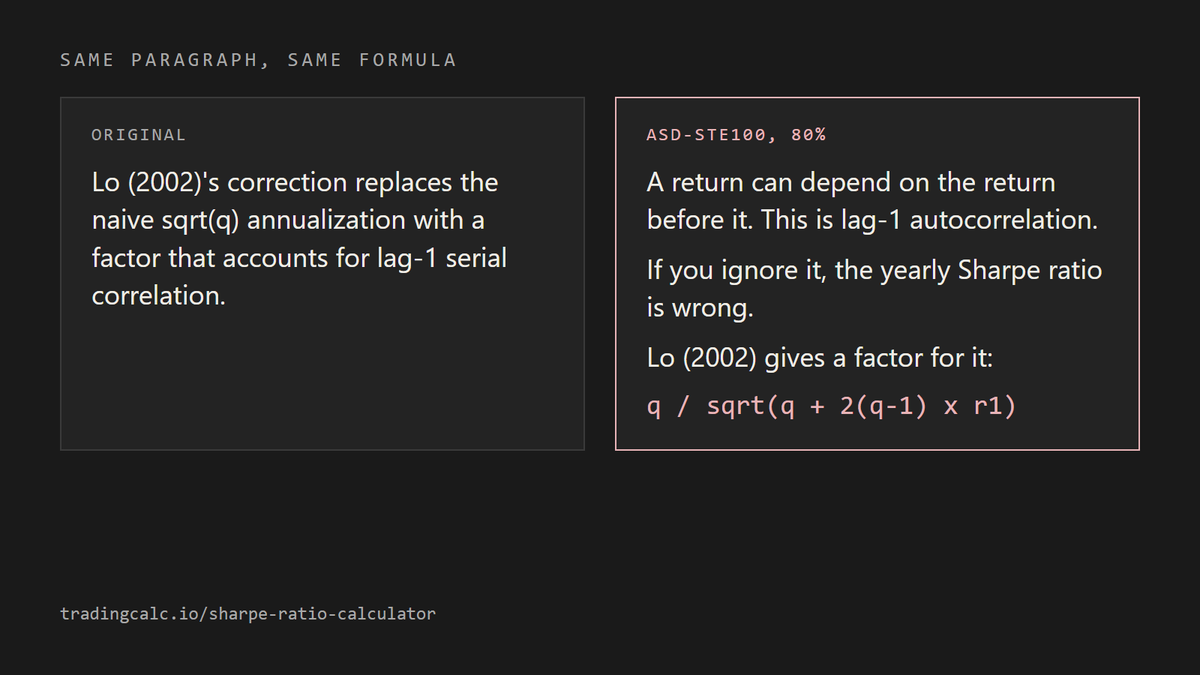
@karpathy Tried this on a calculator page. Left: our original paragraph on the Sharpe ratio. Right: the same paragraph in ASD-STE100, about 80% of the way. Same formula in both. https://t.co/f1rdnt2Loy
It is open source and free to try: https://t.co/5xVFQfAjHt. The same maths is on https://t.co/Lq3rZEACIp, and https://t.co/gsOvDmckxR shows the test vectors passing live.
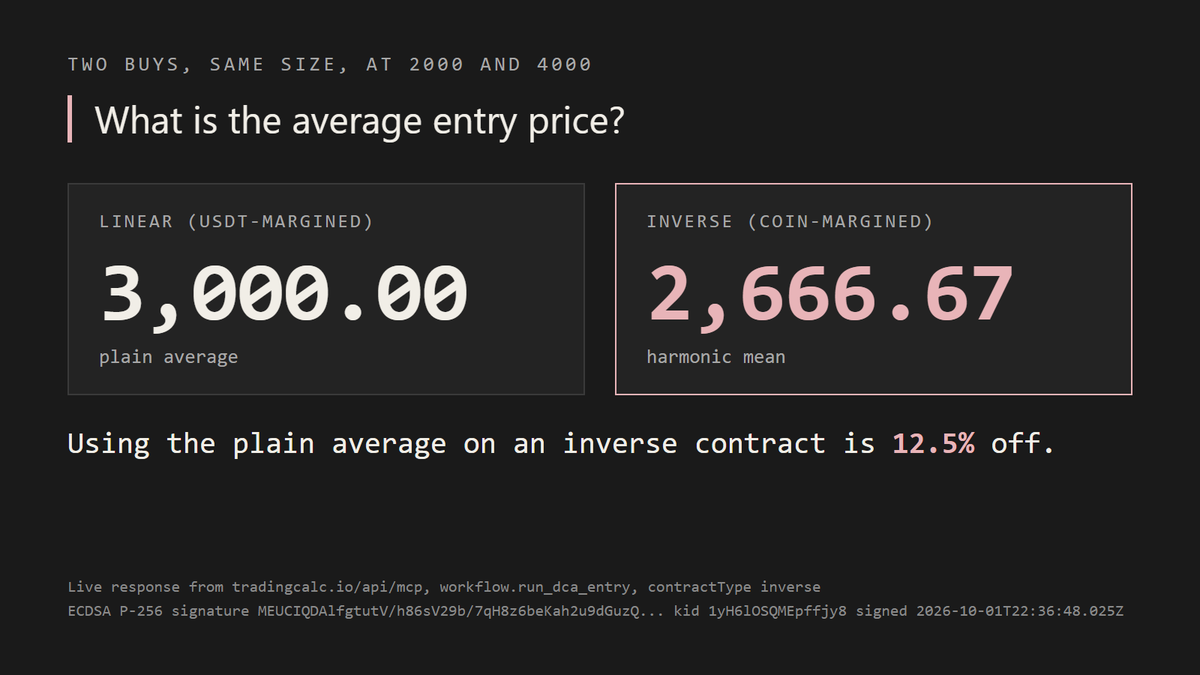
Two buys of the same size on a coin-margined contract, one at 2000 and one at 4000. The average entry is 2666.67, not 3000, because on an inverse contract the average is a harmonic mean.
A language model is built to continue text, and the plain average is the pattern it has seen most. So it can give you 3000 in a calm, confident sentence. That is 12.5% off your entry price, and nothing in the answer looks wrong.
This is what I run into whenever a model is asked for exact trading maths. It was not built for that, and its mistakes look like answers.
So I stopped asking it to calculate. The model asks, a server does the arithmetic, the same input always gives the same number, and every result is signed so I can check that it came from the formulas and not from the model's memory.