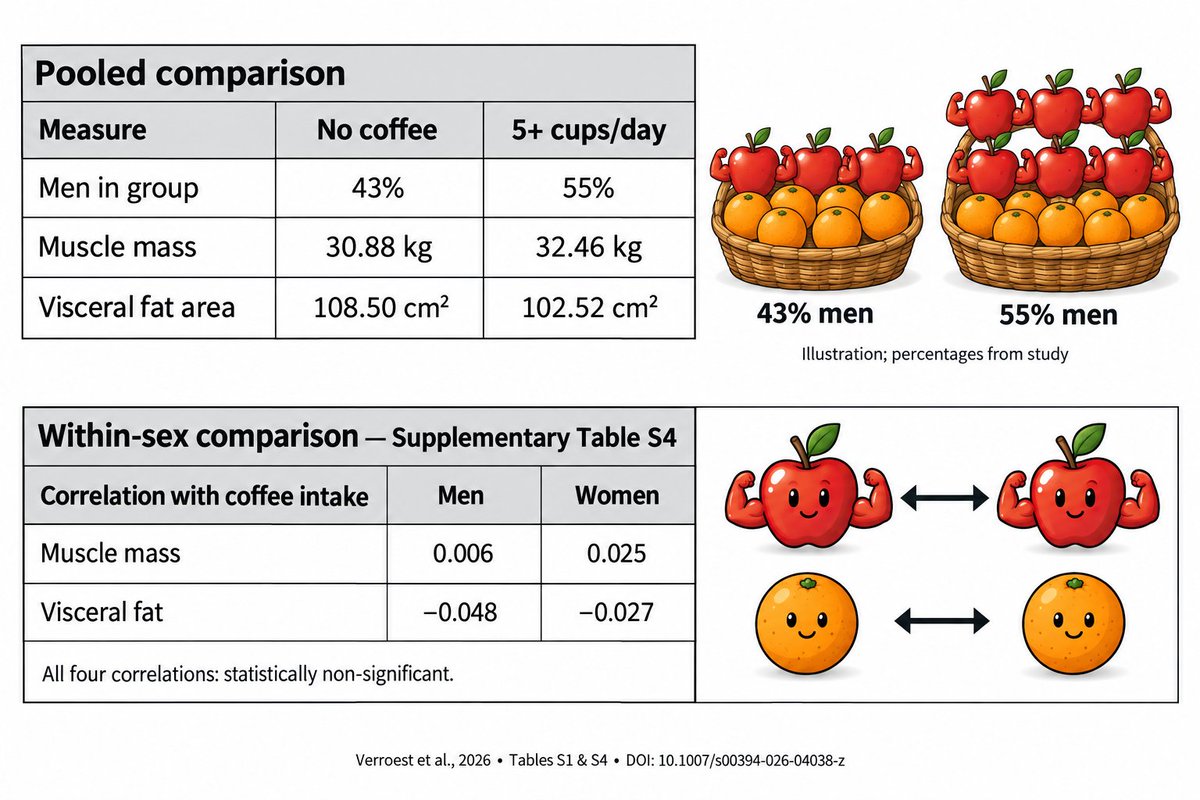
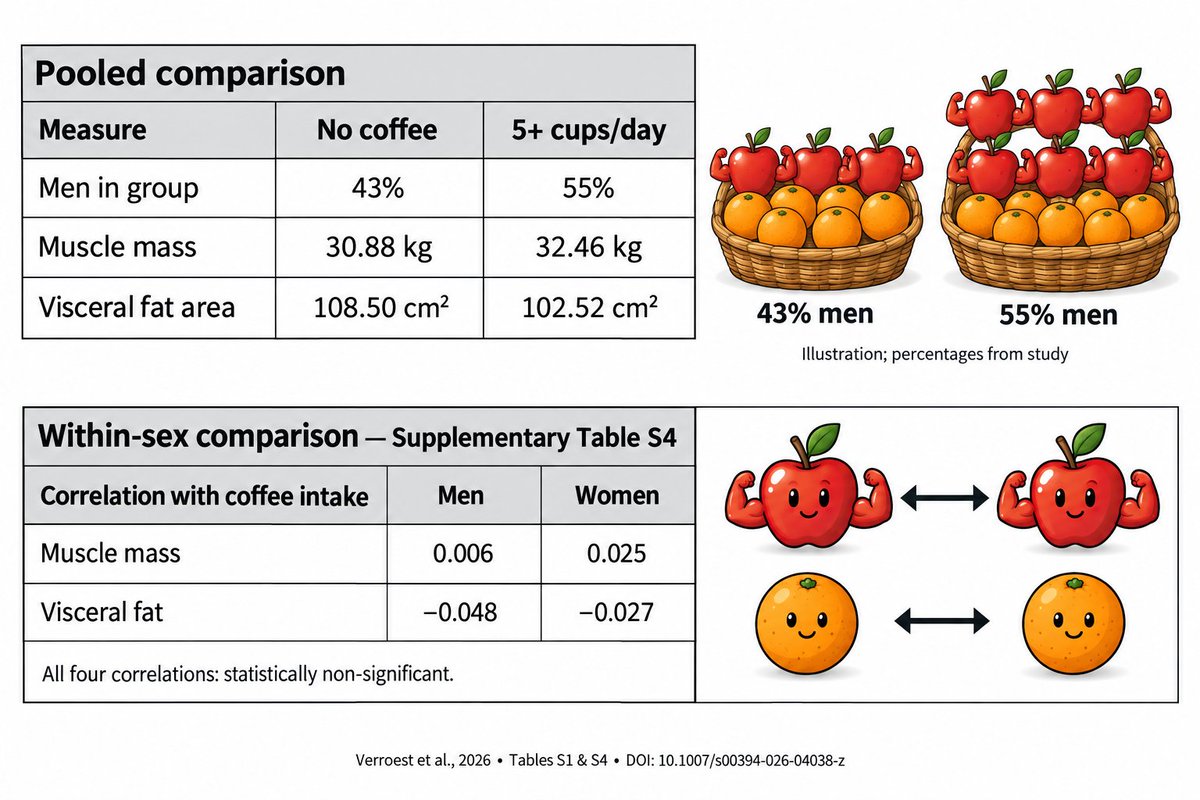
@foundmyfitness Deep down in the article’s supplementary data section—the extra tables accompanying the paper—they compare men with men and women with women. Both links are then near zero and statistically non-significant.
This is totally misleading!
@foundmyfitness The paper highlights more muscle and less visceral fat in heavier coffee drinkers. But it pools men and women: the highest-coffee group is 55% male, versus 43% among non-drinkers. That’s not comparing apples with apples.
@foundmyfitness The paper highlights more muscle and less visceral fat in heavier coffee drinkers. But it pools men and women: the highest-coffee group is 55% male, versus 43% among non-drinkers. That’s not comparing apples with apples.
@foundmyfitness Deep down in the article’s supplementary data section—the extra tables accompanying the paper—they compare men with men and women with women. Both links are then near zero and statistically non-significant.
This is totally misleading!
@DoctorTro@PeterMShaw@DrEenfeldt https://t.co/zKf73eNVR5
Here they kept the protein constant at 30%. But the low carb high fat keto group had more satiety than the moderate carb non keto group🤔
@DrEenfeldt@raphaels7@KetoCarnivore If you're open to challenges, why not try the opposite of high-fat carnivore? A low-fat vegan diet eating only bananas (39), blueberries (48), and apples (46) with an avg. satiety score ~45 in your system could test your theory. It would be interesting to see the results!
@DrEenfeldt But if you look at this, low energy density and low hyperpalatability in UPF environment is leading to fat gain, despite weight loss. So they are loosing muscle?
@DrEenfeldt If you one only looks at this one would conclude that most of the effect is comming from energy density and hyperpalatability. Since UPFll is actuly losing weight!