Directional elements: the preprints are out! Congratulations to our amazing team linked here:
https://t.co/SxNw2isNcd
https://t.co/f48w42FKcJ
https://t.co/o5NXdGcViw
We screened for principles governing global brain dynamics by developing a set of new methods: 1) conformal immersion microscopy for recording high-speed/high-resolution neural activity across dorsal cortex; 2) unbiased computational screening of brain-spanning activity for fast directionally-propagating spatiotemporal elements; and 3) novel genetically-encoded voltage sensing integrated with designed spectrally-compatible opsins (derived from our channelrhodopsin structure work) for systematic causal testing.
This unbiased screening/testing approach (which we show is applicable either to voltage or calcium imaging) allowed discovery and functional validation of a surprisingly well-defined set of directional elements that generalized across cell types and frequencies. The ability to work over long timescales at high speeds and with broad scope, anchored in optogenetic causal testing, unveiled rich spatiotemporal structure that was remarkably tractable.
From the perspective of natural brain function, the directional elements were found to be behaviorally relevant and robust to diverse perturbations; however, we also found specific conditions allowing elemental incidence and boundaries to be selectively modulated, which may provide translational as well as basic-science insight...
I'm so grateful to all our collaborators, and honored to work with all the outstanding students, postdocs, and staff who worked together to develop and apply this approach...
An important moment for American science. @NeilShubin is preparing to become president of the @theNASciences, helping lead one of the nation’s most influential scientific institutions at a time when scientific expertise and public trust matter deeply.
My portrait accompanies the story.
https://t.co/EVbXXaw8H6
June is Alzheimer’s and #BrainAwarenessMonth. #EndAlz 🧠
Lasker Laureates Dieter Oesterhelt of @MPI_Biochem, Peter Hegemann of the Humboldt University of Berlin, and Karl Deisseroth of @Stanford developed optogenetics, a revolutionary technique in neuroscience: https://t.co/Cjv7g46zy4
Yes! ASAP7y works well with both conformal immersion microscopy (CIM):
https://t.co/inwrH1oCCd
and other widefield methods including tandem lens macroscopy:
https://t.co/hrIcONFQ8p
helping to unveil fast dynamics (see video).
Congrats to the ASAP team:
https://t.co/zv1tG0CNUM
These preprints, as well as 2 others using ASAP7y posted this week from the lab of @KarlDeisseroth, show how GFP-based voltage imaging, once though physically impossible, has come of age, revealing the electrical basis of brain computation from 1-μm to whole-brain scales.
13/14
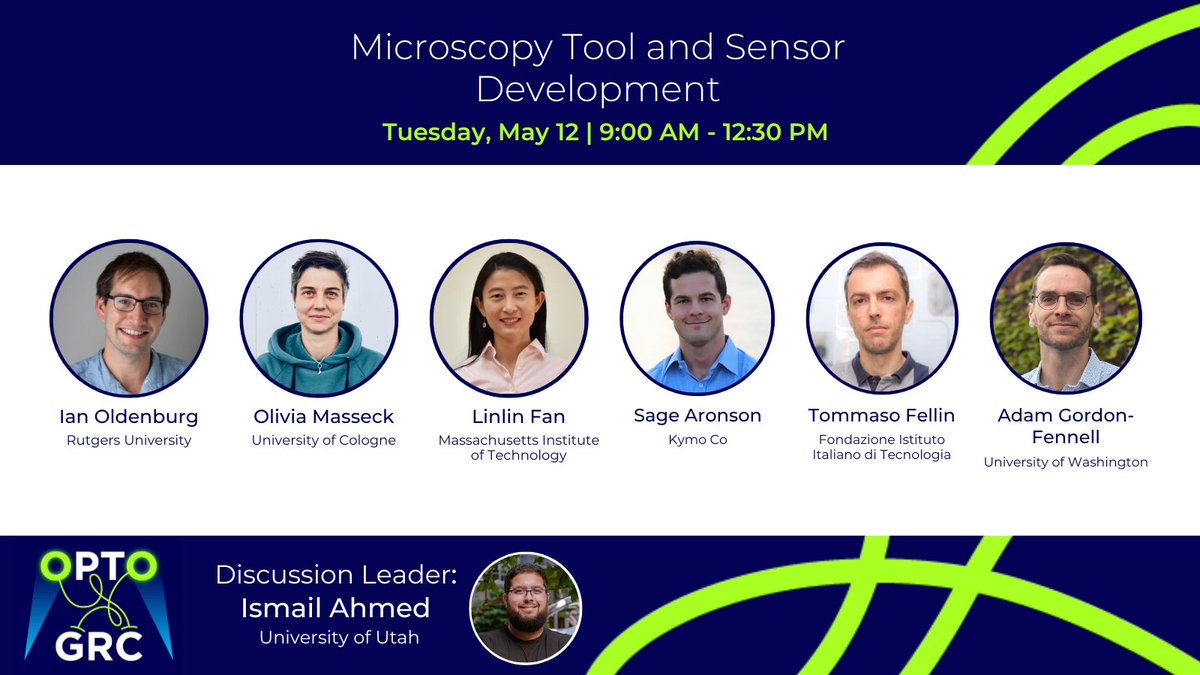
#OptoGRC2026 has officially come to a close!
Thank you to our incredible lineup of speakers, discussion leaders, and poster presenters �� and to everyone who joined us and made this a meeting we won’t forget.
Stay tuned for more on #OptoGRC2028!
From cells to behavior, this #OptoGRC2026 session explores how neural activity shapes behavioral outputs 🧠⚡
Featuring @J9Kwapis, Catherine Peña, @Nicole__Ferrara, @thefrankslab, Priya Rajasethupathy, Jennifer Lawlor & @YasmineAyman20, you won't want to miss this lineup!
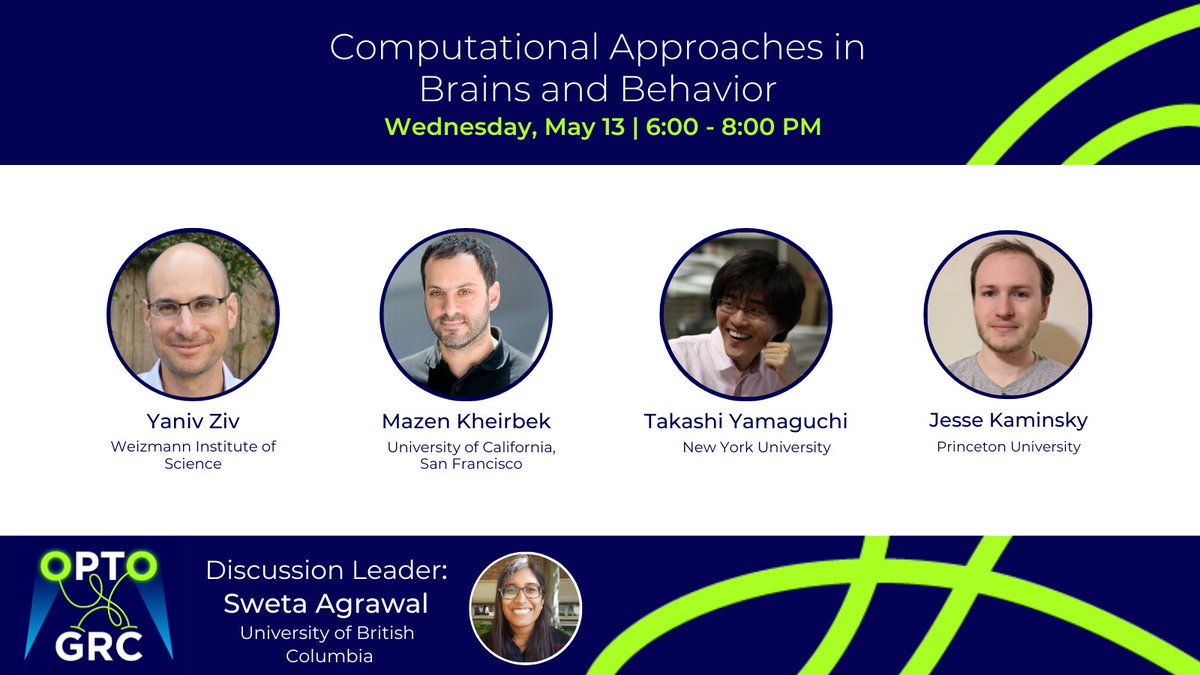
Don’t miss this session exploring the computational side of brains and behavior at #OptoGRC2026 🧠 💻
Discussion to be led by Sweta Agrawal, featuring speakers Yaniv Ziv, @mazen_kheirbek, Takashi Yamaguchi & Jesse Kaminsky, Wednesday evening!
From the neuroscience perspective, behavior is unmatched as noninvasive quantitative readout of brain function (and best of all, it is a readout that matters). This initial lifelong continuous screen of behaving vertebrates provided a wealth of new ideas regarding progression and staging of brain function across the adult lifespan. Truly impressive work from Claire, Ravi, and the whole creative and dedicated team. Lifelong work takes a long time, even with killifish!
@uoftmdphd@KarlDeisseroth@mathepan@kao_jenn Thank you @KarlDeisseroth! Getting a glimpse into your thinking process and philosophy behind your writing was very inspiring. It encourages us to work with vigour, treat with humanity, and reflectively express ourselves.
@SamVesuna@SfNtweets 📷
thanks @SamVesuna and the secret cake team! And congratulations to all the wonderful presenters from our HNC clinical program, and to the whole lab. The surprise cake got me through to the end (I had forgotten how physically challenging being a poster presenter can be...)
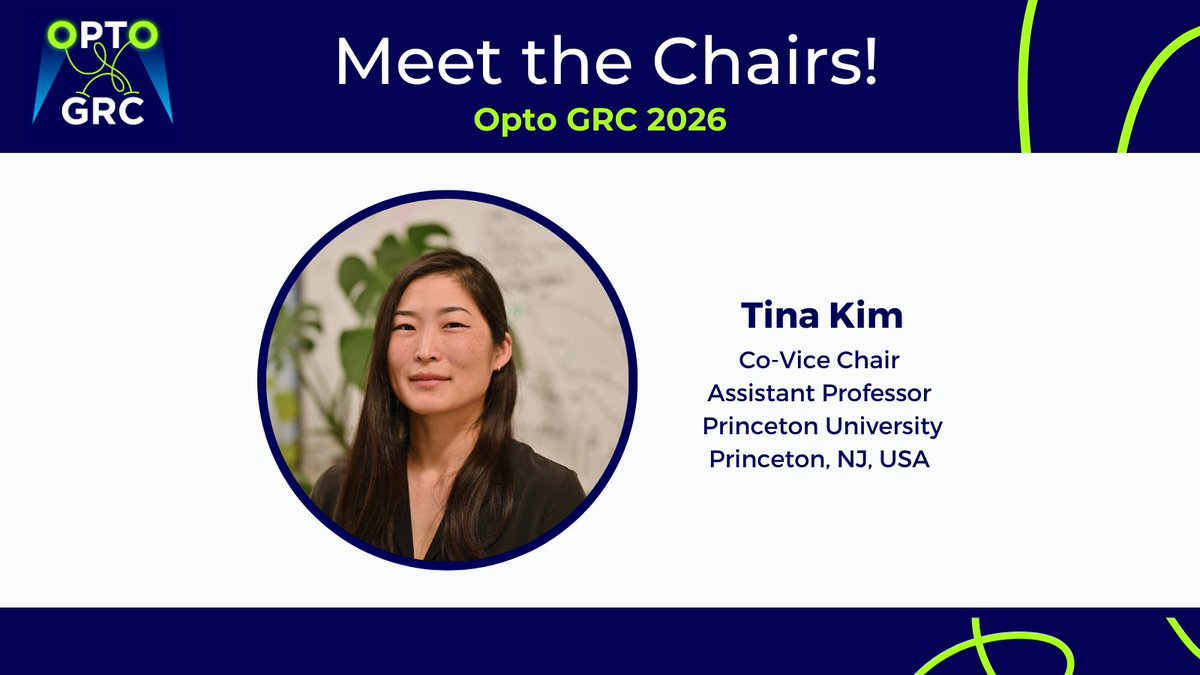
It's time to meet your #OptoGRC2026 chairs!
Co-vice chair @tinakim_neuro is an assistant professor at @Princeton who spent the summer building a van for weekend adventures 🚐✨
She's most looking forward to meeting new people & exploring areas outside of her usual wheelhouse!
My lab’s microbial-opsin work (and by far most of the field also) is pure basic science, but it was intriguing to review the community's clinical progress– both direct translation as in retinal degeneration, and indirect translation not involving gene therapy– with a wonderful and broad international team of co-authors…
https://t.co/p7vfMsVRy7
& to adapt a long-ago figure from PMID:28912215 (2017) on the inner workings of light-gated ion channels with my long-time collaborator Peter Hegemann; photo is a memory from that year.
Our new paper on large scale holographic read-write experiments observing and controlling thousands of neurons in mouse visual cortex reveals a new functional cell-type that detects even moderate levels of excess activity (just 50 extra neurons firing) then inhibits top down cortical inputs.
This cell type is a subclass of somatostatin neurons, whose dysfunction is implicated in schizophrenia.
This suggests an intriguing hypothesis for the origins hallucinations in schizophrenia: the breakdown of this highly sensitive cortical gate allows top down inputs to enter visual cortex that should not, creating hallucinations.
This work was expertly lead by @ADrinnenberg w/ @allanraventos and @Alex_Attinger on data analysis and theory. Another fun collab w/ @KarlDeisseroth!
For more see: https://t.co/bBNPiFd8C0
And also this excellent thread: https://t.co/s31JiPW1Fm
Amazing collaboration with @AllenInstitute team—@HongkuiZeng, @BosiljkaTasic, Tanya L. Daigle, La'Akea Siverts—to develop new transgenics for all-optical neuroscience.
And deeply grateful to @KarlDeisseroth for his support and mentorship. 🙏
12/13