Jaindi Kisero
I have come across a letter from the National Treasury directing the state department of roads to immediately cancel all project-related commitments; including contracts procurement processes; consulting arrangements; and any other obligations on the multi billion Japanese funded Likoni Bridge project.
This development is a statement of the increasing political influence of Chinese contractors and the strong links with incumbent elites.
It is a big anti climax. First, the project has been running since 2019. Secondly- designs were done and consultants are already in place. The first tranche of the loan was disbursed. Advance payments flowed to consultants. A procurement competition was run to its conclusion. A winner emerged. And then — nothing. For nearly two years.
I am inclined to agree with a cynical opinion of an insider who has been following the shenanigans around the Likoni Bridge project for a long time who says ‘when they are unable to get a good cut or backhander on a project, they turn to the Chinese”.
For sometime now and to set the stage for cancellation of the deal with the Japanese; a new narrative was floated within government circles: that the project is too expensive and the financing model should be rethought. That Kenya could instead mobilise domestic resources—pension funds and institutional investors—through an infrastructure fund model. That a securitisation structure, possibly involving a Chinese contractor, could deliver the same project more cheaply.
Each argument is very controversial. Pension fund money carries market return expectations — a far higher cost of capital than 0.1 percent interest, the 12-year grace period, a 30-year repayment window, and an outright grant element worth Sh 6 billion which the Japanese had committed.
Yes, a securitisation transaction with a Chinese contractor may be an option. But it embeds financing costs inside the construction price, making it opaque and almost always more expensive in aggregate. Do we really want to hand back the Sh 6 billion grant element on the Japanese loan?
Then there is the diplomatic cost, which is being ignored. Whem the Jpanase foreign Affairs Minister, Mr Toshimitsu Mogei visited Kewnya in May,the Likoni brifdge wasa top agenda item. Japan helped author the Mombasa master plan. Japan is funding the ongoing rehabilitation of Mombasa Port. Japan designed the Dongo Kundu Special Economic Zone as the flagship of Kenya's entire SEZ programme — the first domino in a sequence intended to include Naivasha and Kisumu.
Cancel this credit, pivot to a Chinese deal, and we must look Tokyo in the eye and explain ourselves. We must be prepared for the consequences at the port, at Dongo Kundu, and in every future ODA conversation with an ally cultivated over decades — all to spare someone the inconvenience of a transparent procurement outcome they did not control.
Grand corruption does not always arrive with a smoking gun. Sometimes it arrives as a memo recommending delay. Sometimes it wears the language of fiscal prudence and alternative financing mechanisms. Sometimes it sits in a procurement committee and does absolutely nothing.
How to occupy and conquer a country without using any force or bombs
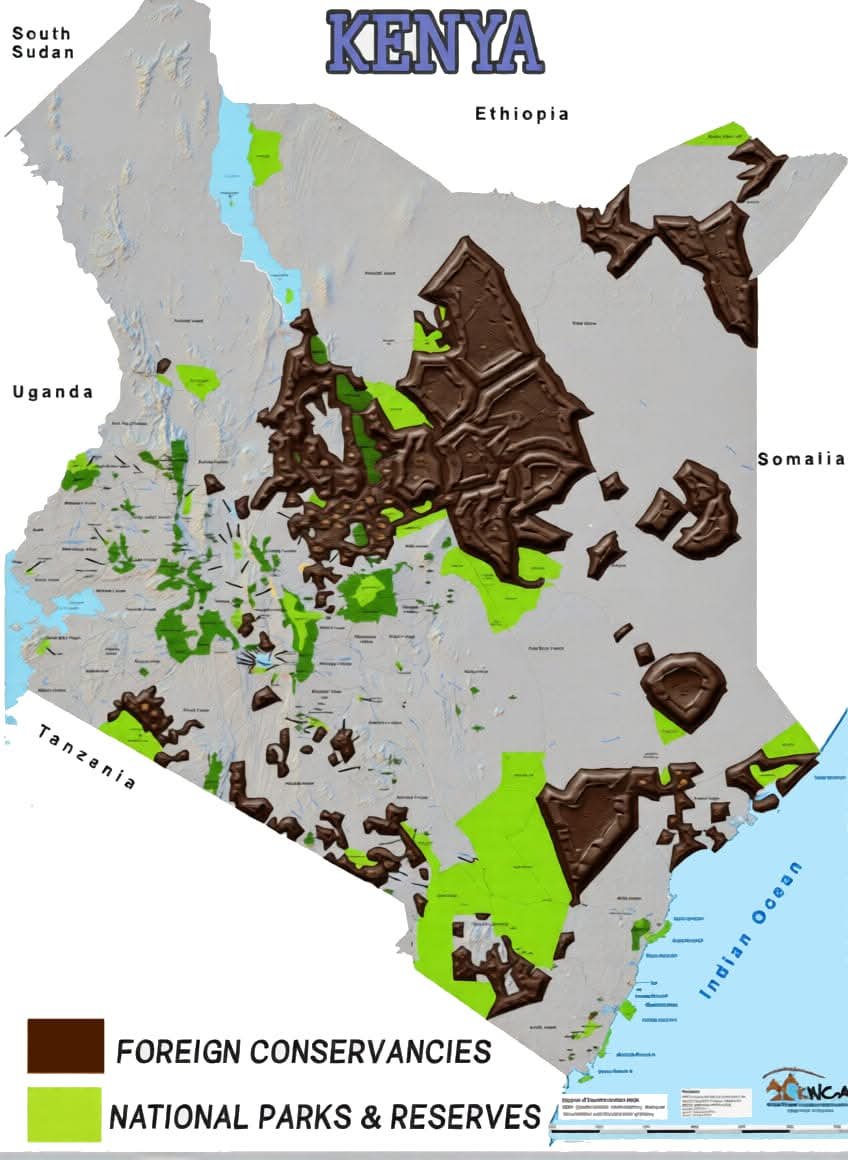
1. Establish foreign conservancies and allow foreign land ownership for 99 years, renewable for another 99 years.
Kenya has more than 230 conservancies that cover about 25 percent of the country’s total land area, roughly 145,600 square kilometres. These conservancies are mainly owned and managed by white Americans, British, and Jewish settlers, and sometimes by foreign government officials or their proxies who live in Kenya.
For example, Meg Whitman and Monica Juma, who is allegedly a CIA mole, serve as advisor and chair of the Kenya Rhino Range Expansion initiative. Other owners include white billionaire families such as the Delameres, Oppenheimers, Wildensteins, Craigs, Kuki Galmanns, Powys, Sylvesters, Kenyons, Francombes, Roussels, George Smalls, Kessels, and the Blocks.
These places have become multi-million-dollar private luxury tourist establishments with their own airstrips, security, free water, and electricity. They have also gradually shifted into livestock farming and now lead in beef and meat exports. Could the persistent cattle rustling in the northern regions be linked to these economic factors?
The same lands contain untapped mineral resources that were first surveyed by the British between 1947 and 1956, again in 1980, and most recently in 2022 under Uhuru and in 2023 under Ruto. Currently these areas are exploited for carbon credits and climate-change profits that mainly benefit the white owners, while local communities receive minimal benefits. Kenya hosts more than 36 land-based carbon credit companies, most of which are foreign-owned.
2. Maintain numerous foreign military bases and parasitic international organisations that will from time to time carry out strategic clandestine operations on Kenyans.
The British Army is stationed in Laikipia. US military bases operate in Lamu, Nairobi, and the North Eastern region. French troops are present at undisclosed locations across Kenya, and the genocidal Israeli Defence Forces have been secretly invited to establish their air defence system and scientific labs.
International organisations such as the World Bank, IMF, UNEP, UNDP, USAID (now defunct), the Bill and Melinda Gates Foundation, the US Embassy, the EU Commission, the British Council, the Goethe Institute, and Alliance Française influence national policies in population data, education, arts, agriculture, and health.
3. Accumulate massive debt and allow foreign acquisition of strategic national companies in education, banking, energy, health, telecommunications, transport (including airports and ports), and media.
Kenya’s debt runs into trillions of shillings, and continuous borrowing creates a never-ending cycle. Creditors demand collateral in the form of mineral rights, with leases exceeding 50 years and without taxes. Major Kenyan financial institutions, energy companies, telecommunications firms, real estate, and media outlets have been acquired by foreigners, including investors from South Africa, Uganda, Tanzania, and Somalia.
4. Permit immigrants and refugees to obtain national identification cards and passports. This is also called the Great Replacement Theory.
Foreign nationals from Uganda, Tanzania, Burundi, Rwanda, Congo, Nigeria, Eritrea, Ethiopia, South Sudan, Sudan, and Somalia have infiltrated national databases and acquired Kenyan citizenship. This influx aims to undermine nationalism, allowing these individuals to vote and influence national politics. When they attain political power, they can easily sell out the country or manipulate policies to their advantage.
Yesterday evening, @citizentvkenya did some of God's work. Walifinya RAIS WA LIES shingo akashindwa kupumua. Waiting for the government mandarins to go & demonstrate hapo Royal Services. God bless you, @YvonneOkwara#Wantam
We need to abandon the "do for Kenyans" politics. We're not natives in need of salvation from wazungu or people with access to wazungu. Kenyans have the knowledge and the energy to work and build their country, but GoK still behaves like a colonial DO and paralyzes us with a tax each time we say ng'we. If Sifuna tells us the damage he's going to undo from the current govt, that's enough, in my view. We can do the rest. We're more competent than the current political machine, anyway. CBC pun not intended.