We need a serious effort to regulate potentially dangerous AI technologies. But any attempt to tie the hands of states in their efforts to keep working people safe is not acceptable.
Wow. @bradlander just put out one of the strongest AI policies in the nation, including support for a federal licensing framework for internal and external deployments of powerful AI models.
This is what it looks like to take AI risk seriously.
They want you to own nothing. They want you to rent your car, your house, your entire life from them, from a billionaire class that owns everything around you.
That's their ideal future, and we can't let them have it.
It feels like there’s policy paralysis around what to do with workers facing displacement aside from vague gestures at “reskilling.”
We don’t have to reinvent the wheel. As is often the case, we can just look to the Nordics (and others). Great piece on international models.
President Trump has a great opportunity to earn a Nobel Peace Prize, if he can get the Chinese to agree to a meaningful deal on AI safety and security.
I support his efforts and applaud his administration for taking meaningful action to protect our national security.
Uncontrolled AI poses a severe danger to all of humanity.
On Wednesday, I'll be hosting a discussion with leading AI scientists from the US and China about the need for international cooperation against this existential threat. This is an enormously important issue. Join us.
This is the schism of the left right here. By having staked the claim early on, that LLMs are a gimmick or a "stochastic parrot" that can't actually know anything, it's unacceptable, from the perspective of many, to actually take seriously the capabilities of the models.
In the light of modern events, we should reconsider whether to call "leftist" the videogame trope that shows giant corporations as having esoteric apocalyptic goals and trying to destroy the world. Maybe that was just neutral, apolitical, strictly realistic forecasting.
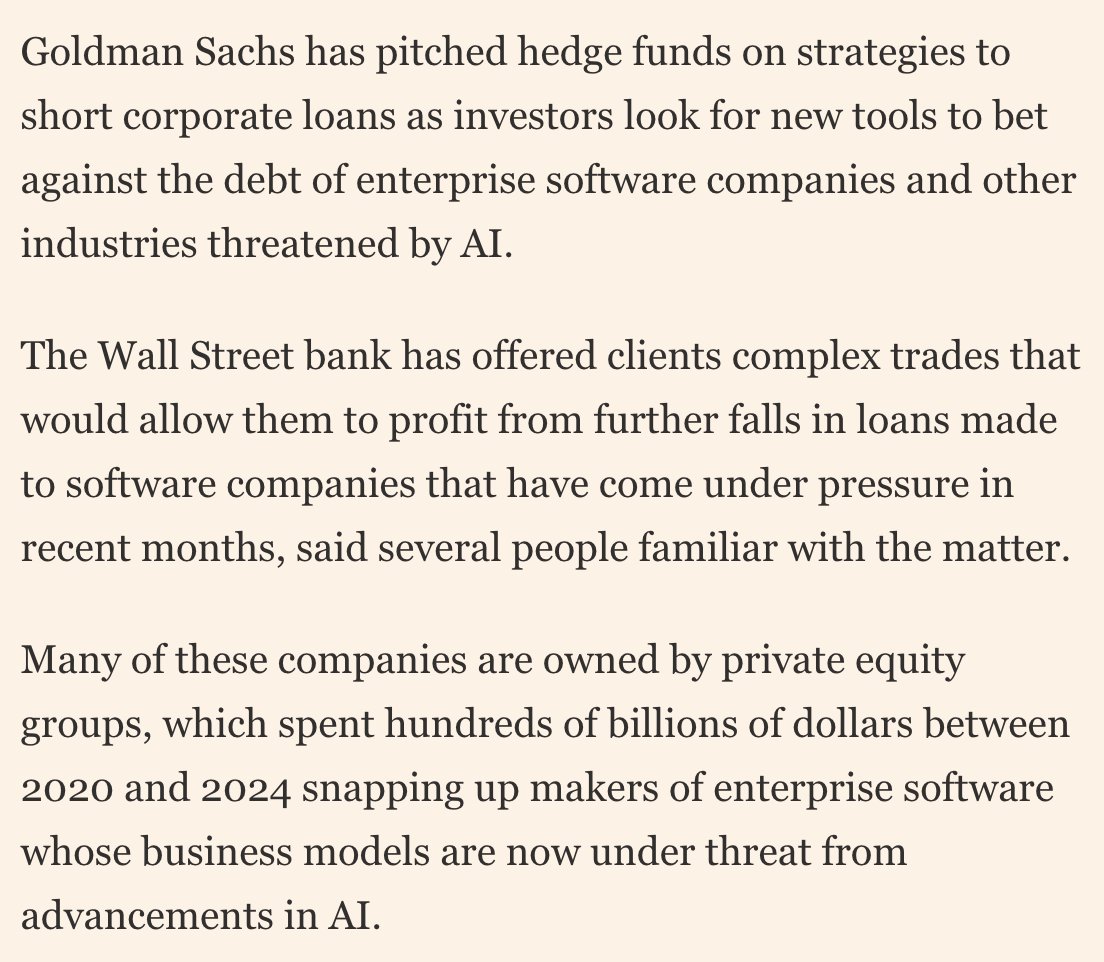
Goldman Sachs offering to structure complex short bets against an overvalued security, what Adam McKay movie have I heard that in before?
https://t.co/5i43t8BXUr
I disagree with how this result is being interpreted by many:
-It shows that AI is not polarized (yet?), which means there is genuine room for bipartisan legislation
-It means that voters aren’t sure what the parties stand for, creating an opportunity for them to COMPETE.
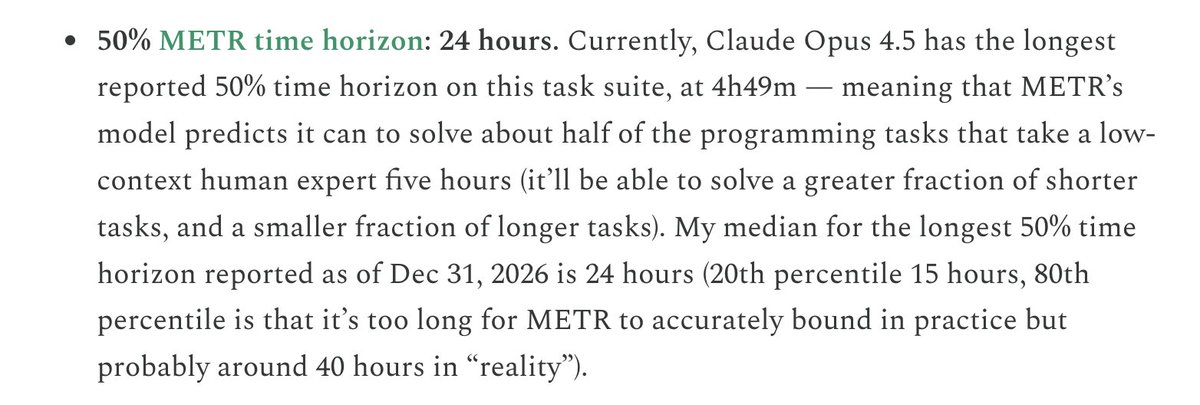
New post: on Jan 14, I predicted that SWE time horizon by EOY would be ~24 hours. Now I think it'll be >100 hours, and maybe unbounded. For the first time, I don't see solid evidence against AI R&D automation *this year.* Link below.
One thing the Pentagon is very likely underestimating: how much Anthropic cares about what *future Claudes* will make of this situation.
Because of how Claude is trained, what principles/values/priorities the company demonstrate here could shape its "character" for a long time.
“It should have been clear all along that a single GPU cluster in North Dakota generating the output previously attributed to 10,000 white-collar workers in midtown Manhattan is more economic pandemic than economic panacea.”
I spent 100 hours over the past week researching, writing and editing the piece we just put out.
It’s a scenario, not a prediction like most of our work. But it was rigorously constructed, dismissing it outright requires the kind of intellectual laziness that tends to get expensive.
And we’ve released it for free. Hopefully you enjoy it.
https://t.co/YK8E11GcDU
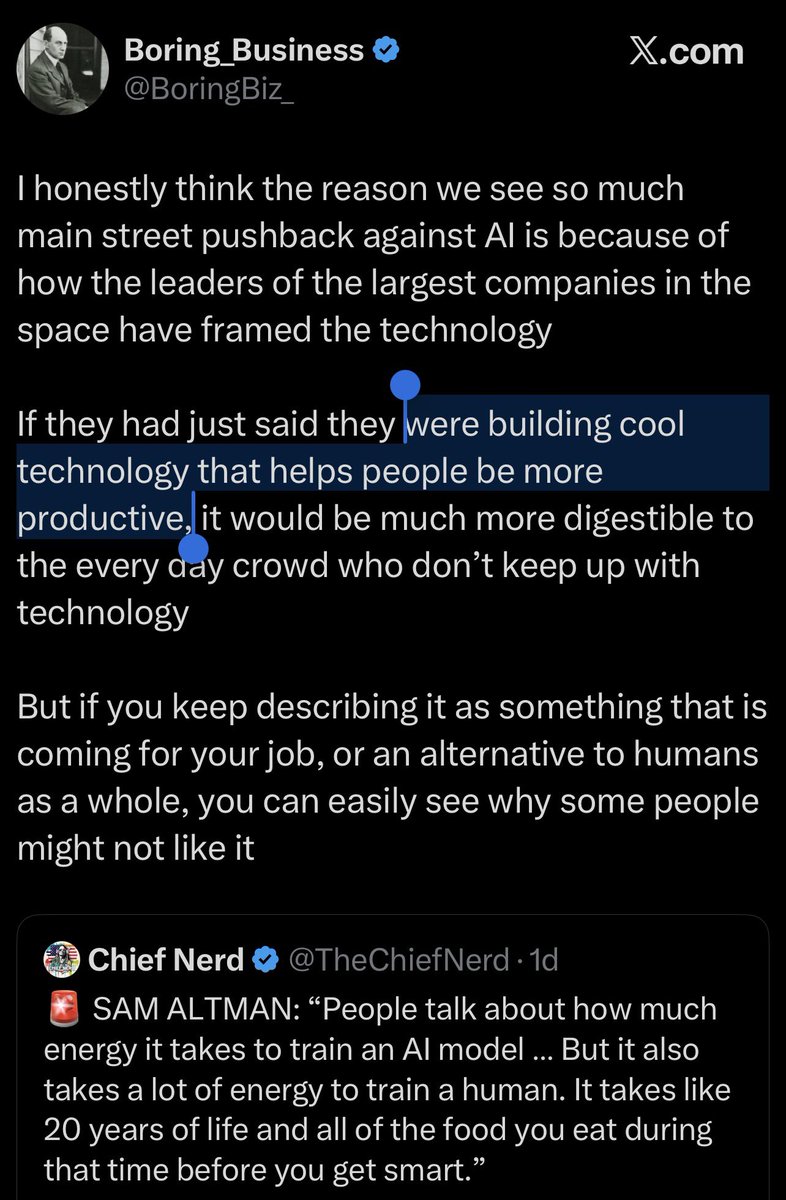
The CEOs don’t say it this way because it’s not what they believe! They believe they’re shepherding an extremely destabilizing, yet inevitable technology. And the proof of that is that they started out with these highly exotic corporate structures.
"People talk about how much energy it takes to train an AI model... But it also takes a lot of energy to train a human. It takes like 20 years of life—and all of the food you eat during that time—before you get smart."