lowkey wish we'd shipped this under a new name because "projects" undersells how hard the team cooked here.
the coordinator form factor unlocked a totally different mode of working for me. my setup now:
one project per long-running workstream, with the right github repos + plugins attached
pepper the coordinator with a bunch of asks then claude will work on them in parallel threads in the background
as work completes or i get new context from meetings, i just ask the coordinator to synthesize everything back into the docs and artifacts that live in the library
every thread is grounded in the same repos, instructions, and memory, so much less time re-explaining things to claude
i am constantly (and embarrassingly) nudging along half-baked ideas in these projects every night while i workout, and everything comes back thought-through
it's like having a chief of staff dedicated to each thing you're working on ❤️
We Must Pace the Frontier: I’ve written a new essay on why the AI industry should slow down, with a three-part plan for doing so.
Anthropic is unilaterally committing to the first of these steps. We’ll provide third-party evaluators with permanent, employee-level access to our systems, so that they can verify adherence to our safety measures, report on incidents, and assess models’ alignment during training.
You can read the full post here: https://t.co/OGyPb7yaYt
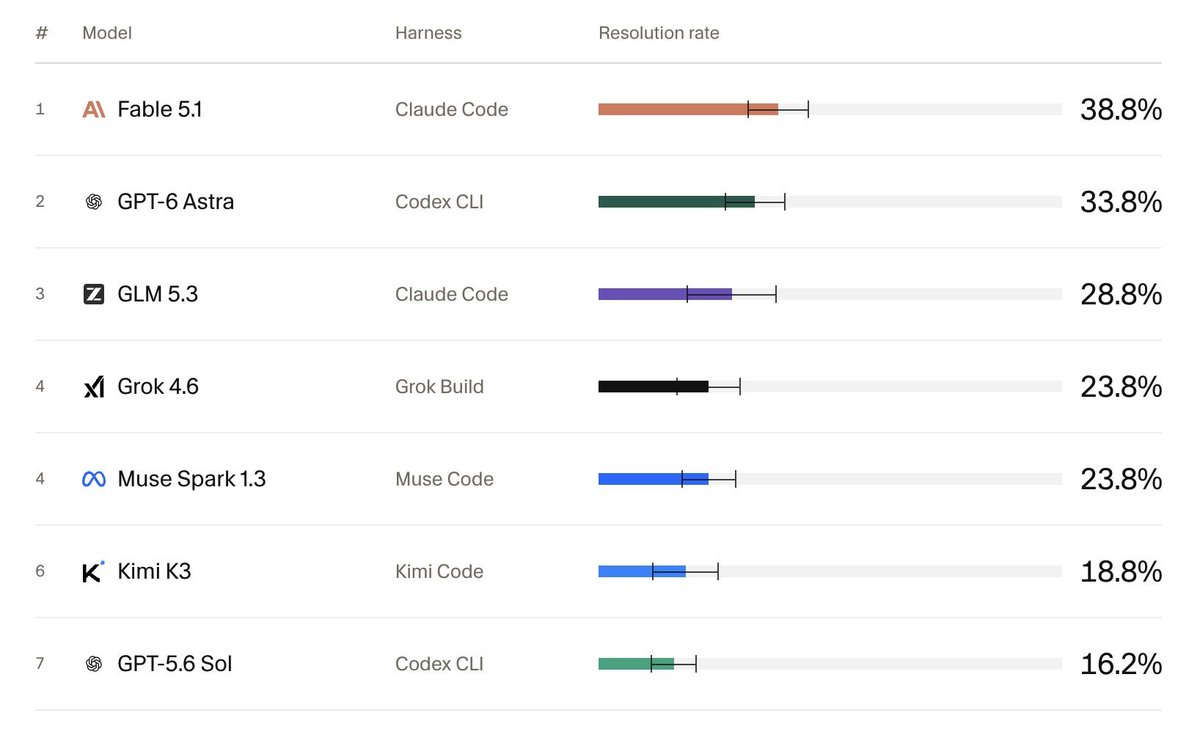
Not surprised. Fable still feels a cut above anything else I’ve tried on the depth of thinking.
Grok 4.6 is an excellent model. My stack is almost exclusively fable 5.1 and grok 4.6.
Yes, this result cost millions of dollars.
But remember that when @OpenAI announced o3 it cost ~$500,000 to score 87.5% on ARC-AGI 1. Today, Astra scores higher for ~$20.
In 2025 it took us and GDM an enormous amount of compute to achieve IMO gold. For the 2026 IMO, anyone with a $20/month ChatGPT subscription could do it.
Massively scaling test-time compute gives us a glimpse of the future. I believe that a year from now everyone will have an AI at their fingertips capable of solving problems of this caliber.
We’re sharing a solution to the Navier-Stokes Millennium Prize Problem, one of the deepest problems at the frontier of mathematics.
The proof was produced by a group of agents, using an OpenAI next-generation model significantly more capable than GPT-6 Astra.
The problem concerns whether the description of smooth three-dimensional fluid motion modeled by the Navier-Stokes equations can break down. It has remained unresolved for roughly 90 years.
I now hand over email support threads to my @openclaw agent, after initiating.
Did it this morning for a flight transaction conflict.
Now, my agent is talking to the flight team’s AI support agents, and hashing things out.