@sameercarpenter@IndianGems_ Negative experiences tend to stick longer in people. Criticising will not solve the problem immediately at hand, but it will discourage them from doing it again in future.
Surely, we can't expect people to change overnight, but we shouldn't be laughing it off either.
@ForkYeah07@beebomco The harder any material gets, the more brittle it becomes. Im assuming 6 is a sweet spot where they are willing to compromise with both.
I use WhatsApp Web everyday. The few times my WhatsApp web session had terminated and I had to log in again, I hated it.
Now, the government is forcing crores of Indians like me to do the very thing every 6 hours.
It might be trivial for the government, but for crores of Indians it is going to be a huge pain in the ass.
The government should think about us and roll back this compulsory WhatsApp web log out.
Through Sim Binding the government wants to know everything about your private life but they won't tell us anything about them
Zilch, Nada for government transparency and todo for mass surveillance.
Speak up ! Defend your right to privacy !
Roll Back Sim Binding !
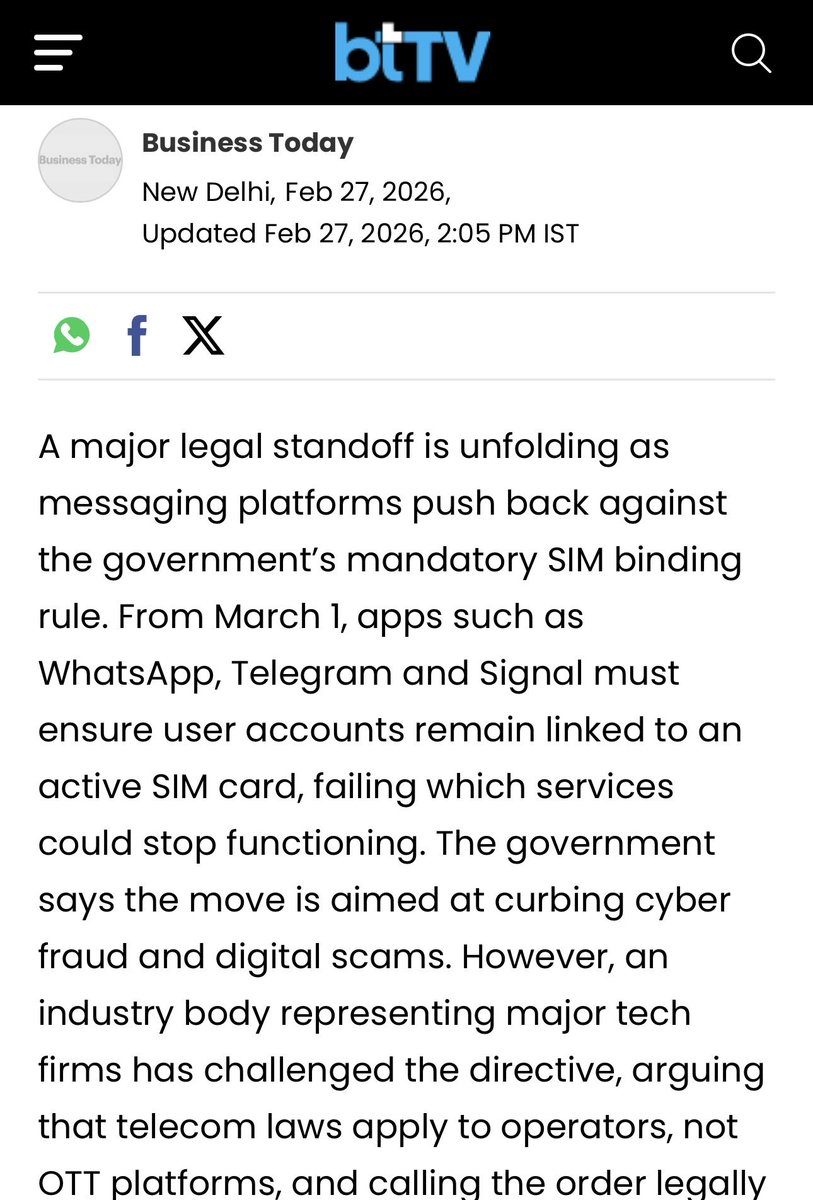
🚨 No Extension For WhatsApp SIM Linking
Sim-Binding Need Apps Linked To Active, KYC-Verified SIM Cards Installed on Smartphone
Users Won't Be Able To Use WhatsApp Otherwise
WhatsApp Web To Logout Every 12 Hours
Govt Should Rethink About This Regulation
*STATEMENT: Escalating Digital Censorship in India*
*New Delhi, February 28, 2026*
The Internet Freedom Foundation (IFF) is concerned by a cluster of online blocking and takedown actions and ISP level service disruptions reported between 24–28 February 2026. Across these incidents, users and affected services face restrictions without clear, timely reasons and without access to the underlying orders needed to challenge state action by exercising their rights to obtain legal remedy.
Developers reported severe, uneven disruption in access to Supabase across multiple Indian networks. Reporting indicates the disruption followed a government direction, with accounts suggesting use of Section 69A of the Information Technology Act, 2000. Yet there has been no public statement of the grounds, scope, or duration, and no accessible order for those impacted. Supabase has publicly stated that its domains became inaccessible due to a “ministry order”, and users have been pushed to workarounds such as alternative DNS or VPNs. In parallel, users on X (formerly Twitter) continue to receive “withheld in India” notices restricting specific posts within the country. Such notices usually do not provide the government order or its reasoning. Hence, for those who are being censored the basics of natural justice of a notice, opportunity for a hearing and remedy are delayed or absent.
This is enabled by secrecy built into the blocking framework. Section 69A is implemented through the 2009 Blocking Rules, which contemplate a committee process and, where feasible, notice to intermediaries and identifiable originators. But they also impose “strict confidentiality” over requests and actions taken. When orders and reasons are secret by default, affected persons cannot test legality, necessity, proportionality, or factual errors except through protracted litigation. When in _Shreya Singhal v. Union of India_ (2015), the Supreme Court upheld Section 69A while relying on the existence of procedural safeguards and reasoned decisions, indicating that impacted users could approach court in writ remedies. However, due to the operational secrecy and providing copies of orders and notices those who are censored and prevented from obtaining judicial remedy.
The February 2026 amendments to the IT Rules, 2021 further increase these risks. The substituted Rule 3(1)(d) requires intermediaries to remove or disable access within three hours of receiving “actual knowledge”, which can arise from a court order or a written “reasoned intimation” by authorised government officers. While the rule lists what a “reasoned intimation” should contain, the legal basis, statutory provision, nature of the unlawful act, and specific URL/identifier, the three-hour window pressures platforms to comply promptly which may often occur without any substantive assessment. These inherently opaque censorship practices are being accelerated through "Sahyog" portal. Developed by the Indian Cybercrime Coordination Centre (I4C), the Sahyog portal operates entirely without statutory footing, only being anchored in the IT Rules, 2021 that are created by executive notification. It functions as a censorship clearinghouse that deliberately bypasses the established, albeit weak, procedural safeguards of Section 69A. By routing automated takedown directives directly to intermediaries under Section 79(3)(b) of the IT Act, the portal structurally excludes citizens and impacted users from the grievance process.
We demand that the government introduce strictly judicially enforceable transparency requirements, publish all blocking orders, and restore the principles of natural justice to India's platform governance framework. Based on requests from our community we will also next week launch a rough public sheet in which social media users can input and add information on digital censorship.
From tomorrow, India becomes the ONLY country in the world to mandate SIM binding for WhatsApp, Telegram and Signal.
Not the US. Not the UK. Not even China. Just India.
The government says “cybersecurity.” Let’s fact-check that with their own data.
They already blocked 9.42 lakh fraudulent SIM cards. Already saved INR 5,489 Crore through existing systems. Already froze 24 lakh mule accounts.
The existing tools ARE working. So why put 100 Crore+ Indians under surveillance?
Cyber fraud in 2024 was INR 22,845 Crore. Banking apps ALREADY have SIM binding. Did that stop it? No. Fraudsters use burner SIMs. They’ll keep using burner SIMs. This rule punishes ordinary citizens, not criminals.
The Supreme Court in Puttaswamy (2017) ruled Privacy is a fundamental right under Article 21. Any restriction must be legal, necessary, and proportionate. This fails all three.
Meta and Google have formally called it “unconstitutional” and “ultra vires.” Even former Qualcomm VP Parag Kar confirmed Apple’s iOS literally blocks apps from reading SIM identifiers. The tech doesn’t even support what the government is demanding.
No public consultation. No parliamentary debate. No judicial oversight for disconnecting your access. WhatsApp Web forcefully logged out every 6 hours.
Internet Freedom Foundation demanded a rollback. Industry challenged it legally. Government’s response? “No extension.”
Yesterday I wrote about how the Whistleblower Protection Act was never implemented. Today the same government wants your messaging identity without a court order.
Won’t protect those who expose corruption. But will track every message you send.
This isn’t cybersecurity. This is a pattern.
I'm not saying delete UPI today. I'm saying demand answers. Who has your data? Where is it stored? Who can buy it? You have a right to know.
RT if you think Indians deserve real answers.
@kdcloudy@AppleSupport People who are clowning you are missing the point. I mean, it’s okay to make fun of you buying digital content, but it’s unacceptable for a big corporation to just remove the content you purchased without any prior warnings or refund.