Chinese Hamster Ovary, or CHO, cells are widely used in the pharmaceutical industry. And, incredibly, these cells can be traced back to just twenty hamsters that were packed into a crate and smuggled out of China in the 1940s.
Chinese scientists had been using these hamsters — native to northern China and Mongolia — to study pathogens since at least 1919. The hamsters were unusually well-suited to scientific research because they have short gestation periods (18-21 days), a natural resistance to human viruses and radiation, and it was thought, early on, that they possessed just 14 chromosomes, making them easy to work with for mutation studies. (They actually have 22 chromosomes.)
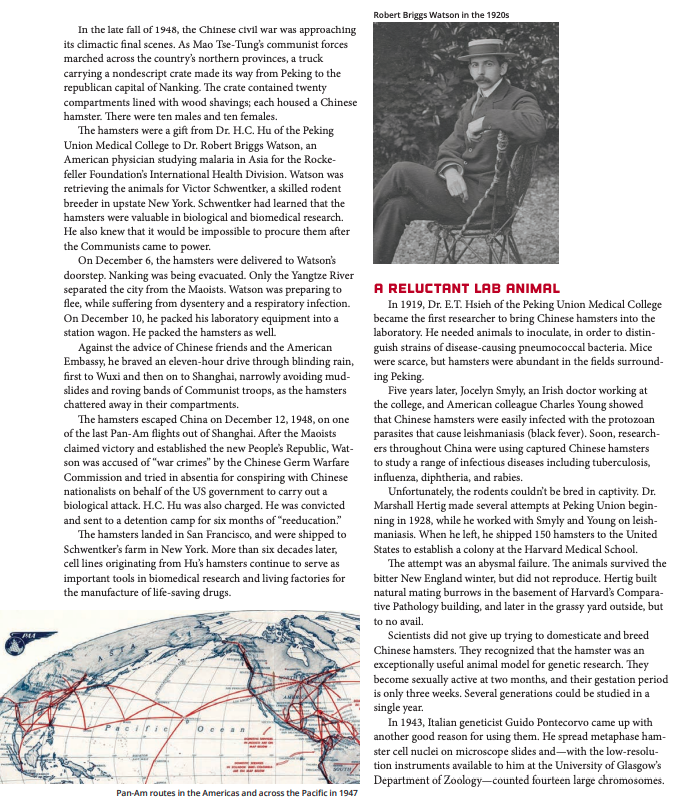
During the Chinese civil war, a rodent breeder in New York named Victor Schwentker worried that, if the Communists won the war, he’d never be able to get his hands on these special rodents. So in 1948, Schwentker sent a letter to Robert Briggs Watson, a Rockefeller Foundation field staff member, and asked him to “acquire” some hamsters so he could begin breeding them.
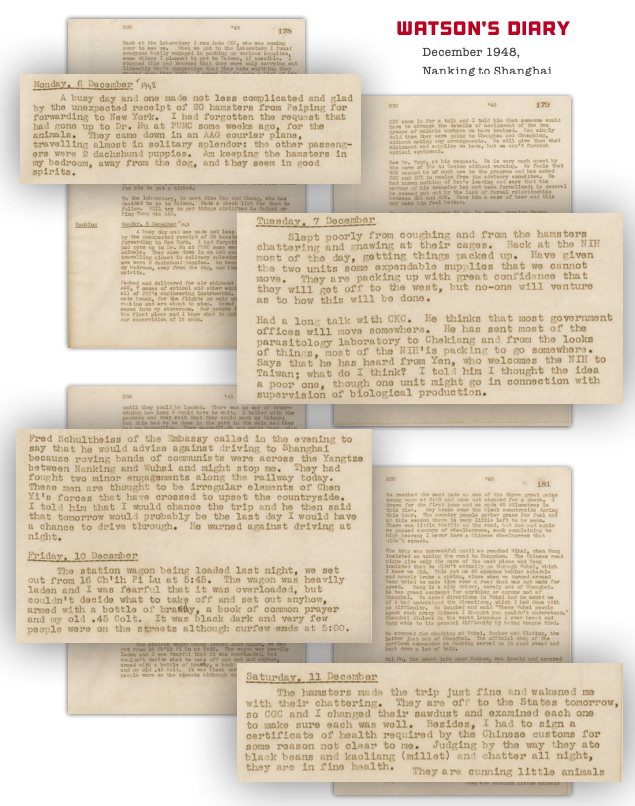
Watson collected ten males and ten females and packed them into a wooden crate with help from a Chinese physician (who was later imprisoned for this act). Watson slipped the crate out of the country on a Pan-Am flight from Shanghai, just before the Communists took control.
In New York, Schwentker received the hamsters and then began breeding and selling them to other researchers.
In 1957, a geneticist named Theodore Puck, intent on creating a new mammalian “model system” for in vitro experiments, learned about the Chinese hamster and contacted George Yerganian, a researcher at the Dana-Farber Cancer Institute, to obtain a specimen. Yerganian shipped Puck one female hamster.
Puck took a small piece from this hamster’s ovary, plated the cells onto a dish, and passaged them repeatedly. He eventually isolated a clone that could divide again and again; an “immortalized” CHO cell with a genetic mutation that rendered it immune to normal senescence.
Today, descendants of these immortalized CHO cells make about 70 percent of all therapeutic proteins sold on the market, including Humira ($21 billion in sales in 2021) and Keytruda ($17 billion). Many of these drugs are monoclonal antibodies, or Y-shaped proteins that lock onto, and neutralize, foreign objects inside the body.
CHO cells are well suited to biotherapeutics because they can perform a biochemical reaction called glycosylation. Many human proteins, including antibodies, are decorated with chains of sugars that control how they fold or interact with other molecules in the body. Only a few organisms, mostly mammalian cells and certain yeasts, can do this chemical reaction.
I first learned about this history from a really spectacular article in LSF Magazine, called "Vital Tools: A Brief History of CHO Cells." I recommend it. (You can find it with a quick search.)
Here's an excellent STAR protocol for identifying actively translated small open reading frames (smORFs), which is often an initial step to discovering microproteins.
Great work from @kcaoscience and @tfmPhD!
https://t.co/cS46usF8JE
Ribo-Seq is a powerful tool to find translating small open reading frames (smORFs), but it's restricted to smORFs without repetitive regions. Here, my colleague developed an integrative proteogenomics + Ribo-Seq approach to find previously missed smORFs.
https://t.co/LpfPtf1TjN
I'm thrilled to be part of an incredible lineup and excited to share my work from the @GygiLab on covalent drug discovery for the UPS using multiplexed targeted proteomics!
A new study uncovers how stress from childhood trauma can lead to mental illness. The key? Astrocyte-mediated removal of excitatory synapses in the brain. This finding brings us closer to understanding & treating mental disorders.
https://t.co/22HSP1eYkB
#neuroscience
1/2
Anyone who wants to study #HLA but feels hesitant as HLA is too complicated☹️? Happy to share our paper @NatureProtocols describing the up-to-date knowledge on HLA #genetics and step-by-step tutorial for HLA imputation and association with @soumya_boston🥳
https://t.co/fCXTmPMqt3
Led by @fcyucn we present MSFragger-DIA for direct peptide identification from DIA data. It leverages the speed of fragment ion indexing and searches DIA MS/MS spectra prior to feature detection and peak tracing. Complete DIA analysis workflow in #FragPipe https://t.co/x5Vl3y4WFb
Paving his own path | Ajay Kirpekar, @UCIrvine finance and macroeconomics Ph.D. #classof2023, reflects on his academic journey and why the study of finance is not about money.
https://t.co/k8qmMNsFLR
#zotzotzot#ucpride
#FragPipe 20 has been released, as well as updates to MSFragger, IonQuant, Philosopher and other tools. Thanks to all our (many!) users and collaborators for continuous support and feedback. Release notes: https://t.co/SkLoNsE4h8. Heading to #ASMS2023 now, hope to see you there!
Powell Cat was a true icon at @UCLA, and their passing has left a profound impact on our community. They were loved by all who knew them, and their memory will continue to inspire us to spread kindness and joy to those around us. #PowellCat