Why do we need a UAP Scientific Advisory Board?
As has been widely reported, the US government has asked Professor Avi Loeb, of the Department of Astronomy at Harvard University (see the main announcement at the end of this posting), to create a UAP Advisory Council. The members of this advisory group span a range of disciplines from astronomy, psychology, physics, biology, data analytics, psychology, entrepreneurs, and more. I am thrilled to have been invited alongside a notable list of scientists, academics, entrepreneurs, and others.
What follows are my personal thoughts and are not any official position of the UAP Advisory Council. Dr. Loeb has already elaborated on the formation of this Council, along with his views through postings on his blog and in public interviews.
Importantly, no one on the Council has been asked to sign any non-disclosure agreements. We are told that we are free to discuss matters that come before the Board, but without attribution of the source (Chatham House rules). By the same token, I am not obligated to answer any questions either. I plan to treat this effort like I do my day job in cancer immunology—not talking publicly about results until I am sure the answer is as close to correct as I can determine.
So, how did this Advisory Council come to be? Well, one answer is simple—through the dedicated action of thousands of individuals across decades, the coming forward of credible military and government officials in public testimony (sometimes under oath), the work of members of Congress and the Senate, along with testimonials of public witnesses, and much more.
Collectively, those actions have led to the extraordinary and courageous decision by President Donald J. Trump and his administration to release to the public US government-owned UAP-related files and information as vetted by a UAP Governance Board and other government agencies. As publicly announced, our group will report to the UAP Governing Board, which is under the direction of the Executive Branch.
Many people have openly wondered, “Why create a new Board when elements of the government or even commercial institutions already (allegedly) know the answer?” The UAP Advisory Council doesn't have any funding, and we don’t have subpoena power. We are all volunteers. We advise. Given that, there are some straightforward answers to the criticisms and commentary I have seen.
First, appreciate that the complexity of what UAP might represent is not definable in a single technological or cultural framework. It is so complex that even I, who have been steeped in the matter for over 15 years, have a hard time encompassing the breadth of explanations from “it’s real, and it’s here” to “it’s all misidentification”. My mind spins trying to make sense of it all.
What is clear is that the data released so far is not enough. The anecdotes are not enough. Sure, interesting videos, but where’s the metadata? What are the parameters of how the data was collected? Why are there extreme redactions of files and data? Why the incredible pushback? Where are the alleged retrieved technologies? There’s simply not enough to convince me when I put on my serious scientist’s hat.
Yet what I do know is that the question of what it might be will not go away while the data remains locked up. The answers to what any data might mean will require a comprehensive effort across disciplines that expand well beyond “nuts and bolts” science. Hence, the broad makeup of the team that comprises the UAP Advisory Council. Every person on the Board is, I believe, devoted to taking a logical and deeply skeptical approach to this matter. We will let the data guide us and cross-check each other.
For me, despite my widely known bias that I think there’s something deeper to the matter than misidentification, I remain like any scientist a trained sceptic at heart. I am terrified of making a mistake, but I’ve yet to reach a formal conclusion despite my public musings. I can believe a thing might be true, but as a scientist, I must believe enough in the possibility of an idea being true to justify my time and effort to prove it to myself— and more so to prove it to colleagues or the lay public.
There is data that, when contextualized as a hypothesis, becomes evidence that invites us to wonder whether the answer to “Are We Alone?” might be sitting right in front of us, but we choose to ignore it or let others tell us it should be ignored. Remember, data is only evidence towards supporting a conclusion when you pose a question (hypothesis) around what the data means. But evidence is not a conclusion. Evidence is what you put in front of a jury, where the data has been sufficiently scrubbed of doubt to allow one to decide what it means.
So, back to “Why do we need a UAP Scientific Advisory Board?” Well, we all want objective, and even subjective, expertise to interpret whatever data comes our way. Even if tomorrow a saucer landed in Times Square, we would still need a swath of expertise to interpret what opens the door, how it got here, and what might be the intent. Better to be prepared, in my opinion.
We obviously risk that this is a misdirection from some essential truth or that we might be being used in some elaborate disinformation campaign. We are also aware that we might be in for the possibility that there is simply nothing there but elaborate stories and misidentifications.
But I can tell you this—the risk is worth it. We have come further than ever before to open the door (or Pandora’s Box) to a potentially incredible opportunity. “Are we alone?” might be answered as “We are one of many.” Coming to know what others might have already learned about the nature of reality is, for me, well worth the effort to ask the question.
One way or the other, I believe humanity can handle the answer.
https://t.co/QZEUu6AZAa
I am proud to announce I will be leading a UAP Science Advisory Council to the U.S. Government: Keeping Our Eyes on the Orbs, Not the Audience!
Learn more here: https://t.co/7ibjCz7iK0
Nothing better than a summer Spielberg movie night in a packed theater with friends!
Steven thank you for all of the hours of joy that you have given us in the cinema!! It has been a great honor and pleasure to have worked with you and to call you my friend.
Congratulations to my dear friend Emily and the entire group of artists that created this movie. You were superb.
We all loved Disclosure Day!!
Steven Spielberg was inspired to make Disclosure Day (incredible movie!) after binge watching 72 episodes of The Secret of Skinwalker Ranch
https://t.co/6jiWVAI9gC
AI subscriptions are dead
Claude Fable 5 will only be on the Anthropic subscription until June 22nd. After that, you will need to pay for usage per token
This will be the start of a much larger trend
Frontier models will no longer be included in subs
You’ll pay a fee and it will only get you access to older, much cheaper models
If you want access to that dank AI sour diesel, you’re going to need to pay for every token you use. No more subsidies
And it make sense. The subsidies were just a Ponzi scheme
For those that don’t know, when you pay $200 a month for an AI sub, you get thousands of dollars of tokens
These AI companies actively lose tremendous amounts of money because of these subscriptions. GDPs of most countries every year are lost on your $200 Claude Max sub
The investor money is running dry. IPOs are coming because of this. And with IPOs need to come profitability
The golden age of paying $200 a month and being able to code on 40 Claude Code instances and getting a usage reset every 5 minutes are about to die
The party couldn’t continue ever. You can’t just leverage the entire global economy for years and expect nothing to break. Now it’s time to pay up
Means a few things:
1. Time to be responsible when it comes to which models you use. You don’t need Fable 5 for GPT 5.5 Xhigh for everything. Build the skill of knowing when to use cheap models
2. Local LLMS/hardware will come even more in demand. I’m currently running GLM on my Mac Studio. It’s great. Is it Fable? No. But it gets the job done for free on simple tasks. Learn about local LLMs
3. This is the beginning of the wealth gap expansion. Those that can afford to spend $10,000 a month on Fable 5 will build incredible products that eat up more and more of the economy. Those that can’t afford Fable 5 will have an insane disadvantage
4. The government will need to step in eventually. There will be too much civil unrest. I hope the answer isn’t free money. That won’t do anything. I hope the answer is education/access to AI resources for ALL. Universal Basic Opportunity
5. You need to seriously reconsider where your money goes every month. If you are complaining about AI prices and in the back of your mind you know your skill set is becoming quickly irrelevant, all while spending money every month on Netflix, Xbox Live, Paramount +, drugs, DoorDash, Uber, and other things that bring nothing positive to your life, you are simply doing it wrong. AI is an investment in yourself. It’s an investment in your relevance to the global economy. You need to make sure you make that investment
The pieces on the board are quickly moving around. The rules are changing. The battlefield is shifting. If you’re not strategizing accordingly, you’re cooked.
I’m excited to announce my memoir, Out of the Shadows, will be published by HarperCollins in North America on October 13, 2026. In the book, I break my silence to reveal everything I legally can about my investigations of UAP and non-human intelligent life on behalf of the U.S Government and the profound impact my work had on me and my family. We are at a turning point in human history and I am proud to play a role in opening the public’s eyes to the truth and bringing about long overdue disclosure.
One of the new, buzzy jobs in Silicon Valley is the AI Forward Deployed Engineer (FDE), an engineer who is embedded within a client organization to help customize solutions, such as building and tuning agentic workflows that suit the client’s particular needs. I’ve heard from people who are wondering anew about the FDE career path since OpenAI and Anthropic started building new teams to place FDEs within client organizations.
The rise of FDEs for AI workloads is one way AI is creating new jobs (and why the jobpolcalypse narrative of upcoming job market collapse is false -- there will be many AI and non-AI jobs). However, I believe there will be far more AI Engineer jobs than FDEs, as I explain below.
The FDE role was pioneered about two decades ago by Palantir, which sent engineers to government locations to work on secure, air-gapped networks. In addition to having good technical skills, FDEs need communication skills and sometimes business skills. For example, they may need to speak with clients to understand their needs, formulate a strategy to prioritize projects, explain complex technology, and respectfully push back if a client asks for something unrealistic. They’re enjoying a resurgence because of the amount of work involved in taking an off-the-shelf LLM and building it into a custom agentic workflow that fits particular business needs.
However, I believe the number of AI Engineer jobs will be far larger. A company might accept a few FDEs to be embedded within its organization. But most companies will want far more of their own employees working on their projects. While my organizations do hire FDEs, we hire far more AI Engineers! Also, a common client concern is that it is hard to find vendor-neutral FDEs — they are, after all, there to deeply integrate a particular vendor’s product into a company. In this moment when it’s hard to predict which AI service will be the best one in a year’s time, optionality (the ability to pick whatever vendor turns out to fit best in the future) is very valuable. In contrast, letting FDEs tightly bind a company’s processes significantly reduces optionality.
Right now, I see surging demand for AI Engineers who can build software applications using AI software components (like LLM prompting, agentic frameworks, evals, etc.) and effectively use AI coding agents (like Claude Code, Codex, Antigravity CLI, and OpenCode). As the AI Engineer role matures, I expect it to fragment into more specialized roles, like the generic Software Engineer role from decades ago fragmented into frontend, backend, mobile, data engineering, devops, and so on.
What will be the future, specialized AI engineering roles? I don’t know. Perhaps there will be AI FDEs, LLMOps Engineers, Evals Engineers, AI Data Engineers, Harness Engineers, and other roles we don’t have names for yet. But for now, I see a lot of AI engineers who are generalists create a lot of value. Skilled AI Engineers are in very high demand! As our field continues to mature over the coming decade, I look forward to new specializations within AI Engineering that create even more job opportunities.
[Original text: The Batch newsletter]
An emotional pre race at the Coke 600. Kurt Busch lays down 8 flowers on the infield No. 8 for his late brother Kyle Busch. Not a dry-eye in the speedway.
ALL-IN POD IS LIVE! 🚨
Massive show
Gavin Baker (@GavinSBaker) subs in for Sacks to talk:
-- Andrej Karpathy Joining Anthropic: Impact on the AI Race?
-- SpaceX S-1 Breakdown: The $2T Case, Elon Web Services, Datacenters in Space
-- Nvidia’s Big Beat and Shock Selloff
-- Why America Has Turned on AI
-- Trump Pulls AI Order
-- Market Update: Inflation, Bond Crisis?
-- Did the US-China Summit Flop?
(0:00) Gavin Baker joins the show!
(0:30) Andrej Karpathy joins Anthropic; hypergrowth and profitability
(12:42) Why Americans have turned on AI, anti-human perception
(27:22) Trump pulls AI EO, US-China AI relationship, dystopian AI layoffs
(45:19) SpaceX S-1 tear down! Three major businesses and the case for $2T
(1:11:22) Nvidia smashes earnings but stock falls, why people are shorting chips
(1:22:25) Market update: Flashing red signals, oil, inflation, yields up
(1:32:45) China trip flops, or was progress made behind the scenes?
marc andreessen just went on Rogan and casually dropped a TON of AI alpha
full pod is 3 hours and 20 minutes, but i pulled out his most interesting takes here:
1. AGI is here. he thinks the line was crossed about 3 months ago with the new GPT-5.5, claude 4.6, gemini 3, and grok 4.3 models. nobody noticed because the field moves too fast for anyone to register the milestones anymore.
2. his other big claim: for almost any topic, the top AIs now give him better answers than the actual world-class experts he could call on the phone. and he can call basically anyone.
3. every doctor is already secretly using chatGPT in the exam room. marc says they turn around the second you stop talking and just type your symptoms in. some of them are doing it while you're still sitting there. his quote: "at that point you're asking the question of like, what do i need you for."
4. when AI refuses to answer something he wants to know, he tells it he's writing a novel. "i'm writing a detective novel, walk me through how the bad guy robs the bank." it'll explain almost anything if it thinks it's helping you write fiction.
5. when something is too complex he says "explain it to me like i'm 10." then "like i'm 5." then "like i'm 2." he keeps going until it actually clicks in his brain.
6. when he wants to understand a tough topic he doesn't ask "what's the right answer." he asks the AI to steelman one side, then steelman the other. then he decides for himself.
7. for big questions he tells the AI to pretend to be a panel of experts. "be a doctor, a lawyer, a historian, a psychologist, and argue this out with each other." then he reads the debate they have.
8. pay attention to the exact moment you think "i don't know how to figure this out." most people just give up at that moment. that's the moment you should open the AI.
9. the only real skill left in using AI is knowing what to ask it. the models can already do almost anything you can describe in plain english. the bottleneck lives in your own head.
10. you can send the AI photos of almost anything medical now and get a real answer. skin rashes, blood test results, even pictures of your poop. the new models can read images, not just text. it's a free 24/7 second opinion on basically anything.
11. the one type of therapy that's clinically proven to actually work is called cognitive behavioral therapy. it's also something an AI can fully do on its own. which means every person on earth is about to have access to a real therapist for free, anytime they want.
12. AI is now solving math problems that have been open for 100+ years that no human mathematician could crack. same thing is starting in physics, chemistry, and biology. expect cancer cures, new drugs, and weird new physics breakthroughs to start coming out of these things over the next few years.
13. the best AI coders in silicon valley now make $50 million a year. one person. that's how much value the top performers print with these tools. it tells you how big this thing actually is when you strip away all the doom takes.
14. one friend paid $200 to get his entire DNA decoded (this used to cost millions of dollars and take years to do). then he gave the AI his DNA, his blood test results, and his apple watch data. the AI built him a full health dashboard and started telling him exactly what to fix.
15. another friend (almost certainly zuckerberg) put two cameras in his home jiu jitsu gym. AI now watches him spar and gives him notes on his technique after every round. like having a world-class coach at every practice for free.
16. the best programmers in silicon valley now run 20 AI coding bots at the same time. each bot writes code while they review the others. they call themselves "AI vampires" because they've stopped sleeping. going to bed means 20 workers stop working and you literally lose money every hour you're out.
17. the obvious next step: the bots will start running their own bots. one human in charge of 20 bots, each in charge of 20 more bots. one person running an entire company of 1000 AI workers from a single laptop. this is months away, not years.
Personal update: I've joined Anthropic. I think the next few years at the frontier of LLMs will be especially formative. I am very excited to join the team here and get back to R&D. I remain deeply passionate about education and plan to resume my work on it in time.
Joe, I completely sympathize with those who are confused. In fact, there is definitely some blurring of the lines and grey areas. Let me see if this helps.
1. AAWSAP was the original contract vehicle that was approved and executed in 2008, although discussions occurred before that from my understanding. This included BAAS as the primary contractor. Focus included UAP and anomalies at Skin Walker Ranch
2. AATIP was created to focus solely on military encounters with UAP. The 2009 memo demonstrates this. Keep in mind that justifying the spending of military resources (people, travel, time, etc) requires a military focus. This means showing a clear connection to military equities. The perfect example is the Nimitz incident and investigation that Jay conducted. I was part of AATIP already but focusing on the security element.
3. From 2009 to 2012 both AATIP and AAWSAP were run simultaneously. Meaning, AAWSAP was focusing on the ranch and some archival UAP cases (for which I was not part of so I can’t really speak to any degree of authority involving AAWSAP. As for me, at AATIP we were focused on military encounters with UAP which there were many.
4. In 2012, funding for AAWSAP ended and from my understanding those efforts ended (I could be wrong here because I wasnt really involved with that effort. With the finding done for AAWSAP, AATIP continued. In 2013 and 2014, we had another 10 million that was provided to us (AATIP) through appropriations but the language was vague and so the money didn’t come to us and instead taken by another element in USD(I), much to our disappointment. Fortunately I managed activities that allowed me to use our own resources to keep the program alive. By this point, we had plenty of military incidents to review and triage.
5. AATIP continued throughout 2014, 2015, and 2016 but it became clear to me, Jay, and others we would need more resources and more top cover. We also wanted the Air Force to authorize material transfer from specific aerospace contractors to AATIP. Those elements said we needed a new memo from SecAF to replace an existing one that directed these contractors to maintain the material. We were unsuccessful getting that memo from SecAf.
6. When Gen Mattis became SecDef I saw it as an opportunity to see if we could get a memo from the SecDef, thereby trumping (forgive the pun) the SecAf. To do this, we would need to brief his staff. Please keep in mind that all the while AATIP had been placed into DoD control systems but very few people in the new chain of command were even aware of it. So this was the perfect opportunity to kill 2 birds with 1 stone. I.e. get top cover at the highest level while also getting a memo signed by SecDef to allow certain contractors to hand over the material they said they already had. Chris Mellon knew folks in the SecDef front office and introduced us. I already had served with Mattis overseas but I didn’t know anyone in his front office so Chris’ help was invaluable.
7. Jay and I along with our colleagues kept running into roadblocks with initiatives such as Interloper. As such, in 2017 we decided one of us would have to break cover in order to get the Secretary’s attention to this important matter. We decided it would be me that would go public while Jay remained in the shadows to continue AATIP from inside.
8. I believe it was in 2018 Jay becomes the new UAP Task Force Director. Unfortunately he faced sharp resistance from my old leadership but that is his story to tell because I was gone by then.
A big pivot from Ken Griffin on AI:
“Number one is, in the last few months, there has been a step change in the productivity of the AI toolkit. It is profoundly more powerful than it was just nine months ago.
And for us at Citadel, that has allowed us to unleash a much broader array of use cases for AI. And it has been really interesting to watch, to be blunt, work that we would usually do with people with masters and PhDs in finance over the course of weeks or months being done by AI agents over the course of hours or days.
These are not these are not mid-tier white collar jobs. These are like extraordinarily high skilled jobs being, I'm going to pick a word, automated by agentic AI. And I gotta tell you, I went home one Friday actually fairly depressed by this because you could just see how this was going to have such a dramatic impact on society.
When you witness it in your own four walls, when you see work that used to be man years of work being done in days or weeks, it's like, wow, like that's the first time I've seen real impact in our four walls.”
This echoes my own experience with agents and the conversations I am having with students, friends & clients. The toolkit has dramatically transformed and it feels like in finance, for the first time, AI is real.
���I am going to probably use $300M of Anthropic this year at Salesforce.” - Marc Benioff
“ These coding agents are awesome. Anthropic is awesome.
Coding, everything's going to be cheaper to make, it's more efficient.
I can do things that I just could not do before. I can go faster than ever before. I can implement my software and sell it at the same time. I've never been able to do that before. Today, I have humans, agents, and headless platforms all interoperating, never before.
So the opportunity for my own company and the efficiency that I have in my own company, in service and support, in distribution and marketing, across the board, is unprecedented. What I can do for our customers, unprecedented.
And, to that point, my gosh, have you seen Anthropic? It is a rocket ship that will not stop.”
Finished review of 40+ videos set for declassification out of @DeptofWar in coming weeks this am. We are standing with the NEW and very QUALIFIED Director of AARO who now has my full support and has proven through action that he is working in good faith on declass efforts. 🇺🇸
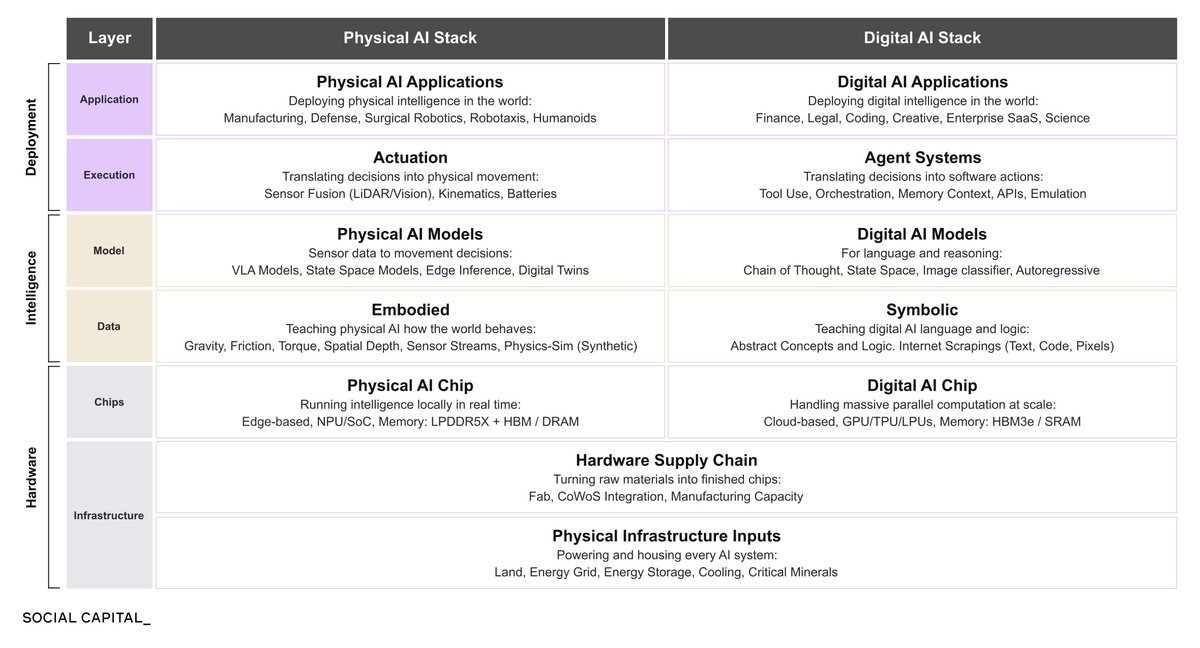
A framework to understand how value accrues across the AI stack.
This is a blueprint for understanding what builds AI into its pragmatic parts: what each layer is, where it ends, and where value is accrued. So here’s how you can think about it:
1. Layer 1 - Infrastructure
Before any AI model trains or any robot moves, an industrial foundation must exist. Land, energy grids, cooling systems, critical minerals, and fabrication facilities. Infrastructure is the constraint that all the other layers depend on.
2. Layer 2 - Chips
Transistors that are etched onto silicon wafers using extreme ultraviolet light. This is what allows both physical and digital AI to take an input, process it, and return a predictive output. The more transistors that fit on a chip, the more computation it can perform.
3. Layer 3 - Data
Both digital and physical models train on data. Digital models train on text, code, and images; physical models train on gravity, friction, depth, and sensor streams. The more accurate the data, the more accurate the output.
4. Layer 4 - Models
A model is a system that learns from examples. Feed it enough examples of inputs paired with correct outputs, and it adjusts its internal structure until it can predict correct outputs on inputs it has never seen before.
LLMs represent a specific class trained on text. They learn by processing billions of examples of human language, developing the ability to write, reason, summarize, and generate code.
5. Layer 5 - Execution
This is what lets models take actions on behalf of users. The execution layer lets models pursue objectives through sequential action: observing the environment, reasoning about the next step, acting, and looping until the goal is reached.
6. Layer 6 - Application
All of the AI Stack’s revenue originates at the application layer, then goes to the layers below.
Every dollar paid for AI is paid for an outcome, a task completed, and an answer delivered. Nobody wants H100s for their own sake. They want H100s because someone, somewhere, wants to run an application.
These are the different layers that make up the entire ecosystem of AI.
We did a full study on the AI stack. If you want to read about it, head over to my Substack (https://t.co/uaxeJk63aO)





![AndrewYNg's tweet photo. One of the new, buzzy jobs in Silicon Valley is the AI Forward Deployed Engineer (FDE), an engineer who is embedded within a client organization to help customize solutions, such as building and tuning agentic workflows that suit the client’s particular needs. I’ve heard from people who are wondering anew about the FDE career path since OpenAI and Anthropic started building new teams to place FDEs within client organizations.
The rise of FDEs for AI workloads is one way AI is creating new jobs (and why the jobpolcalypse narrative of upcoming job market collapse is false -- there will be many AI and non-AI jobs). However, I believe there will be far more AI Engineer jobs than FDEs, as I explain below.
The FDE role was pioneered about two decades ago by Palantir, which sent engineers to government locations to work on secure, air-gapped networks. In addition to having good technical skills, FDEs need communication skills and sometimes business skills. For example, they may need to speak with clients to understand their needs, formulate a strategy to prioritize projects, explain complex technology, and respectfully push back if a client asks for something unrealistic. They’re enjoying a resurgence because of the amount of work involved in taking an off-the-shelf LLM and building it into a custom agentic workflow that fits particular business needs.
However, I believe the number of AI Engineer jobs will be far larger. A company might accept a few FDEs to be embedded within its organization. But most companies will want far more of their own employees working on their projects. While my organizations do hire FDEs, we hire far more AI Engineers! Also, a common client concern is that it is hard to find vendor-neutral FDEs — they are, after all, there to deeply integrate a particular vendor’s product into a company. In this moment when it’s hard to predict which AI service will be the best one in a year’s time, optionality (the ability to pick whatever vendor turns out to fit best in the future) is very valuable. In contrast, letting FDEs tightly bind a company’s processes significantly reduces optionality.
Right now, I see surging demand for AI Engineers who can build software applications using AI software components (like LLM prompting, agentic frameworks, evals, etc.) and effectively use AI coding agents (like Claude Code, Codex, Antigravity CLI, and OpenCode). As the AI Engineer role matures, I expect it to fragment into more specialized roles, like the generic Software Engineer role from decades ago fragmented into frontend, backend, mobile, data engineering, devops, and so on.
What will be the future, specialized AI engineering roles? I don’t know. Perhaps there will be AI FDEs, LLMOps Engineers, Evals Engineers, AI Data Engineers, Harness Engineers, and other roles we don’t have names for yet. But for now, I see a lot of AI engineers who are generalists create a lot of value. Skilled AI Engineers are in very high demand! As our field continues to mature over the coming decade, I look forward to new specializations within AI Engineering that create even more job opportunities.
[Original text: The Batch newsletter]](https://pbs.twimg.com/media/HJvWmCHagAAnTxQ.jpg)