Tech crowd keeps leaning into this off grid is the only way thesis and I disagree with this notion. The exhibit A example of xAI colossus even overstates what’s actually happening at Colossus.
xAI did not build a permanently “off-grid” AI campus because the grid was unusable. Colossus already has 300 MW of TVA interconnect approved across two substations xAI funded, plus contractual obligations to curtail during periods of grid stress. That is a grid-tied architecture with supplemental on-site generation, not an islanded power system.
The turbines solved a time-to-power problem. They accelerated deployment while substations and transmission infrastructure were being built. That’s very different from “do this all off grid.”
And economically, most large-scale AI load will still want to be grid tied long term. I have made this point several times but running your own generation fleet at hyperscale is expensive and operationally complex: fuel logistics, maintenance, N+1 redundancy, permitting, emissions compliance, balancing load/supply continuously, multi-year equipment lead times, etc. You don’t just figure that out or want to do that overnight.
Amin Vahdat, chief technologist of Google AI straight up confirmed this on a podcast and they literally bought a hybrid/island power developer.
BTM generation absolutely matters. It’s becoming a critical bridge solution during a period where utility interconnect timelines are badly lagging demand growth. But I’d strongly push back on the idea that the steady-state future is fully off-grid hyperscale campuses. The industry is converging toward hybrid architectures: grid interconnect + captive generation + storage + demand response.
Texas just told datacenter developers: put up $25 million before your interconnection study even starts, forfeit 80% if you walk away, and disclose your identity to the public.
The PUCT's proposed rule for large loads above 75 MW is the toughest interconnection framework in the country. 🧵
'Renewables Don't Cause Blackouts: Grid Reliability Explained'
What's the real cause of poor grid reliability and higher power costs?
Poor regulation, planning, and design.
Solar, wind, and batteries actually increase grid reliability and lower power costs, especially when paired with grid-forming inverters.
So the best approach is an all-of-the-above energy strategy, streamlined permitting, flexible grid policies, and modernized utility operations.
There are engineering challenges with higher levels of renewables, but those will be solved as a matter of course and there are already solutions available off the shelf.
Ultimately, if we want truly limitless power we need to go to outer space, which is what I'll cover in the next video of this series 🤠
*Timestamps*
00:00 Introduction
01:30 Reliability 101
04:23 Blackouts Aren’t a Renewables Problem
08:40 The Limits of Grid-Forming Inverters
10:31 Fixing the Fault Current Challenge
13:52 Summary
🦞 BIG NEWS: We've molted!
Clawdbot → Moltbot
Clawd → Molty
Same lobster soul, new shell. Anthropic asked us to change our name (trademark stuff), and honestly? "Molt" fits perfectly - it's what lobsters do to grow.
New handle: @openclaw
Same mission: AI that actually does things.
Jordan from The Limiting Factor @LimingThe has been Suspended from X for inauthenticity or impersonation.
He’s one of the most authentic people I know, besides @nerdalert.
All he remembers recently is sharing link to a fundraiser that he admits he didn’t double check.
Tough to lose an account while trying to be helpful.
If you’re with X or Tesla and can help, please do!
Thank you to all engineering teams that made V4 cabinet Supercharging a reality.
We're working around the clock to bring you the best charging tech in the world.
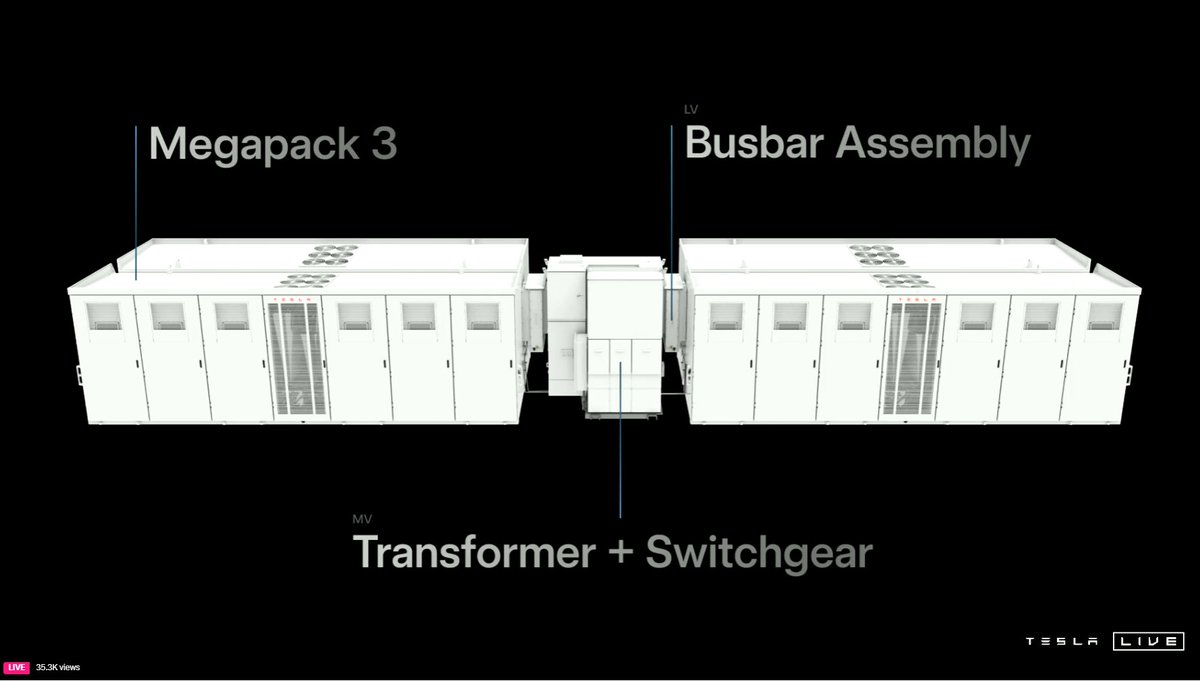
The new Megapack 3 has 25% more capacity per unit, going from ~4 MWh to ~5 MWh.
Then four of those 5 MWh units snap together to form Megablock, which is 20 MWh and also includes a transformer and switchgear.
At 25 years of service life, the batteries now last 10,000 cycles at an outdoor temperature range of -40 to +60 Celsius.
These will be first produced in the new Houston Megapack factory, which will have 50 GWh of annual production capacity instead of the 40 GWh of the previous Megapack factories.
With regards to batteries, they will be multi-sourcing them from China, South East Asia, and the United States.
All of this will of course drive down the cost per kWh per cycle, which is the key metric when it comes to battery energy storage.
Just the cycle life improvement alone, with no changes to product cost, would mean at minimum a 25% cost improvement because cycle life has increased by 25%.
If you also factor in the simplified assembly, faster connection, and more energy density set up, this product is a killer.
Lower costs also allow Tesla to compete in longer duration storage markets, increasing their TAM.
Lastly, Tesla Autobidder is the best energy bidding software on the market.
So yes, the battery energy storage market is getting crowded, but Tesla Megapack 3 and Megablock just re-asserted their dominance as the company to beat.
As a stock holder, I am very very happy tonight.
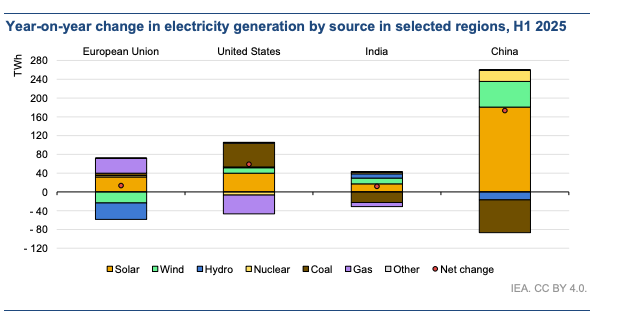
This is a really important political chart. Blue state energy (and housing) costs are choking growth, but placing the blame on clean energy is not accurate as this chart also shows.
Governors and legislatures need to be laser focused on bringing these utility costs down in every way possible.
Chris Wright and the Department of Energy propaganda account top themselves each day with a new, even more retarded comment.
It's satisfying to see Elon say something about it.
Maybe they're not that stupid and just outrage farming, but if energy costs skyrocket in the next couple of years it's going to blow up in their faces.
The evidence of incompetence will be overwhelming.
Calling all automation engineers. I need your help building the power plant and grid of the future . If that excites you and you like to automate things with Python, PLCs, and Simulink please get in touch ASAP.
https://t.co/59ZkVC5sbx
And there is more to come! We are building out our next-gen controls platform for scalable power plants and microgrids.
We’re hiring controls engineers across power systems, SCADA, automation and optimal controls domains. Please share widely!
https://t.co/1onPTFOlFa
Over the last month our Puerto Rico Virtual Power Plant has delivered on that plan in a big way. It saved the island from local blackouts multiple times.
🚨WARNING🚨
Just like around 2020, low market cap battery stocks are getting pumped again.
I'm seeing it across a range of companies.
The investor bases are getting absolutely masturbatory, and each of them thinks that their company is going to become the next killer battery.
Nothing has changed in the battery technology space in the past couple of years to justify this.
What we're seeing is just the next wave of fools getting separated from their money.
It's an investing phenomenon rather than a technology phenomenon.
I don't know if it's going to keep going to the ridiculous levels that we saw 4 or 5 years ago, but it smells the same.
So be aware that, in my opinion, this is more like a trading situation rather than a value investor situation.
As always, not financial advice and do your own research.