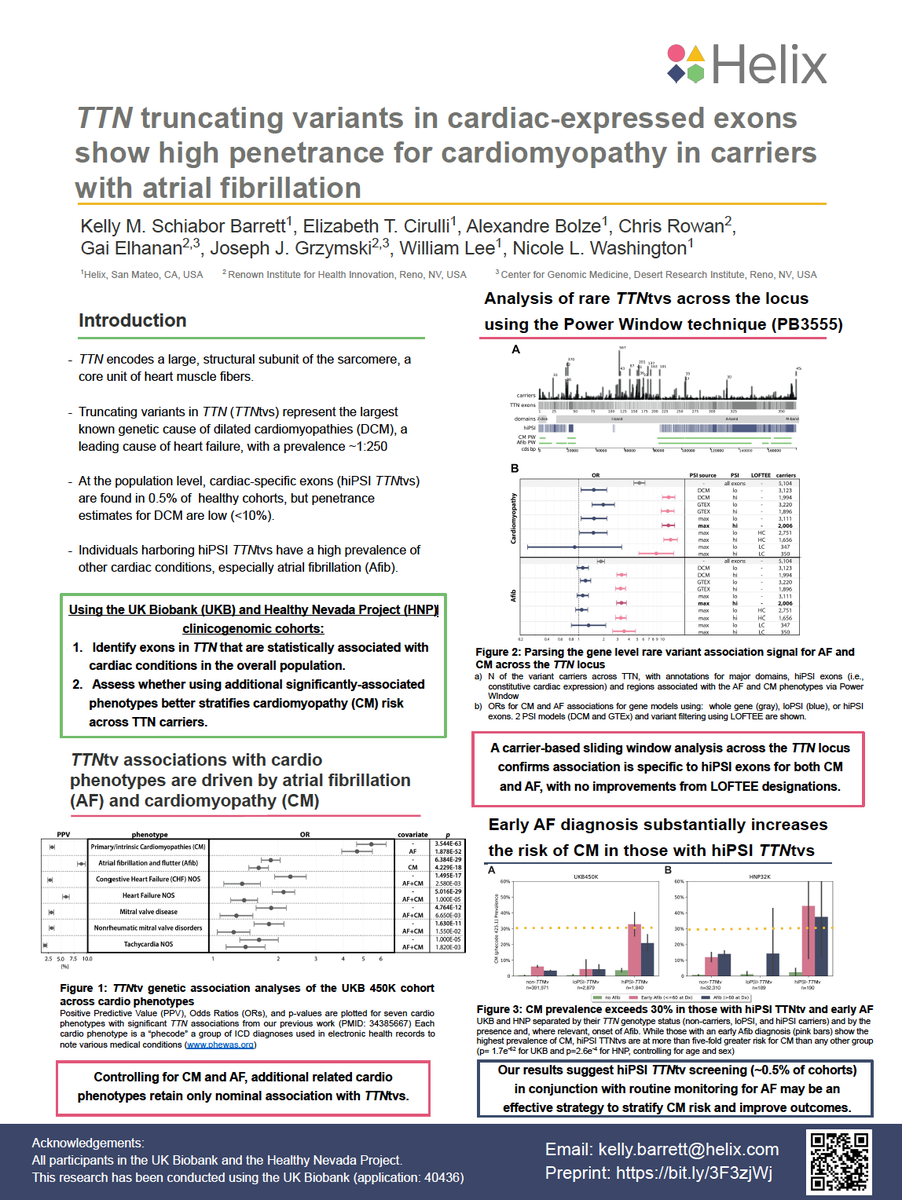
Is there a connection between #Afib and #Cardiomyopathy in individuals carrying certain genetic variants? Read more about the gene TTN and heart failure in our most recent @my_helix study, published in @GIMJournal https://t.co/MiTVdLO1hh
I was excited to see genetics and common disease prevention highlighted in the @nytimes, but an important class of human variation was not discussed, so we decided to write a bit about it 👇🏼
#OnTheBlog: While a recent @nytimes article highlighted the use of Polygenic Risk Scores for heart disease prevention, @cassiehajek, Helix's Medical Director, shares how testing for rare variants before or alongside PRS leads to enhanced preventive care: https://t.co/26bN3jPEZo
Those with DNA mutations inactivating APOB or PCSK9 genes have ⬇️ LDL-C and protection from🫀
disease.
We identify 801 carriers and observe
stable LDL-C reductions of ~47 mg/dL, corresponding to a 49% ⬇️🫀disease risk.
Details in @JamaCardio! https://t.co/VN9UxePdnS
1/10🧵
Proud to announce we are partnering with @WellSpan on a #populationgenomics initiative aimed at empowering physicians to deliver #precisionhealth care for Pennsylvanians through one of the largest #populationhealth programs in the state. Learn more here: https://t.co/zQYtb8rIWQ
@BiotechInvestNG@my_helix For this analysis, we look specifically at TTN truncating variants in exons constitutively expressed in cardiac tissue (hiPSI TTNtvs), which are found in about 0.5% of individuals in an unselected population cohort
A big one.
I've been saying for a decade: "This is biology's century." And we're still not ready.
My editors asked me to explain what that means. It was harder than I expected. I hope you like reading it.
https://t.co/nMyL8crshw
Our final #ASHG22 poster by @kellyschiabor and @renownhealth shows how a specific variant type of TTN can serve as a disease marker for elevated risk of cardiomyopathy, which could be evaluated in patients with atrial fib or other heart conditions. https://t.co/9ae7DfVcFv
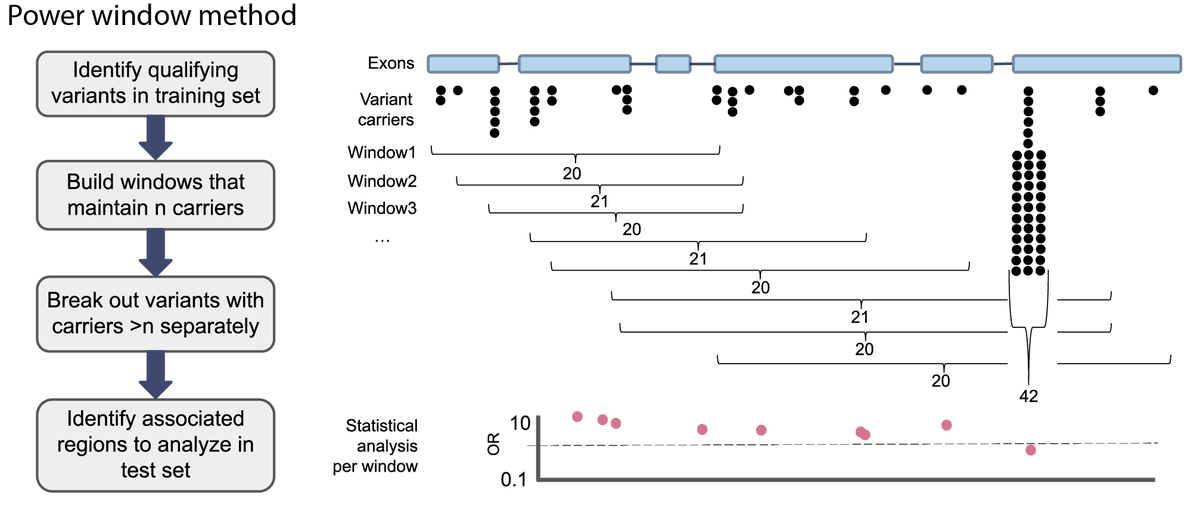
Introducing our new genetics 🧬 method, “Power Window”, lead by the stats genius @ETCirulli , for both discovering and refining *within* gene rare variant associations in populations. The key insight comes from defining association windows by statistical power- read more below 👇🏼
Thrilled to present @my_helix paper ID'ing the rare variants/regions w/in genes responsible for the statistical associations seen in gene-based collapsing analyses. Key innovation is to slide window not by # bases or variants, but by statistical power. 1/ https://t.co/bh5TJMVrLW
@wayneriekhof Yep! @mbeisen and I did a whole series of experiments with various BY knockouts and others-definitely created some interesting stuff, but found it to be more dependent on the media (esp. nitrogen) supplementations. Watch out for sulfur off flavors 🍻
Certain genetic variants in the gene TTN (present in ~1/200 ppl) often underlie progressive heart failure, but genetic testing for this gene has been limited as the risk has been hard to quantify. We discover a path forward for assessing risk in our recent preprint, described👇🏼
1/
If you have a truncating variant in TTN & you were diagnosed with atrial fibrillation (Afib),
you are at high risk of cardiomyopathy
Clear & rigorous study based on @uk_biobank & @HealthyNV
https://t.co/als9mS0H0r
👏 @kellyschiabor@ETCirulli@grzymski
🧵
Looking forward to moderating this journal club next week from @alexbolze@ETCirulli and team!
Combining my two current obsessions - work and Covid vaccines - sorry to all geneticists for bombing your timelines with vax for u5s chatter lately 😂
Curious about Delta-Omicron recombinants?
Our study 👏 @shishiluo@my_helix: https://t.co/psFMnqndvI
Co-circultation of both variants
20 samples with co-infections
Evidence of a few recombinations in co-infections
& 2 infections with 100% recombinant
Details in 🧵
I hope to continue to leverage clinico-genomic population datasets to help validate more functional variant screens of well-established gene-disease associations– please send along your favorite examples!
🧵on our #OA article at @HGGAdvances “Clinical Validation of genomic functional screen data: analysis of observed #BRCA1 variants in an unselected population cohort” in collab with the incredible @MyCode and co-authors @AdamBuchanan76, @hwillardX, @masnick https://t.co/VedPyX7BYg
Overall, our analysis supports the amazing work of @TheGenomeLab and @lea_starita with clinical evidence in one of the most likely use cases: population genomics risk screening and demonstrates the power of functional genomics for advancing variant interpretation.