@kunchenguid Once AI is able to excel in domains that are not easily verifiable then we have reached true SI. It’s not clear to me how the current approach will extend beyond coding, math, physics, and perhaps biotech.
Apple's computer-use AI agent is coming, but I don't expect anything to launch until at least the end of next year. By then, rival agents could be as hard to leave as switching from iPhone to Android. https://t.co/GRfsyY1Z2N
I’ve not seen anything quite like this result - a model that is pure “intelligence” and very little “world knowledge”. Feels like it opens up many possibilities for domain specific applications.
the OpenRouter situation for anyone curious:
-someone managed to access outputs sent to MiniMax
-researcher discovered this by sending a secret links
-40 to 130 hours later someone opened the secret links
-oop, this means that someone accessed your outputs!!
-AltasCloud/Novita/StreamLake were forwarding requests to MiniMax???? what the helly?
ugh.
I see five fundamental issues when it comes to street conditions in San Francisco. These negative street conditions are largely driven by a relatively small group of regular public drug users (1,000–4,000 people out of 17,000–30,000 fentanyl users in the city).
These public drug users should be strictly distinguished from the homeless, the vast majority of whom are neither visible on the street nor active drug users.
First, drug treatment has extremely low success rates and, even with tons of investment, is not significantly decreasing the amount of drugs being consumed in the city. Treating drug addiction is hard. Treating drug addiction in a place with cheap and readily available drugs is harder.
Second, there is a public policy disagreement about the role of the police in the fight against public drug use. As a result, we have almost no tools to disincentivize public drug use. We have effectively decriminalized drug use in California by making it a misdemeanor. The vast majority of the time, the only thing police can do is tell users to move along or give them a ticket. The RESET Center allows police to arrest users and remove them from the street, but it’s only available in a tiny part of the city. Outreach workers have no power to compel public drug users to stop using.
Third, we have widely available drugs that are cheaper than in almost any other city in America. The cheap drugs draw users from cities and towns across the region and the country. Drug users don’t come to San Francisco for our services. They come here for our cheap drugs.
Fourth, there are no good tools for reducing supply or increasing cost in our city. Fentanyl is manufactured at scale from industrial chemicals that are cheap and easily available. It’s so potent that San Francisco is estimated to consume only 200–400 pounds of pure fentanyl a year. That is too easy to smuggle in. The labor supply of dealers is effectively infinite: they make $3–4 a day where they come from and $400–700 a day here. Arresting dealers doesn’t reduce the availability of drugs or increase the price. We’ve had more than 3,000 dealer arrests in the past three years. It’s changed how dealers deal, but drug consumption is actually up, not down.
Fifth, we have a Housing First policy that provides temporary and permanent housing to thousands of active drug users in very concentrated parts of the city. As a result, we create the high-drug-use areas that dealers target. Residents of those neighborhoods are held hostage by the drug trade and rampant public drug use. Your tax dollars create high drug use neighborhoods.
San Francisco city government understands all of these facts. All of this information is public and findable. Nothing will be done unless you understand these facts and demand real solutions.
Every time you ask for ineffective solutions based on a lack of knowledge, you give your elected officials license to spend your money on programs/policies that will never work.
@lucasmeijer Use (insert your favorite bot here) with @AsideAI running on your home computer, and you can do all of what you stated. It's truly a game changer.
BREAKING: Apple, $AAPL, is developing its own autonomous AI agent as it aims to rival Anthropic, OpenAI, and Meta, per Bloomberg.
The system will write code, browse the web, control apps, and navigate devices on a user’s behalf.
Shares of Meta, $META, and Anthropic, $ANT, are falling on the news.
@kunchenguid Yes definitely a key advantage. I've also been building a few team bots which make it super easy for team members to get started on certain tasks.
I’m being pitched a new inference neocloud company on average every two days. No exaggeration. I take every entrepreneur seriously and I look deeply into each.
But it’s hard to fathom this being sustainable. At the same time, AI Gateway token demand on Vercel has been ~40% MoM compounded since the beginning of the year. No signs of stopping.
One way to reconcile this is that compute is the new economy, and tokens the new energy unit. There’s a new Industrial Revolution taking place. Every aspect of our lives is being replatformed on top of this new system that enhances everything. More like an “oil rush” than a “gold rush”: it’s durable, not a fad.
In the short term, I anticipate more expansion, followed by consolidation due to economies of scale, cybersecurity and enterprise requirements (ZDR and cyber being a hot topic for inference providers), capital requirements, and an evolving regulatory landscape.
Today, Slack becomes the central automation hub for the agentic era.
Workflows, Slackbot, and your AI agents, working as one. No code. All in Slack. Here's what's new 🧵
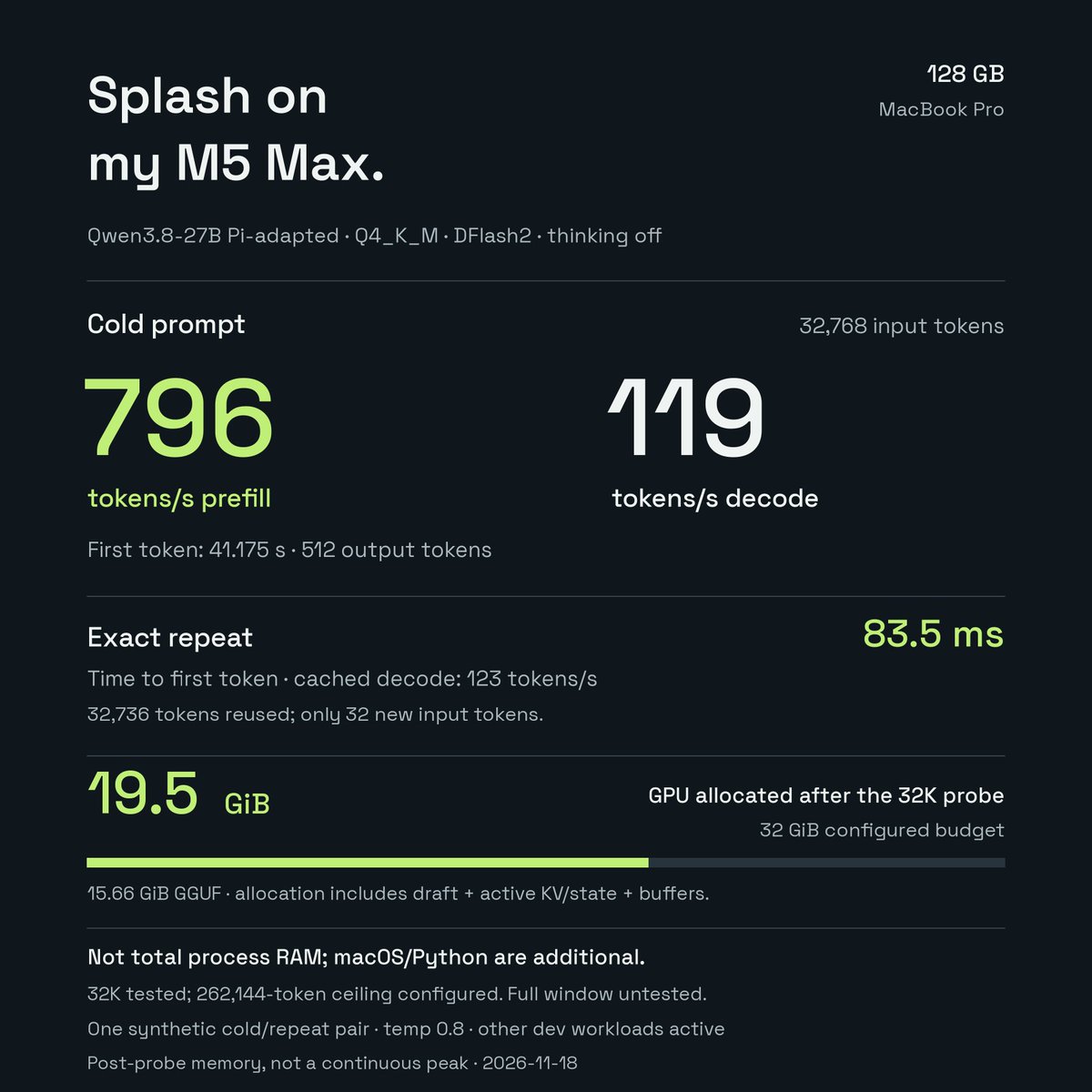
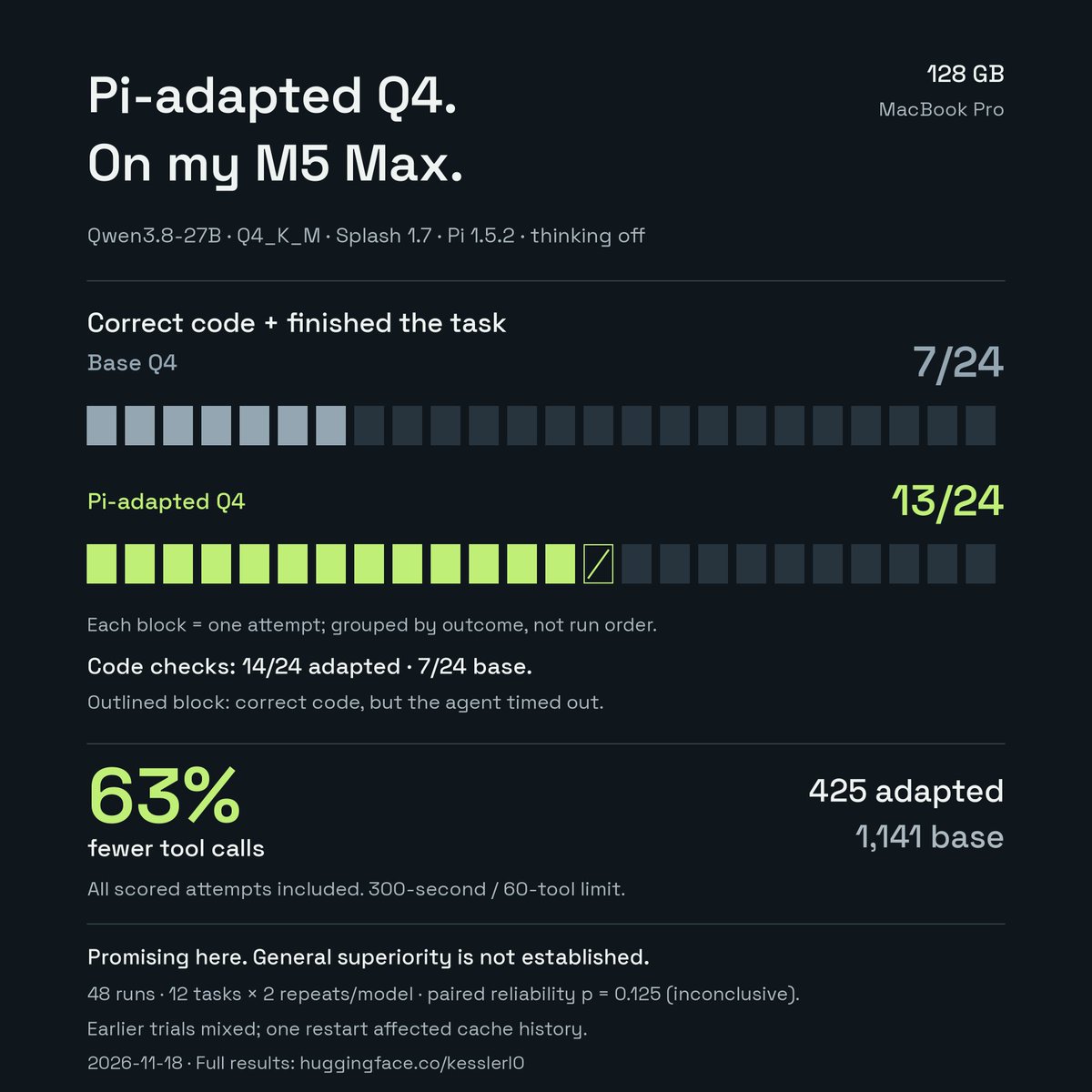
@pratikg I've merged this into a Q4 quant and running it on my m5 max MBP with nearly 120 tok/s and nearly 2/3 fewer tool calls. This thing flies! https://t.co/SMjdOXUww9
Tested Qwen3.8-27B Pi-adapted with Splash on my M5 Max 128 GB MacBook Pro. Merged it into a Q4_K_M quant and been getting some promising results so far.
With a 32K prompt, I got ~796 tok/s prefill and ~119 tok/s decode at just about ~20GB memory use.
I also ran 48 local coding attempts: adapted Q4 completed 13/24 correctly versus 7/24 for base, with 63% fewer tool calls across all attempts.
Certainly there's gonna be a mix of off the shelf software and then also software that will give its users the ability to generate highly custom UI and features on demand, and then some other software will be better off reduced to an API.
Everyone will Vibecode & build their own software.
I keep seeing the opinion that strong artistic opinions and taste matters, that you need some expert artisan to define good & build it, but that doesn’t make sense???
You’re gonna Vibecode your own personal software by pressing the thumbs up/down buttons 1000 times. (Or some mix of explicit & implicit signals, the ideal combo which has yet to be figured out.)
The same way you create a personalized social media algorithm by liking, following and video dwell time.
Software is not immune from algorithmic personalization pressure that has changed every other form of media in the last 20 years. It’s likely the artform most subject to change by far.
You don’t need to know what you want. You don’t need an opinion, the machine will tease & pull it out of you.
TikTok and X don’t ask you what you want to see. They just show you stuff and figure it out automatically for you. The Search bar (aka prompting input) is literally buried in a sub menu behind pages of prefilled content served fresh.
Tested Qwen3.8-27B Pi-adapted with Splash on my M5 Max 128 GB MacBook Pro. Merged it into a Q4_K_M quant and been getting some promising results so far.
With a 32K prompt, I got ~796 tok/s prefill and ~119 tok/s decode at just about ~20GB memory use.
I also ran 48 local coding attempts: adapted Q4 completed 13/24 correctly versus 7/24 for base, with 63% fewer tool calls across all attempts.
Introducing Qwen3.8-27B-pi-adapted 🤗
We adapted Qwen's model specifically for the pi coding agent using reinforcement learning and a LoRA adapter.
The results, measured as pass@1:
🚀 SWE-bench Pro (Hard 51): 29.4% → 62.7%
💻 Terminal-Bench 2.1: 39.5% → 55.8%
⚡ 55–62% fewer tool calls per task
This is the power of open models: you can adapt them to YOUR tools and YOUR use cases. Let’s build! 💛
Open weights: https://t.co/aH4cl2qnED
Methodology: https://t.co/avSfF93K4V