In light of another WSJ search fund article dropping, here's a hot take. I don't think a 5x EBITDA deal with 25% equity is worth it for the searcher.
It doesn't sound like much, but the difference between 10% and 25% equity almost cuts your economics IN HALF, while your bankruptcy risk barely goes down (more on that below).
In my opinion, self-funded search has always been one thing: you take a ton of risk (lever up with PG) and if you survive, you are set for life on a single deal in about 5 years.
That's what the math works out at 4x EBITDA and 80-90% ownership. It doesn't work out at 5x EBITDA and <50% ownership. The latter is a bad economic trade for the searcher.
You'll hear every investor tell you to overequitize. Yes, that does derisk the deal, but the real winners are the investors here. What good does a deal do you that still has a ton of risk but you don't have homerun upside on the other side. The potential to make $1-2mm over 5-7 years with a ton of risk is not a good trade for the average searcher. Most of you can just keep a $200-400k job with no bankruptcy risk.
For the deals I have seen gone bad, having 75% debt instead of 90% would not have saved them. In small businesses when things go bad, it's often binary. So all that extra equity you raised barely reduces risk and but gives a ton of the upside to investors.
6 months of fixed cost is plenty of cash in the bank. If it takes more than that, the business likely wasn't going to make it anyway. And yes, someone will bring up a scenario where a business was saved by having 7 months. Doesn't matter, when you are going down this path you are playing the average odds. If bankruptcy is an impossible risk for you, then don't get SBA debt. You're better off getting paid carry at that point.
TLDR I don't think signing the PG is worth it if you don't have the chance to be done if your deal works out.
“Venture capital has created the biggest businesses in the world and private equity has not�� - @jeremygiffon
This comes down to the cost of being wrong.
In VC, the fatal mistake is passing on the winner. In PE, the fatal mistake is buying the loser.
That’s why VC takes many shots. One outlier pays for the portfolio. PE takes few, deliberate shots because there is no outlier coming to bail out a bad deal.
My second conversation with @jeremygiffon. His first episode became one of the most popular we've ever done.
Since then he's become a friend I talk to every day, so this is a taste of one of those conversations.
We discuss:
- The billion dollar PDF
- Why billionaires have become subservient to the "poaster" class
- The philosophers who secretly shaped Silicon Valley
- Lessons from the last 18 months in private markets
- East v. West coast finance
- Buffett + beating the market
- and much more
Enjoy!
0:00 Intro
5:50 The Billion Dollar PDF
11:31 Algorithms and Power Laws
20:28 Peak Guy
31:19 Opting Out of the Timeline
36:14 AI and White-Collar Jobs
43:31 The Next Era of Finance
53:56 The New Economics of Software
1:03:22 Underwriting Emerging Managers
1:18:17 Silicon Valley’s Hidden Philosophy
What a lot of people fail to realize about ETA or being an independent sponsor is that you are the most disadvantaged buyer.
Many people come from PE firms or strategics and assume it will be just as easy to close a deal on their own. However, you no longer have a capital base, credibility with the counterparty, and most notably, the ability to pay up.
You have the highest cost of capital. Oftentimes your LPs have LPs, so your LPs need a much higher return to be able to collect fees and achieve their DPI target. You also have no synergies and in fact have the opposite, as you will likely be adding G&A and fees to the business day one. All of this moves your bid lower and makes an auction process for a quality company incredibly difficult to win.
Great read on the IS market. Data may not be 100% accurate, but I do believe the flexibility and often more focused approach of the independent sponsor model can allow for superior risk-adjusted returns in the LMM.
Below are a few great highlights:
“Our performance analysis shows that independent sponsor investments have generated strong absolute returns and, more importantly, competitive-to superior relative performance compared to matched non-IS buyout transactions”
“suggesting that higher returns are driven by greater upside rather than lower risk. These results are consistent with the hypothesis that independent sponsors are able to exploit informational frictions, sourcing advantages, and bespoke structuring opportunities that persist in smaller and more complex private companies.”
“Independent sponsors appear to represent a differentiated channel for accessing less intermediated deal flow while delivering attractive risk-adjusted returns comparable to, and often exceeding, those of traditional buyout strategies.”
Thought this was pretty interesting. I am a bit skeptical about the data set. IS investors all tell me that the loss rate is higher because when a deal goes bad the sponsor has limited incentive to fight. I am also skeptical about the small loss rates just given the size of the deals and the multiples they are paying....
https://t.co/f8z89PikqW
@LoganARobison The timing does not matter for you. What you need is a meal plan you don’t deviate from and to train to failure. Could probably do with less cardio unless you enjoy it.
What a lot of people fail to realize about ETA or being an independent sponsor is that you are the most disadvantaged buyer.
Many people come from PE firms or strategics and assume it will be just as easy to close a deal on their own. However, you no longer have a capital base, credibility with the counterparty, and most notably, the ability to pay up.
You have the highest cost of capital. Oftentimes your LPs have LPs, so your LPs need a much higher return to be able to collect fees and achieve their DPI target. You also have no synergies and in fact have the opposite, as you will likely be adding G&A and fees to the business day one. All of this moves your bid lower and makes an auction process for a quality company incredibly difficult to win.
@tom_sietsema Buying smaller with less revenue and employees is also generally riskier. These deals are more expensive and of lower quality making the risk adjusted return less attractive.
PE is this generation’s doctor/lawyer track. It’s prestigious, structured, hierarchical, and well paid.
But it is not a moonshot. If you’re entering PE today expecting to be flying private with a penthouse and a $10mm second home at 35… that’s a pipe dream.
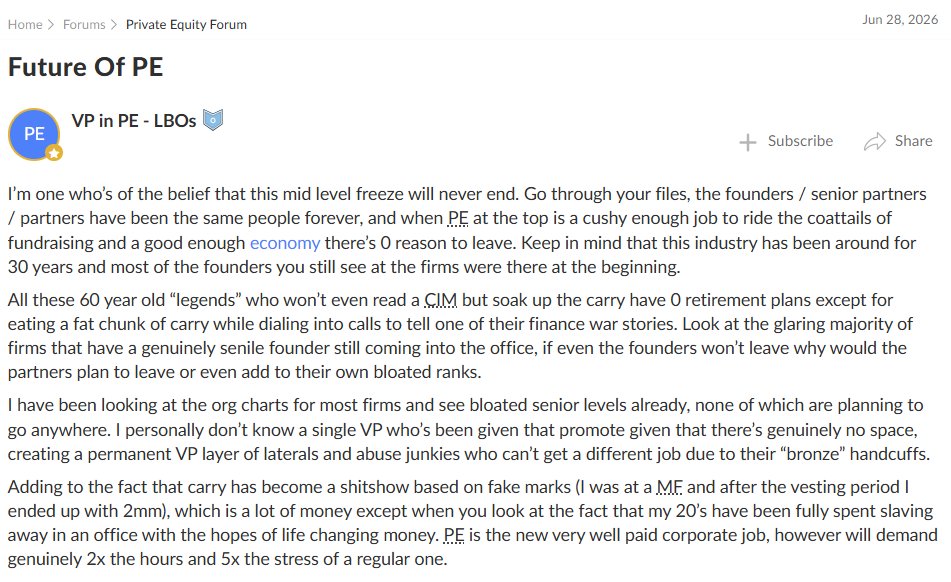
Incredible timely post on how Private Equity is really crowded at the top and how seniors will never leave
Made only $2mm of carry after many years in MF PE
"PE is the new very well paid corporate job, however will demand genuinely 2x the hours and 5x the stress of a regular one"
Me and Brad Gerstner asked Dan Loeb if he would donate $1 million to the kids of America🤣
Parents go claim your Trump accounts at https://t.co/pfZeGGryE4 for your child to receive shares in amazing companies!! @altcap@DanielSLoeb1
David Sacks just delivered an economics masterclass on Elon becoming the world’s first trillionaire.
@davidsacks: “People see the headline and imagine Elon suddenly has a trillion dollars in the bank. That’s not how it works. His balance sheet didn’t change overnight.”
Why?
The real point is deeper. Wealth isn’t in the “stuff” we consume. Food, shelter, clothes. Things that depreciate and disappear. It’s in the machines that create stuff for decades: tools, workflows, and corporations.
These are the true engines of human progress.
“If you create a machine that makes more stuff, then there’s a discounted present value for all the stuff in the future that machine might create. That’s where the wealth comes from.”
Elon started with nothing. An immigrant who slept on the floor building Zip2. He created these machines from vision and relentless effort. Thousands joined him, including a SpaceX welder who turned his labor into a million dollars in stock.
That’s the magic of tech and free markets: labor can become capital. It’s fluid.
The outrage misses this entirely. The people building machines that deliver medicines, energy, and abundance are creating lasting prosperity for everyone.
What do you think? Does viewing wealth as future productivity change how you see stories like this?
Well said @chamath
All the excess, especially the kind you see on Instagram, doesn’t signal high status or elegance. In fact, it does just the opposite…