Don't waste 2 years learning to become an AI agentic engineer in 2026.
Andrew Ng, the godfather of AI, gave the complete playbook to become one from scratch.
1 hour course. Free:
• 00:00 - AI agent basics
• 12:12 - AI Agentic workflows & design patterns
• 53:27 - Practical tips for building AI agents
• 1:20:30 - self-improving AI agent loops
• 1:30:19 - multi-agent AI systems
I watched it last night.
Halfway through, I realized I could get into Anthropic in weeks, not years.
Bookmark now. Watch it. Then build your own AI agent
يا اخوان نصيحة لوجه الله وبكيفك
اذا تبي شي مرتب او انك ضايع وخاصة المشاريع الكبيرة انصحك بمهارة انا اسميه فيلسوف المهارات
@mattpocockuk
مهاراته هي اعلى مهارات في التقييم على Github وكلها في ال Top10 ، خذ وحدة بس اسمها grilling/ وبداية اي مشروع حطها واعطه بس طرف الفكرة ، راح يسألك زي الانترفيو اسئلة وانت تختار الاجابات وبناءً عليها يطلع بأسئلة غيرها وهكذا لين توصلون لوش تبي بالضبط وبعدها يستأذنك ببدء التنفيذ .
https://t.co/VRTtCHzPlt
If you've ever wondered how Large Language Models like ChatGPT work, this course is for you.
It covers the data preparation, model training, and fine-tuning that has to happen before an LLM is ready to go.
You'll learn about the whole training process from tokenizing raw text to fine-tuning a functional chatbot.
https://t.co/7a5u9fw2g6
Verification is one of the most important things for getting great results out of your agent.
Clearly define "done" before code review starts.
A reviewer, human or agent, asked to find bugs without this may still find something that could be improved.
Give Claude checks it can run (bash commands, tests, clicking through the app in a browser) and have it pass that too before it says it's finished.
When nothing blocks merge and ship.
Dusting off this tweet from April because this gap in shared understanding of LLM capability is *widening*. It's now less "two groups of people speaking past each other" and more a sharp funnel.
- Napkin math somewhere around 6B people (~75% of the population) have barely come in contact with LLMs at all.
- Around 1-2B (~20%) are casual and infrequent users of free-tier ChatGPT-like products. This group sees derpy chatbots and treats them a bit like a better Google search, a writing aid, or etc. Maybe an agent tries to book you a flight. I have non-tech friends who (reasonably, imo) say they have not much use for it at all. Even many professionals outside of math&code are in this tier. For example, execs and many other functions spend a lot of their time talking to other people, so while they understand what is happening intellectually, it is still second-hand and a bit abstract.
- Now we get to professional use of frontier-grade LLMs in math&code. Somewhere around 20M people (0.2%) see first-hand that large, complex projects that used to take them weeks/months can now be completed by agents with a prompt. Building apps, copying apps, translating apps, decompiling apps from binaries... This has all happened very quickly and recently - less than 1 year ago, I was writing code manually by hand, typing memorized computer code commands into a code editor character by character, occasionally pressing Tab to autocomplete a little chunk of code.
- And finally we get to the ~5,000 people (~0.00006%) with access to frontier-grade systems internally. The external world has seen the preview. It looks like swarms of thousands of agents collaborating over weeks on software mega projects: minting zero days, running cyber attacks and defenses at machine speeds, discovering new science, advancing the frontier of mathematics. Things that would have taken top professionals in the industry years of work. Meanwhile, human review and comprehension are starting to fall behind. For example, people are still involved in the "archeology" of the OpenAI-HF incident from many months ago. Mathematicians may be poring over the 722 manuscripts on frontier mathematics for a while.
The funnel is driven by a combination of factors:
1. The impact scales with ambition, problem size, and horizon. A question with a paragraph answer barely stresses the system. You need a reservoir of big, difficult problems that you really care about. This aspect drives the consumer / professional dimension of the funnel.
2. The jaggedness of the system (which I have written about a lot separately). Capability peaks in domains that are digital, verifiable and economically valuable. This is because LLM capability emerges from reinforcement learning on verifiable rewards on a curated environment mixture driven by revenue potential. This aspect primarily drives the area (e.g. math&code) dimension of the funnel.
3. Access. Free-tier, paid-tier, internal.
So this is the weirdness of the moment. The general public has mostly not interacted with these systems. When they have, it looks like a derpy chatbot. The majority of professionals still see only a modest uplift. And a small sliver of professionals are experiencing the vertigo of the curve going vertical. And it is all happening at the same time.
Andrej Karpathy spent 8 years at OpenAI and Tesla
Last week, he condensed everything he knows into one free 2-hour lecture
Agents → Loops → Harness → Self-Improving Systems
People pay $14K for bootcamps that teach less than this
This lecture beats most paid AI engineering courses
You probably don't have 2 hours right now
Don't let this disappear from your feed
Watch it
Then read the article below
تطبيق جديد ومهم الهند تحاول رفعه من أبل ستور الهند. تطبيق رسائل لا يعمل عن طريق الإنترنت، بل عن طريق أجهزة المستخدمين ذاتها عبر شبكة البلوتوث.
إذا أردت ان ترسل رسالة إلى أحد ليس حولك رسالتك تقفز عبر أجهزة الناس التي حولك إلى الأبعد ثم الأبعد إلى ان تصل للمستخدم الذي تقصده الرسالة، بدون اي إنترنت، بلوتوث فقط.
تطبيق عبقري الصراحة.
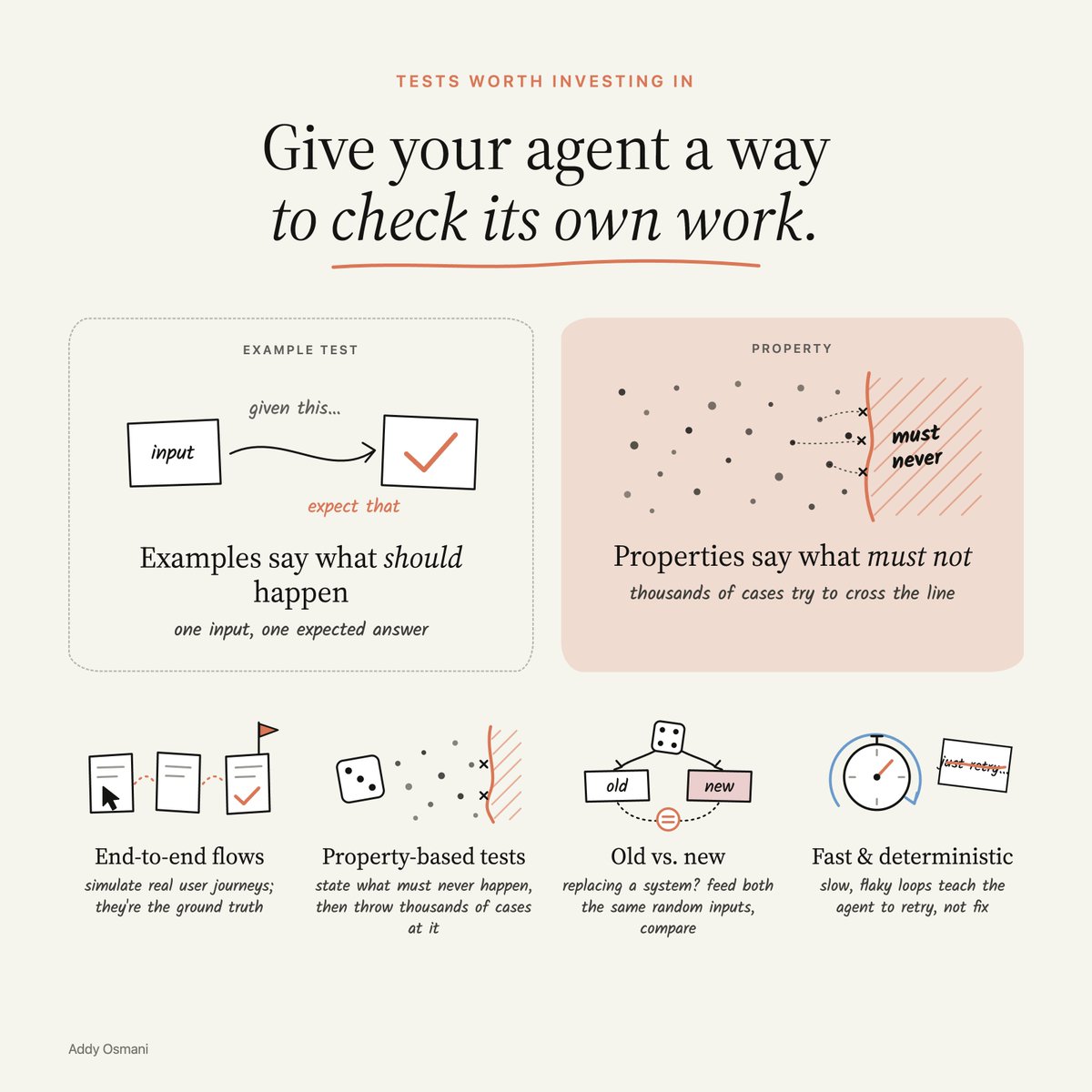
To make your agent produce high-quality output, equip it with a way to check its work. Tests are part of that.
Here are some of the ones I think are worth investing in.
- Write end-to-end tests that simulate real user flows and act as the ground truth
- Use property-based testing to specify what should never happen and generate thousands of test cases that attempt to break those constraints
- If replacing a system, compare the old and new versions using randomly selected inputs
- Require tests to run quickly and deterministically, which reinforces the agent to retry when the loop is slow or unreliable (the agent may learn to retry, not fix the problem)
Example tests say what should happen; properties say what must not.
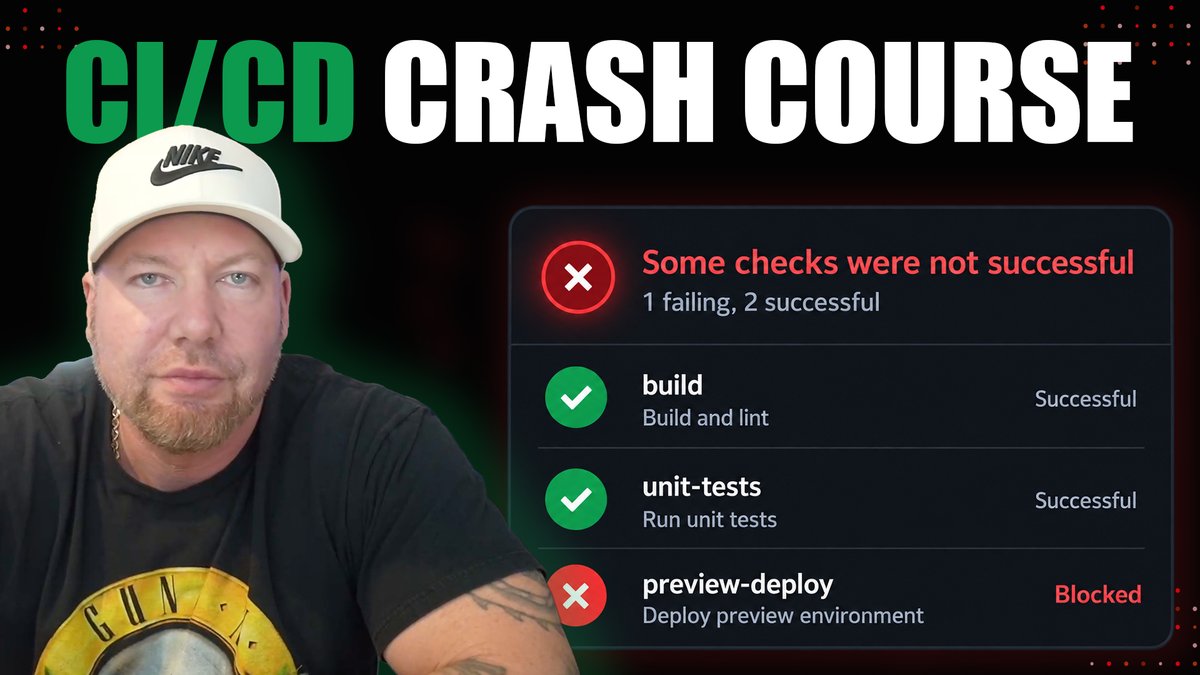
Having guardrails is more important than ever with all the AI generated code being shipped. Learn how to setup CI/CD with Github Actions & @render from scratch
CI/CD Made Simple: Build a Real Pipeline
https://t.co/uHgQivkiwk
The Kotlin programming language is used for Android apps, backend services, and cross-platform development.
In this course, you'll learn modern Kotlin from the basics through async programming.
It covers functions, collections, OOP, generics, coroutines, Flows, and reactive streams.
https://t.co/xMDMZlmpcB
mattpocock/skills v1.3 is out!
- /pr (new) writes easy-to-read PR bodies, showing hard evidence that the changes work and assessing merge risk
- /implement-spec (new) takes in a spec and tickets, and implements them with subagents
- CONTEXT.md renamed to GLOSSARY.md
- /retro (new) reviews recent coding agent sessions and suggests repo improvements
/retro, especially, feels like a huge upgrade. Enjoy!
rust never was the defacto language for agents and will not be. i love rust - it’s my primary language - but i work on runtimes and platforms
application code belongs in the default language - JavaScript (or its extension TS)
I've had agents implement and optimize the Campfire web app in Elixir, Go, and Rust. Yes, Ruby is the slowest. I didn't care about that when the pay-off was huge in terms of productivity and developer joy. But if you're no longer reading the code? https://t.co/MM4yFETaI3
I wanted a charting library that was light and fast, but could also keep up when “a simple line chart” inevitably turns into way more. So that’s what I built!
Give it a try! (Or tell your agent to)
The first step is types.
We're adding a TypeScript-compatible type checker to Bun.
It’s the best shot ahead-of-time compiled TypeScript has at beating languages like Go on memory and speed.