The decline of reading.
‘By the end of the twentieth century, a college graduate born after 1969 read less than someone born before 1950 with a basic level of education.
Indeed, nowadays many rich and highly educated people are much less well-read than many members of the least privileged classes had been in the middle of the twentieth century.’
https://t.co/4masbWNbcJ
Introducing Transformation, Quanta Magazine’s weekly bulletin chronicling the latest news in math and AI — and what it means for mathematics as a whole, written by @kkakaes. Read our first post: https://t.co/CqMCTnyF8Y
@greatbong@NGKabra I want to understand this from anyone having real knowledge about the field. Are we platueing in terms of the abilities of LLMs or will we see more drastic improvements than what we saw in last 3 years. How is the growth graph most likely going to be?
@NGKabra This book talks about this in captivating detail. Merchants facilitated chola's expeditions interms of logistics. Their contributions are real and tangible. Bramhins through rituals invoking God's favor. The decline of empire happened because of caste based suppression of others
this is such a beautifully humbling experiment. phage ϕx174 has just 5,386 bases encoding 11 proteins—about as small and well-studied a biological system as you could ask for. mutate every nucleotide and ask what happens. even here, ~25% of damaging mutations have no mechanistic explanation. and ai predictors didn’t do particularly well. we can read biology. we can increasingly perturb biology. but we are still a long way from understanding biology.
https://t.co/gmdhGR5YHY
Academics worldwide are rethinking their assessment approaches — from developing exams that artificial-intelligence tools can’t pass to sneaking hidden AI prompts into tasks to catch cheating students.
https://t.co/ooDOZvnymz
The Diels–Alder reaction was discovered in 1927, and nearly 100 years later, chemists still use it to build complex molecules. 🧪
I remember being amazed at university when my professor showed me how chemical synthesis works.
One of the practical tasks he gave me was to demonstrate how nucleotides could have formed under the conditions described by the Oparin–Haldane hypothesis, often referred to as the primordial soup. I struggled a lot with this task 😅
Today, I’m even more excited to see AI learning to reason about this process.
Insilico trained the @liquidai LFM, a 2.6B-parameter language model, on single-step retrosynthesis, using 45.6M verified reactions and rigorous out-of-distribution evaluation.
The result: SOTA performance, outperforming dedicated chemistry tools and frontier models.
#insilicoSOTAFM
I am super excited to share this educational video that I had GPT-6 Astra create from a single prompt: “Create a 5 minute educational video about T cells,” cells that I had devoted most of my life studying!
I also had Astra to use the Remotion plugin for the video generation. Astra also used Imagegen to create the visuals, it also suggested to use HeyGen for narration (have not used that before) and then assembled the entire educational video on its own one-shot, including what to say, how to explain it!
The result is so incredibly well made that, narration, the animations are all so perfectly created that even with 35 years of experience studying T cells, I really don’t think I could have explained this any better myself! The quality is also better than anything I had seen before, Astra is far ahead of all models now!
I’ve also been creating much longer and more advanced videos on T cells, immunology, and related topics, and I’m now planning to build an entire video lecture series and put it all on a dedicated website.
I am just having the time of my life making these, it actually makes me emotional to be able to magically create these with few prompts!
Terence Tao wrote a clear, nontechnical explanation of the Kakeya Conjecture (for which Hong Wang won the Fields Medal in July), why it matters, how it was solved, and future directions, and posted it on the arXiv: https://t.co/CejKG704Rn
Found a gem: https://t.co/lPcnwh6k1U, where mathematicians (including Fields Medalists) reflect on how AI is reshaping math. It's inspiring beyond math, for anyone pursuing curiosity-driven research with AI. We don't know where research is headed, but we must think deeply now
What Vincent Keymer describes here fascinates me, perhaps precisely because it has so little to do with spectacular combinations and so much to do with the very essence of chess.
Being able to tolerate tension without feeling the need to resolve it.
To me, that represents one of the most difficult forms of chess understanding. Sometimes you want to clarify a position simply because uncertainty feels uncomfortable. But that is exactly where the mistake can lie: you are evaluating the position only from your own perspective. If I feel uncomfortable, that certainly doesn’t mean my opponent feels better. Perhaps my discomfort is actually their greatest problem.
And then Vincent talks about winning won positions. I particularly like this thought because it shows how little chess is ultimately just about moves. The moment we realize we are better, our perception changes. Suddenly, we are no longer playing only against the position, we are playing against our own expectation that we are supposed to win.
I believe this is exactly where Vincent’s development is becoming so fascinating. Defeats seem to carry less and less emotional weight for him. They become information, not baggage. He doesn’t retreat into the past; he takes the lesson with him and moves forward.
Perhaps that is one of the most important qualities of an elite player: not to never doubt, but to refuse to be controlled by doubt.
The longer I follow Vincent, the more I feel that his greatest strength is not any particular opening, tactical motif, or even his remarkable calculating ability.😵
🧵1/11 Among all the books about proteins I've read, I think "Introduction to Protein Structure" by Carl Branden & John Tooze deserves the prize for the most aesthetic diagrams. They did an amazing job with their handcrafted diagrams. Here's my top 10:
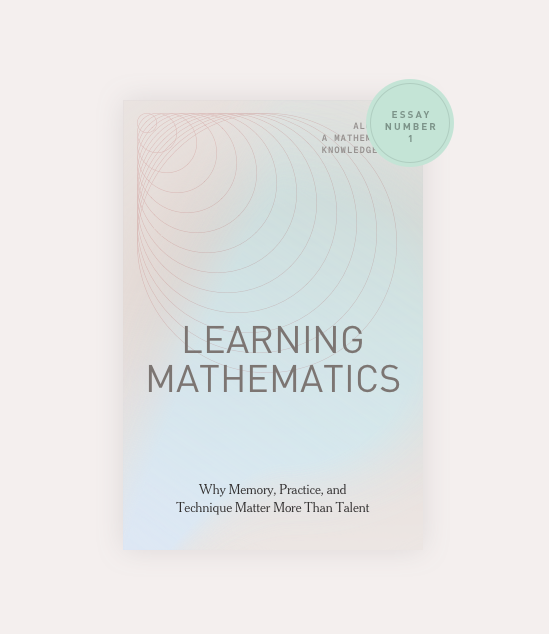
"Learning Mathematics: Why Memory, Practice, and Technique Matter More than Talent" is a short essay about a simple idea: many mathematical problems are far more mechanical than they may initially appear.
Intuition matters, but perhaps less than we often think. Practice, memory, repetition, and technique come first. Without them, it is difficult to develop the intuition that eventually makes mathematics feel natural.
If you are studying mathematics and simply cannot seem to get the hang of it, perhaps it is worth a read.
https://t.co/IJjp3SlePq
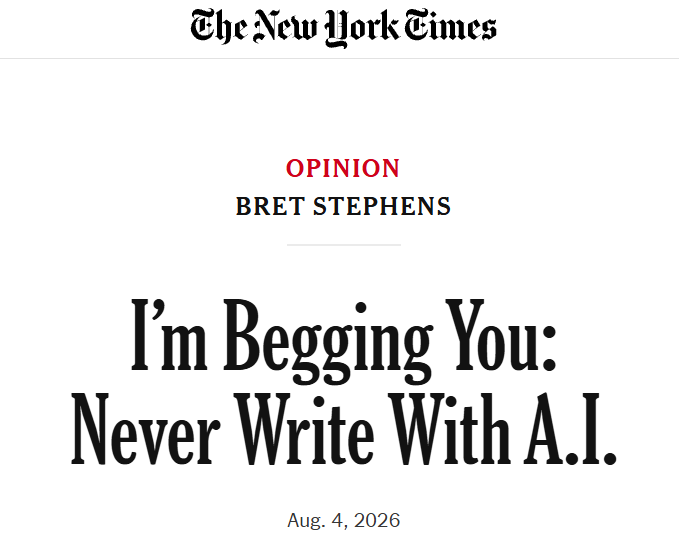
Must-read article for anyone whose job involves *thinking*
https://t.co/88ezsrjMgz
"The problem with writing with A.I. is that it’s mentally enfeebling...
What, uniquely, does writing do? ... It compels thinking in ways that silent contemplation or spoken language rarely can."
@Fintech03 what do you call @nitin_gadkari for claiming ethanol is zero emission fuel. I heard from common people saying this, and many believe that ethanol burning will give out only water because of such misleading statements
"He explained to me one day that it was for him an absolute necessity to review, by lecturing, his subject of concern in all its length and breadth. Only so, he remarked, could he see the great lacunae, the places where deeper understanding is needed, where work should focus. "
-From 'Hermann Weyl and the Unity of Knowledge' by John Archibald Wheeler.