Postdoctoral Fellow | LST, HKPolyU 🇭🇰. Interested in individual differences in resting-state EEG, neurolinguistics especially speech perception in noise.
Checked:
Nothing here survives within families.
"controlling for all the right stuff" evidently did not include using reasonable fixed-effects like family-level ones.
Social scientists have one job and they consistently fail to do it properly.
I've made this cheat sheet and I think it's important. Most stats 101 tests are simple linear models - including "non-parametric" tests. It's so simple we should only teach regression. Avoid confusing students with a zoo of named tests. https://t.co/9PFR1ly3lW 1/n
Today is release day for my new book, Wired for Words! It took me 25 years from book contract to release. It started out as a textbook project but the field was advancing so quickly--eg, we had just proposed the dual stream model--I was compelled to wait. It eventually morphed into a monograph, but still follows the structure and content of my course and is written to be accessible to students without dumbing down the science. Never give up on a worthwhile project!
https://t.co/bayV58xw6k
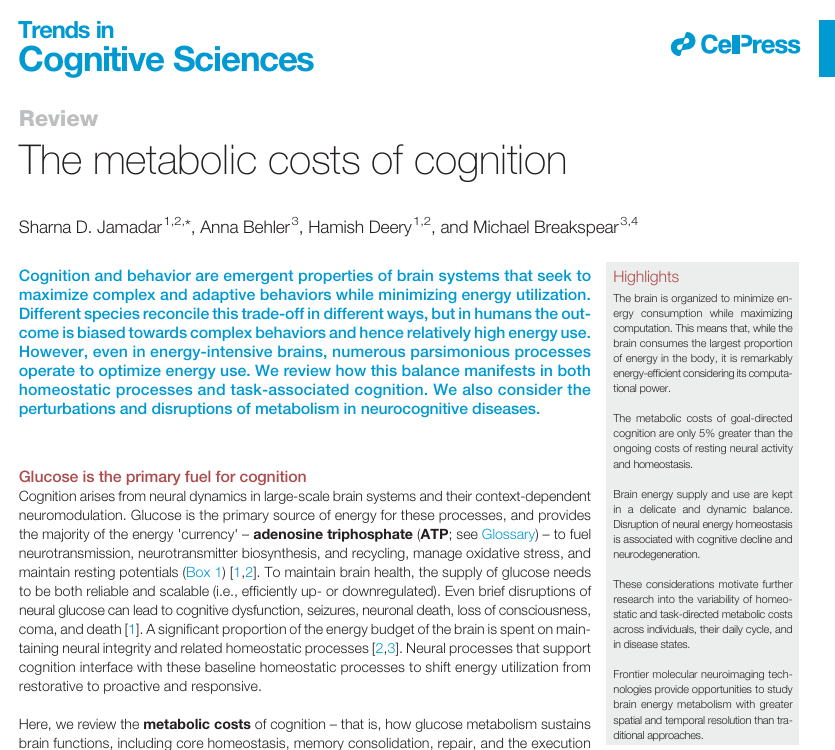
This is one of the best review papers I've read in a while.
Looking at cognition through the lens of metabolic costs is incredibly fascinating, especially in the context of neural efficiency.
Individuals with higher intelligence generally show lower glucose metabolism during task performance, suggesting they require less energy to achieve the same or better results, and their neuronal computation is more efficient. After practice or learning, metabolic demand decreases more sharply for higher-IQ folks (indicating faster neural adaptation, quicker optimization of circuitry, less redundant processing). In straightforward metabolic terms: higher intelligence = lower energy cost for the same cognitive computation. Physiologically, that means fewer neurons firing to handle the info, less excitatory synaptic activity, lower ATP and glucose consumption, more optimal recruitment of hub regions and network cores, etc.
my girlfriend wrote a research paper - she did 99% of the work
the professor took the paper, added 7 other professors to the work, 1 btech student, 1 phd and 1 mtech student as co-authors - which was never informed to my girlfriend
today was the camera-ready deadline, and she had already submitted it earlier. The proof edited it and added the above people, citing they had helped in editing the paper
[mind it 7 other profs were added]
this is highly unethical and i don't know how this happens. the professor concerned holds a high position in some important places
i am lucky to have profs who are very kind and credit me for the work i do, every single day - i hear such stories coming from elite institutions of this country. i can speak out because i am lucky in the earlier aspect, 90% can't.
why isn't anyone taking any action, why is it so normalized? many other people are literally btech students who work the best [i consider them to be the cream in research area in india], and the professors instead of motivating, steal the work of bright individuals and do citationmaxxing.
why would any talented individual work in research? the first paper i worked on, my girlfriend worked on, we both were scammed to a unethical level, that can't be described by words at this point.
we are encouraging brain drain at this point
UCSD’s “Math 2” course teaches grade-school math (grades 1–8) to freshmen. From page 49 of the university’s own report:
• 25% of students got 7 + 2 = ___ + 6 wrong
• 61% of students, a large majority, couldn’t round 374,518 to the nearest hundred
• 37% of students couldn't subtract fractions
UCSD is ranked as the nation's 5th best public university. Universities are cooked.
We are about a month away from the publication release date for my @mitpress book, Wired for Words - The Neural Architecture of Language. Here's a synopsis of each chapter.
Chapter 1: What is Language?
This chapter introduces the biological perspective on language, distinguishing between language phenotypes (the surface forms like English, Spanish) and the underlying biological machinery that enables language. The author recounts his personal journey from disliking language study to discovering its scientific depth. Key evidence for language as a biological system includes: its uniqueness to humans, universality across all human societies, critical period effects, genetic influences, and evolutionary continuity. The chapter establishes that language comprises multiple components (vocal motor control, speech perception, syntax) that likely evolved along different trajectories for different purposes, coming together to form the collective language trait we know today.
Chapter 2: The Dual Stream Brain
This chapter introduces the dual stream architecture found across multiple sensory systems. The ventral stream processes "what" information for perception and understanding, while the dorsal stream processes "how" information for guiding action. Evidence comes from neurological cases like visual form agnosia (patient DF) who couldn't consciously recognize objects but could accurately grasp them, and phenomena like echolalia and echopraxia. The chapter explains why dual streams are computationally necessary: the "what" system allows organisms to make category-based predictions and decisions about whether to act, while the "how" system enables rapid, reflexive sensorimotor transformations. This architecture applies to vision, touch, audition, and importantly, language processing. The chapter clarifies that dual streams make sense from a sensory/perceptual perspective, but when considering volitional action from thought, both streams are engaged.
Chapter 3: The Hidden Symmetry of Speech Perception
This chapter challenges the traditional view that speech perception is strongly left-lateralized. The author presents the case of Mr. L and others, who had word deafness (inability to comprehend speech), which is most commonly associated with bilateral damage. Data from split-brain patients, Wada procedures (temporary hemisphere deactivation), and stroke patients consistently show that both hemispheres can process speech sounds reasonably well. The chapter argues that the field has been biased by "dichotomy glasses" inherited from split-brain research, focusing on hemispheric differences rather than similarities. The conclusion: speech perception at the acoustic-phonological level is largely bilateral, with unilateral word deafness cases being rare exceptions in people with atypically strong left dominance.
Chapter 4: Left Brain, Right Brain: Wrong-Minded
This chapter traces the evolution of ideas about hemispheric asymmetry more generally. Before the 1860s, the "law of symmetry" held that identical hemispheres must have identical functions. Broca proposed "symmetry with modification" - hemispheres are fundamentally similar but the left develops earlier, making it dominant for complex functions like speech. The 1960s split-brain discoveries led to extreme dichotomous views (verbal vs. visuospatial, analytical vs. holistic). The chapter argues this pendulum swung too far. Evidence shows: (1) both hemispheres have sophisticated capabilities, (2) split-brain research revealed two well-functioning minds, not complementary halves, (3) bilateral lesions produce the most severe deficits, and (4) the isolated right hemisphere in split-brain patients shows substantial language comprehension. The author advocates returning to a more balanced "symmetry with modification" view, acknowledging both similarities and differences between hemispheres.
Chapter 5: Toward a Neural Architecture of Speech Perception
This chapter maps the neural pathway from acoustic input to phonological representation. Primary auditory cortex (A1) on Heschl's gyrus functions as a spectrotemporal filter bank, analyzing sounds across frequency and temporal dimensions. Processing proceeds hierarchically up the superior temporal gyrus (STG), with later stages on the lateral surface coding learned phonological sequences (syllables, words). The "auditory phonological area" in the mid-to-posterior STG/STS is critical for phonological processing and is largely bilateral. The chapter discusses various theories about anterior vs. posterior temporal processing and intelligibility effects. Evidence from lesion studies, functional imaging, and intracranial recordings converges on the STG as the core speech perception network. The system shows some left-hemisphere bias at higher levels but remains substantially bilateral, especially for basic acoustic-phonological processing.
Chapter 6: Cracking the Speech Code
This chapter addresses how the brain decodes the complex, multiplexed speech signal. Speech is not simply a sequence of discrete phonemes but contains overlapping information at multiple levels (phonemes, syllables, words, prosody) simultaneously. The acoustic signal has rhythmic properties, particularly in the amplitude envelope tracking syllable rate (3-5 Hz). Neural oscillations have been proposed as a mechanism for parsing speech, with low-frequency oscillations entraining to syllable rhythms and higher frequencies tracking phonemes. However, the chapter expresses skepticism about strong oscillation-based theories, noting that speech rhythm is quasi-periodic (not perfectly regular), that post-stimulus oscillations may reflect top-down attention rather than bottom-up entrainment, and that oscillations alone cannot explain the full complexity of speech processing, and indeed may provide little explanatory power. The chapter emphasizes that architecture - the arrangement and connectivity of the networks - is more fundamental than oscillatory dynamics.
Chapter 7: Word Search
This chapter tackles the "middle level" of language processing between phonology and semantics - variously called lemmas, abstract words, or morphosyntax. Defining "word" is notoriously difficult, but psycholinguistic models agree on a three-level architecture: phonology, a middle level, and semantics. The chapter reviews evidence localizing this middle level to the posterior middle temporal gyrus (pMTG). This region shows up in meta-analyses as overlapping between phonological and semantic processing, is implicated in lemma retrieval in speech production models, and is damaged in transcortical sensory aphasia (impaired comprehension with preserved repetition). The pMTG appears to process abstract word forms and morphosyntactic information, serving as an interface between sound and meaning. While the evidence is less definitive than for phonological or semantic levels, multiple lines of research converge on the pMTG as a critical node for word-level processing.
Chapter 8: Where Do You Know What You Know?
This chapter explores the neural basis of semantic knowledge, starting with semantic dementia - a progressive loss of conceptual knowledge about things and events in the world. Research shows semantic knowledge is distinct from language per se, as evidenced by dissociations between semantic deficits and language abilities. The "hub and spoke" model proposes that sensory and motor features are processed in distributed cortical regions (spokes) and integrated in hub regions in the anterior temporal lobes (ATL). Entity knowledge involves the ATL and fusiform gyrus, organized partly by taxonomic categories. Event knowledge involves the angular gyrus and temporal-parietal cortex, organized by thematic relations. The chapter discusses the modal vs. amodal debate, suggesting both perspectives capture important aspects. Importantly, semantic deficits correlate with general intelligence measures, supporting the view that semantic networks are distinct from core language systems, though language interfaces extensively with semantics for communication.
Chapter 9: Telegrams and Sentence Monsters
This chapter traces the history of syntactic disorder research from early observations of agrammatism (telegraphic speech) and paragrammatism (confused “sentence monsters”) through the 1980s focus on Broca's area as the syntax center. The "overarching agrammatism hypothesis" claimed that Broca's area damage causes both expressive and receptive syntactic deficits. However, this view faced multiple challenges: comprehension deficits in Broca's aphasia are mild and task-dependent, functional imaging shows Broca's area activation for many non-syntactic tasks, and lesion studies implicate posterior temporal regions more than Broca's area in comprehension deficits. The chapter proposes the "HiLine" (Hierarchical Linearization) model of morphosyntax: the posterior middle temporal gyrus builds hierarchical syntactic structures (important for both comprehension and production), while Broca's area (pars triangularis) linearizes these structures into sequences (primarily for production). This explains the expressive-receptive asymmetry and integrates classical observations with modern linguistic theory.
Chapter 10: The Sensory Theory of Speech Production
This chapter develops a model of speech production integrating psycholinguistic and motor control perspectives. The "hierarchical state feedback control" model proposes that each linguistic level (phonological, morphosyntactic) has a sensorimotor architecture with three components: motor planning (frontal), sensory targets (temporal/parietal), and translation between them. At the phonological level: motor planning occurs in posterior inferior frontal gyrus (Broca's area), auditory targets in posterior STG, and translation in area Spt (Sylvian parietal-temporal). Evidence includes: altered auditory feedback experiments showing speech adjusts to match auditory targets, lesion studies showing different effects of frontal vs. temporal damage, and functional imaging showing coordinated activity across these regions. The model explains speech errors, self-monitoring, and integrates with broader motor control principles. Importantly, it proposes that linguistic representations (phonology, morphosyntax) are organized according to sensorimotor control architectures, representing an evolutionary tinkering with existing motor systems.
Chapter 11: Beyond Broca
This chapter elaborates the dorsal stream for speech production, partitioning it into its own ventral and dorsal hierarchies. The ventral hierarchy (familiar from earlier chapters) includes Broca's area for morphosyntactic and phonological planning, ventral precentral gyrus for syllable-level planning, and ventral motor cortex for orofacial articulation. The dorsal hierarchy, less studied, involves dorsal precentral areas for prosodic planning and dorsolateral motor cortex for laryngeal control of pitch. Evidence comes from lesion studies, electrical stimulation mapping, and functional imaging. The chapter also discusses the supplementary motor area (SMA) complex's role in sequencing and timing coordination across effectors. A key insight is that speech production involves parallel hierarchies for different aspects of speech (phonetic/syllabic vs. prosodic), each with its own sensorimotor architecture. The chapter emphasizes that this organization reflects evolutionary adaptation of existing motor control systems for the specific demands of speech.
Chapter 12: The Neural Architecture of Language
This final chapter synthesizes the book's findings into an integrated model (LSM - Linguistic Sensorimotor Model). Key principles: (1) sensory and motor processes are hierarchically organized, (2) all linguistic levels have sensorimotor-like architecture (planning, targets, translation), (3) different portions engage in task-dependent fashion (dual streams), and (4) network components vary in laterality. The model traces language comprehension from acoustic input through spectrotemporal analysis (A1), phonological coding (STG/STS), lemma/morphosyntax (pMTG/vSTS), to semantics (ATL, AG). Production engages the entire network, with motor planning hierarchies in frontal regions. The chapter compares the LSM to other models (dual stream, psycholinguistic), discusses white matter connections, and addresses dynamics (serial vs. parallel processing). An important addition is an auditory-emotional stream in anterior temporal regions for processing emotional prosody and music. The LSM provides a comprehensive framework integrating classical neurology, modern neuroimaging, linguistic theory, and motor control principles.
Just read this new research paper from Google AI called "Attention is All You Need" and I think my brain is actually broken 🤯
All our best AI models are stuck processing language one word at a time, in order. It's this huge sequential bottleneck. These researchers just... threw that all out. They tried something that on paper sounds completely insane.
Instead of reading a sentence left-to-right, they built a model that can look at every single word at the same time and just figure out how important each one is to all the others.
That's it. No more "recurrent" or "convolutional" layers. Just this mechanism they call "attention." They're calling the whole thing a "Transformer."
The results are absolutely nuts.
It’s not just a little better at machine translation, it's blowing the old models out of the water. And here’s the kicker: because it's not sequential, it can be trained way, way faster on modern hardware.
But here's where it gets really weird. They're focused on translation, but this feels like something much bigger. This isn't just an improvement, it's a completely different way of thinking about language.
This architecture feels like it was built to scale. What happens when you take this "Transformer" and make it 100x bigger? Train it on the entire internet? Does it just get better at translating, or does something else happen?
It feels like we've been trying to force AI to process information like a human, step-by-step. This paper just asks, "what if that's completely the wrong way to do it?"
I have a feeling that in 8 years, we're not going to be talking about LSTMs or RNNs anymore. We're all going to be talking about this. This feels like the start of something huge.
Here's something that surprised even me... As the scandal of photoshopped images in neuroscience research continues to drag on, even in 2024 and 2025 there are name brand laboratories still publishing stuff like this! [A thread...]









![addictedtoigno1's tweet photo. Here's something that surprised even me... As the scandal of photoshopped images in neuroscience research continues to drag on, even in 2024 and 2025 there are name brand laboratories still publishing stuff like this! [A thread...] https://t.co/utj9ZtqqeH](https://pbs.twimg.com/media/G0rzevpWwAARDuR.png)





