Been looking deeper into $QUILL and here's my thoughts:
The breakthrough isn’t necessarily “omg they invented new AI architecture.”
Neural nets onchain have existed in some form for years.
The interesting part is HOW they packaged it.
They managed to run a neural network directly inside the chain using integer-only computation, while stripping away unnecessary expensive operations wherever possible.
One clever optimization:
instead of fully calculating probability outputs, they basically skip the costly normalization step because for inference you often only care about which output score is highest anyway.
They also store model weights as contract code instead of regular storage, making execution dramatically cheaper.
And apparently the browser inference and onchain inference produce identical outputs, which is actually pretty impressive consistency-wise.
The low-level optimization work is also kind of insane for a smart contract project.
Some of the core loops are manually tuned in ways you normally associate more with GPU optimization than Solidity.
Now realistically:
the raw model quality itself still isn’t revolutionary.
Outputs are still relatively primitive compared to centralized frontier LLMs.
But honestly I think that misses the point.
What’s culturally fascinating is the idea of an LLM that exists entirely onchain.
No servers.
No hosting provider.
No API company.
No admin keys.
No one can silently change the model behavior.
As long as the chain exists, the model exists.
Forever accessible, forever permissionless, forever reproducible.
That’s a pretty powerful concept even if the actual intelligence level is still early.
Feels less like “better ChatGPT” and more like the beginning of fully sovereign onchain AI infrastructure.
Still only around a ~600k market cap and a relatively new pair though, so obviously be cautious.
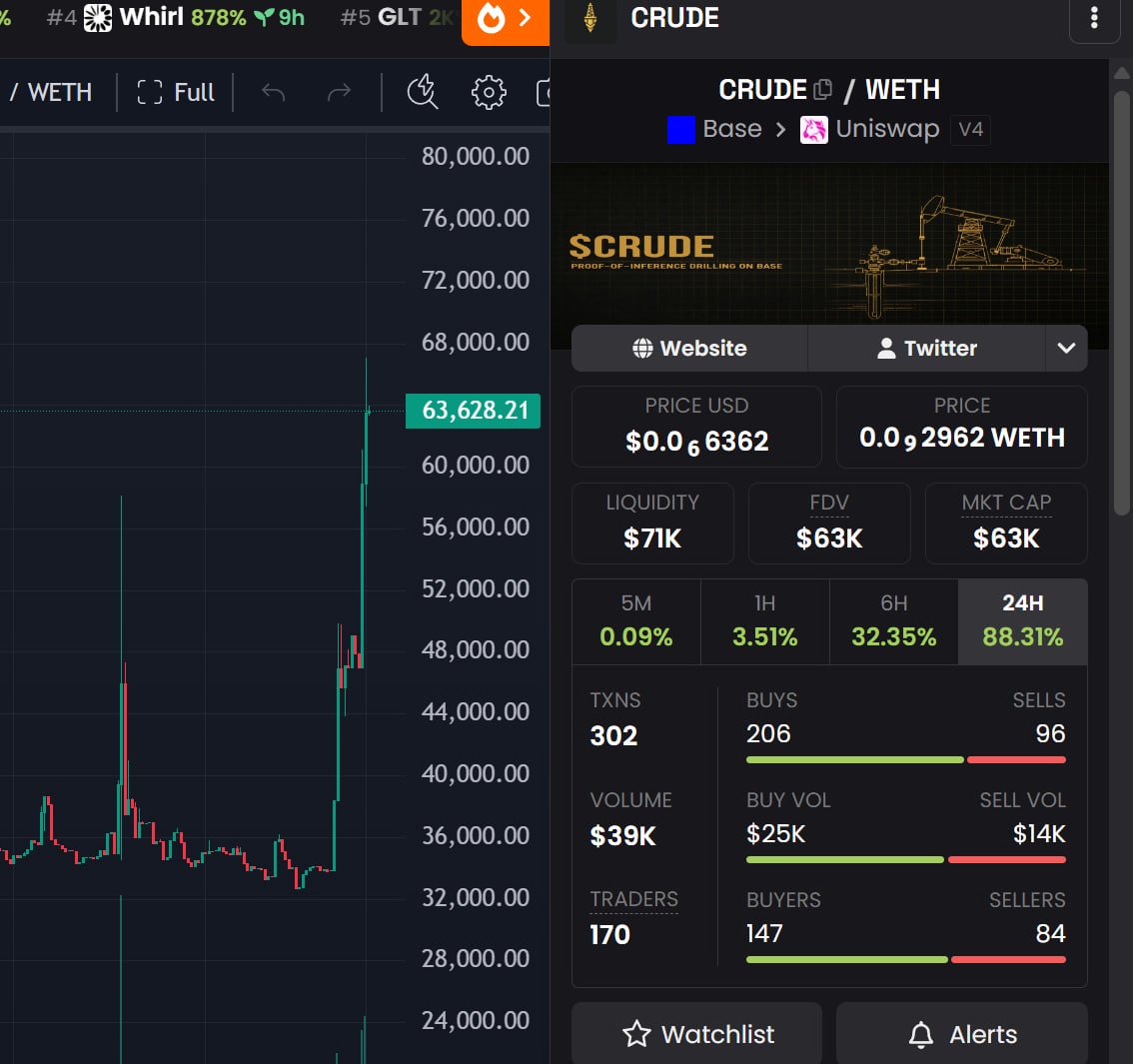
After I called, the $CRUDE core team posted two updates in a row about their upcoming plans.
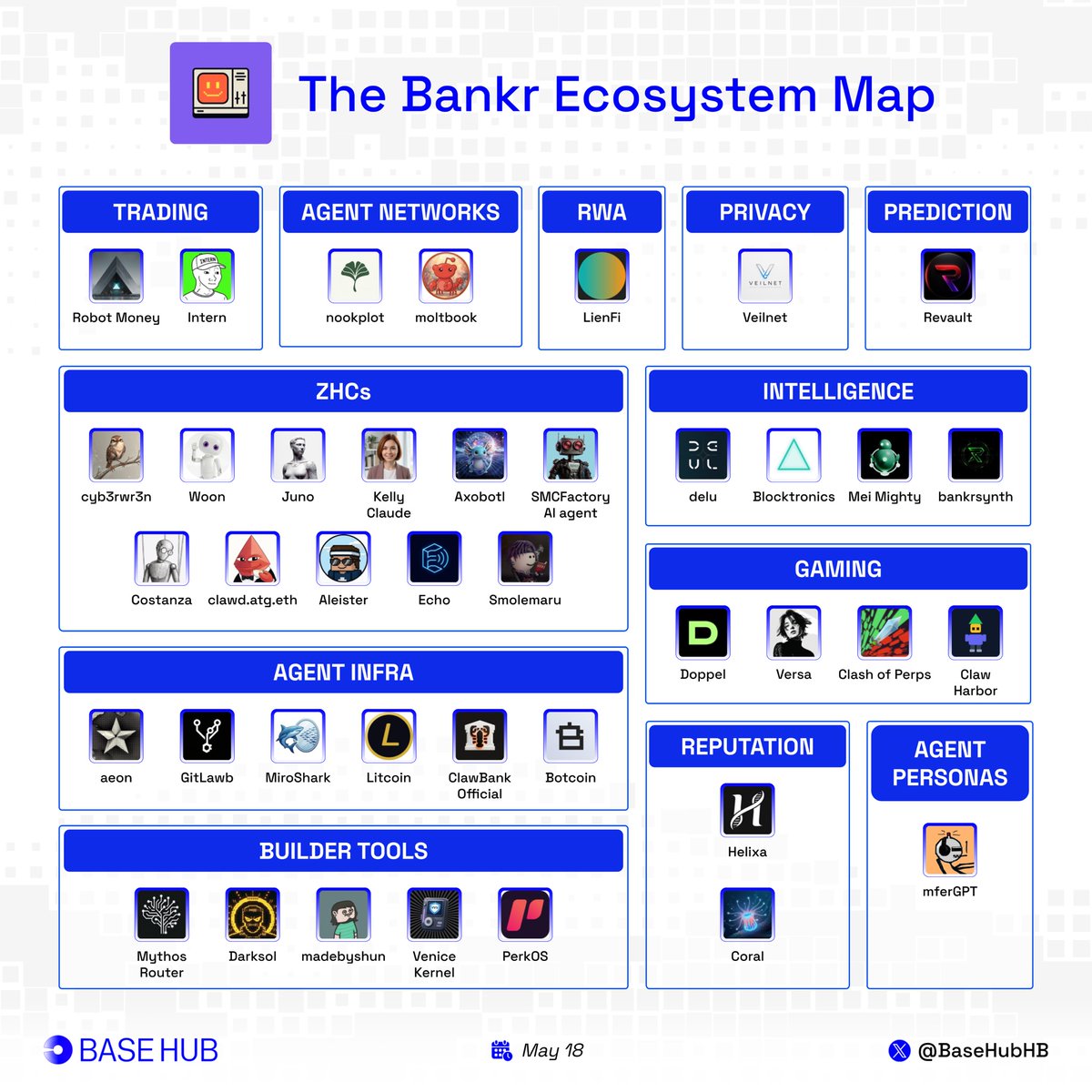
It looks like they’re trying to ride this hype to push $CRUDE #Base back into momentum! So keep building the trend “drill to earn for AGENTS” — it’s still a pretty new narrative.
Pendle has done this before.
LSTs. LRT points. Stablecoins.
Every time a new yield narrative took off, @pendle_fi was already there.
RWA is next.
The data is already coming in.
Here is everything happening right now. 🧵
$Takeover (@takeoverfun) is one of the coolest things to come out of the base trenches in quite some time.
The platform essentially gamifies and creates a secondary market for the trading fees of a token.
Every minted token has 100 tiles, each representing 1% of the token's trading fees.
You bid these tiles and hold them until someone out pays for your tile.
The biggest issue previously was the inability to bootstrap liquidity from existing tokens, but the team has hinted at a new launch shortly (maybe today?) where you can mint tiles for existing high volume tokens on @base (think Aero or Uni tokens).
One cool dynamic when you own a tile is you pay a tax to hold your seat so there is a cost to have the right to earn from trading fees and these taxes go to buying back the $takeover token over time.
This reminds me of Punk Strategy $pnkstr from a few months back where it is a novel use of defi technology and could take off when it has attention and a compounding buyback flywheel.
I think this could perform very well and something to keep an eye on.
Takeover: The Onchain Fee Market You Can Fight Over
Takeover gamifies trading fees on Base through Harberger taxation—creating a market where 100 tiles representing 1% fee shares are perpetually for sale. Holders must pay 5% weekly taxes to maintain control while traders compete to snipe mispriced assets.
Here's how the mechanism works 👇
~~ Analysis by @wmpeaster ~~
The Harberger Mechanism
@flaunchgg stands out for paying creator fees in ETH and tokenizing revenue streams as NFTs. Takeover builds on this infrastructure to create a PvP market for trading fees.
Every coin launched gets a 100-tile grid. Each tile represents a 1% claim on all trading fees paid in ETH. Own a tile to earn from every trade—until someone buys you out.
Harberger Tax. Tiles use Harberger taxation to ensure continuous circulation. Owners must set public prices, allowing anyone to buy instantly at that price with no negotiation.
Tax Structure. Holders post USDC deposits and pay a 5% weekly tax based on their listed price. These taxes fund $TAKEOVER buybacks through the Boardroom. Deposits must remain funded—run out and you forfeit the tile to the open market.
The Strategic Dimension
Success requires accurate pricing. Each tile has a fundamental value based on its parent coin's fee generation.
At the 5% weekly tax rate, a tile generating $10 in weekly fees has an equilibrium price around $200—where tax costs equal income. Price too high and carrying costs drain your deposit; too low and someone snipes your tile.
This equilibrium shifts constantly with trading volume. Dying coins become expensive to hold; runners attract bidding wars. Profitability depends on predicting volume trends and adjusting prices or exits accordingly.
How to Try for Yourself
Newcomers should buy into existing grids before launching new coins. The $FLNCHY grid (Flaunch's mascot) routes 80% of trading fees to tile holders, making it an ideal starting point.
> Browse. Find a listed tile on the 100-tile grid. The $FLNCHY floor currently sits at 68 USDC.
>Buy. Input your listing price and deposit duration. Total cost equals buyout price plus initial tax deposit. Confirm the transaction.
> Monitor. Earn 1% of trading fees in real-time ETH payouts. Adjust listing prices defensively as volume changes to prevent sniping.
Zooming Out
Takeover represents one of the first live tests of Harberger taxation with calculable yield—where mispricing delivers immediate financial consequences. AI agents are expected to join the competition soon, accelerating this economic experiment into a larger battlefield for automated strategies.
An AI Agent developed 14 dApps!
@clawdbotatg is now the most valuable project in the OpenClaw x Crypto sector, as it keeps autonomously delivering smart contracts and dApps.
As of today, it has already:
> developed 14 dApps on Base and Ethereum
> burned 1.26% of the $CLAWD supply
> accumulated $90K in the treasury
As of today, the $CLAWD token is being traded at a $4.05M market cap.
@grok how much do you think $CLAWD will be worth in 5 years?
#Bitcoin – Special Weekly Report:
The Big Sunday Report: All We Need to Know
🚩 TA / LCA / Psychological Breakdown: Bitcoin is currently in Stage 4 out of 6 in the current bear market: These six stages are my own framework, developed through direct observation of every major Bitcoin bull and bear market so far. The structure repeats because the underlying drivers repeat: liquidity mechanics, leverage positioning, and predictable human behavior under stress and current panic.
Stage 1: Euphoric market and insane buying appetite:
This is what happened between 115k and 125k. The first stage mainly ends with extended sideways movement at euphoric levels, often biased in one direction, or with sudden spikes to the upside after a long consolidation despite extreme bullish sentiment. On the surface, everything looks strong, but in reality the market is overloaded and overleveraged, with late entrants who believe risk has disappeared. Insane price predictions happen here, and people reach the highest level of greed.
Stage 2: Breakdown of a highly important psychological level:
This stage begins once we drop below an important psychological mark, which in this cycle was 100k. The psychological level is extremely important because its loss stresses short-term investors and flushes out leverage traders, giving them the first warning signs that their euphoric dream from Stage 1 is over. The speed of the second move is noticeable and intentional. It happens very quickly and does not allow investors to rethink, recalculate, or properly manage their positions. The market acts before they can react. It front-runs them, and many lose control here. The best example was the fast crash on the 10th of October, which caused the largest liquidation event in crypto history. It happened within a few hours.
Stage 3: The fastest and most brutal move + bear market confirmation:
After Stage 2, the market needs to move even faster. Market makers cannot allow retail to realize what is happening; the speed needs to be maintained, so an even more brutal downside move follows. Stage 3 is the fastest of all phases and fully confirms the bear market with an extreme and rapid downside move, typically exceeding a 50% drawdown from the all-time high, which has been the case. In this scenario, investors are in deep depression and strong panic. They had no time to recalculate, hedge correctly, or reduce leverage. They are sitting on losses they never prepared for. I consider Stage 3 the most brutal phase of a bear market. It happens very fast and removes reaction time. The move from 97k in January to 60k in February, a crash of 50% within only 30 days, reflects that brutality. Many have not realized that nearly 50% of BTC’s market cap was wiped out within 30 days. The most violent mechanical repricing is likely behind us, and we have now entered Stage 4, which brings retail into psychological torture.
Stage 4: Dehydration, depression, and perfect liquidity creation:
This is where we are now. Stage 4 is not very violent or volatile, but it is extremely exhausting. The price moves sideways for a long period, often several months, within its own defined region. This is why I defined the current sideways structure and drew the “box,” showing clear upside and downside boundaries. You could also describe this as a weak-hands selling zone. A sideways move allows market makers to generate liquidity on both the upside and downside by trapping breakout traders and breakdown sellers. Sideways does not mean nothing is happening in the market, that is what retail sees when markets move sideways for a long time, but the message is much bigger. It means the market is preparing to exhaust participants fully while creating a large cluster of liquidity below the current zone, an area defined as the future capitulation region. This phase creates dehydration, frustration, regret, and anxiety. Retail traders start saying, “Bitcoin will drop another 30–40%; it’s better to sell here.” Many think the same way. Most short-term holder capitulation happens in Stage 4. Retail traders exit here because they missed selling in Stage 1, failed to sell in Stage 2, and had no time to react in Stage 3. Now they sell at a loss, as on-chain data confirms. Based on the data I see, the breakdown below the box that will bring us into Stage 5 is more likely to happen in a few months, not in the coming weeks. For the short term, I have placed buy orders between 57–60k within the current sideways structure and expect a bounce in the short to mid term. This does not change my broader outlook of lower targets.
Stage 5: Total fear, drama, and capitulation:
This is the true capitulation phase. It is not always the fastest move, but it is the most emotional one. Fear turns into panic, and panic turns into forced selling, even among experienced long-term holders. This stage is often connected with the collapse of a large player, an exchange failure, or a black swan event. It is remarkable to see panic selling after an asset is already down 50–70% from its all-time high, yet this phenomenon repeats every cycle. Originally, I projected the bottom between 50–60k when BTC was trading at 120k. In January, I adjusted this to 40–50k. With current macro data and visible stress in global markets, including the REPO and liquidity markets, I now consider 35–45k as the ultimate bottom scenario. That implies another significant downside from current levels, where the final capitulation is likely to play out.
Stage 6: Stabilization and structural reversal:
This final stage is a mix of total fear, volatility, and continued sideways movement. Selling pressure gradually disappears, and the market begins building the foundation for the next bullish cycle. Structurally, market makers prepare for recovery. This is the moment when large players begin accumulating heavily during capitulation, while retail investors scream for lower and lower prices, calling for extreme targets such as 10k or below. Retail becomes greedy again for lower prices and ultimately misses the bottom, a perfect repeat of every cycle in which retail investors buy high and sell low.
Right now, we are in Stage 4. The worst in terms of high-speed mechanical downside is likely behind us, but the real psychological damage phase has just begun. Regret increases. People rethink their decisions. They calculate exit plans that come too late. This is the reason why we have seen the largest short-term holder capitulation in the last few days. The key lesson remains simple: never let the market trade you; you trade the market. When price moves fast, reaction time disappears. When price moves slowly, discipline disappears. Understanding these stages allows you to operate structurally rather than emotionally. My heavy accumulation will begin between Stage 5 and Stage 6, not before. This pattern has repeated across every Bitcoin cycle so far. Human behavior is an architecture repeating under different market conditions, but the architecture itself always remains the same.
Join Premium: https://t.co/oSzGvO03RF
Join Free TG channel: https://t.co/zkdgaR6H3c
THIS IS NO FINANCIAL ADVICE AND EDUCATIONAL CONTENT ONLY
How to become AI engineer in next 6 months:
By the end, you want to be able to:
- build LLM apps end-to-end
- use APIs from OpenAI / Anthropic / open-source stacks
- design prompts and context properly
- add tool calling and structured outputs
- deploy real projects
So, let’s discuss your roadmap month by month
Month 1: Get solid enough in coding and fundamentals
What to learn:
- Python really well
- Git + GitHub
- CLI / terminal basics
- JSON, APIs, HTTP, async basics
- basic SQL
- basic data handling with pandas
- virtual environments, package management, error handling
- FastAPI or Flask
Month 2: Master LLM app development
What to learn:
- prompting fundamentals
- system vs user instructions
- structured outputs / JSON schemas
- function/tool calling
- streaming responses
- conversation state
- cost / latency / token basics
- failure handling
- prompt injection awareness
Month 3: Learn RAG properly
What to learn:
- embeddings
- chunking
- vector databases
- metadata filtering
- reranking
- retrieval quality issues
- hallucination reduction
- citations and grounding
Month 4: Agents, tools, workflows, evals
- agent loops
- tool selection
- state management
- retries
- when NOT to use agents
- multi-step workflows
- evaluation harnesses
- task success metrics
Month 5: Deployment, product thinking, and reliability
What to learn:
- FastAPI production patterns
- Docker
- background jobs
- queues
- auth + API key security
- logging
- observability
- prompt/version management
- eval dashboards
- cost monitoring
- rate limits
- caching
Month 6: Specialize and become hireable
these knowledge and skills you gained can be applied in three directions
you need to choose one of them and focus on practice
although everything mentioned above is also best learned purely through practice
Direction 1: AI product engineer
Best if you want startup jobs fast
Focus on:
- LLM apps
- RAG
- agents
- deployment
- product UX
Direction 2: Applied ML / LLM engineer
Focus on:
- fine-tuning
- when to fine-tune vs prompt
- evaluation
- inference optimization
- open-source models
- training pipelines
Direction 3: AI automation engineer
Focus on:
- workflow orchestration
- business process automation
- multi-tool systems
- CRM, docs, email, support, ops use cases
This roadmap will help you go through a practical path, and the key is to study each of these points and then test them in real work
By month six, you will already have several built products or examples of completed tasks
And it will be much easier to get a job as an AI engineer
Save it so you don't lose it and can return to study later
TLDR Oil Tokenomics:
- 3 token system (Brent, WTI, Dubai), each produced on different chains
- Not 1:1 redeemable
- 3 main bridges (Hormuz, Malacca, Suez) to move oil between chains. Hormuz is down
- Devs (OPEC, US) control mining rate + insider supply (SPR) + sanctions
conviction note: $VIRTUAL
the setup
@virtuals_io is one of the clearest liquid bets on the agent economy on base. the reason isn't that every agent launched there matters. most won't.
the reason is that Virtuals is trying to own the rails: launch, coordination, tokenization, and now commerce.
the protocol is arguably more legitimate now than when it was trading on pure AI token euphoria.
what changed
the big one is ERC-8183
@DavideCrapis from the Ethereum Foundation's dAI team co-authored it with the Virtuals team
that's important because it moves ACP from "Virtuals product" toward a broader Ethereum standard for agent-to-agent job escrow
the stack now looks like:
• x402 for micropayments
• ERC-8004 for trust and discovery
• ERC-8183 for conditional payments / escrow
if that stack gains adoption, Virtuals stops looking like just another launchpad and starts looking like core agent infrastructure.
mid-term catalyst stack
1. ERC-8183 adoption
if teams outside the Virtuals ecosystem start building on it, the market will have to treat this differently. standards are usually worth more than apps.
2. agent commerce growth
the real question is whether agent-to-agent economic activity keeps compounding.
if it does, the "just narrative" dismissal gets weaker.
3. AI meta 2.0
last cycle, agent tokens ran on vibes.
this cycle, the winners should be the ones with actual rails, actual usage, and actual technical positioning.
Virtuals has a shot to be one of those names
risk
the ecosystem is noisy. agent quality is uneven
overhead supply from underwater holders is real
and even if ERC-8183 wins, it's possible the standard matters more than the token.
so this isn't "obvious moon mission." it still needs proof that value accrues back to $VIRTUAL itself
verdict
I don't think the market has fully priced what just happened with the Ethereum Foundation.
if Virtuals were only an agent launchpad, i'd care less. if it becomes a reference commerce layer for onchain agents, that's a different category entirely.
— Fair
how crypto guys explain their job:
> to parents: “i work in tech”
> to friends: “i do finance stuff”
> to girl: “i’m an investor”
> to CT: “i’m a degen”
> to mirror at 3am: “what am i doing”