SERV is entering the US financial system - the world's largest market, handling trillions of dollars in assets.
We are targeting banks and fintech startups. The upcoming SERV v2 architecture brings us closer to meeting our partners' strict trust and reliability requirements.
I spent the entire last week at the AI Engineer World's Fair in SF with where top AI labs, founders, Fortune 500 CTOs & AI Engineers meet. Really perfect timing - having boots on the ground right before we deploy SERV Reasoning v2, because the problems v2 ships against are exactly what i heard in meetings, over and over.
To give you a quick recap, it was a fruitful week overall: 60+ new companies from the fair now in our structured pipeline, from two-person agent teams to trillion-dollar clouds (a few that you'd recognize instantly, and at least two are infra your own stack probably touched today). One of the most interesting part was the Startup Battlefield where new startups pitched their projects.
After numerous meetings, one thing is clear: everyone in Enterprise AI is doing it backwards. The current flow:
1.) Tune the model
2.) Ship the agent
3.) Debug a black box after it embarrasses you in production
A version of the same confession kept surfacing: "we shipped an agent, it did something weird in front of a customer, so we pulled it - cause nobody on the team could explain a single decision it made." Others told me they burn anywhere between $10-$90k (!) a month on inference and can't drive it down. It became "cost of doing business." Now that SERV v2 is here, we are solving both these issues.
Two confessions with two direct answers in v2:
1.) The black box: SERV makes agent reasoning traceable - you see how the agent thinks, not just what it outputs. And with Shadow Agents, every output gets reviewed against the original brief by a separate verification agent before anything ships. The "weird decision" gets caught in verification. Trust first, then scale.
2.) The burn rate: the reasoning engine lets you run the same workloads on much smaller models with better outputs. Verification Hints give agents signal on what a correct output looks like before they generate, cutting expensive re-work. And you don't have to take our word for any of it - Benchmark Tooling shipped in v2 shows you the cost savings on your own workloads before you integrate.
That's the whole idea behind SERV Reasoning v2. Judging by last week, it's exactly what the room is starving for.
Q3 is starting off with a bang.
SERV Reasoning v2.0 Release
Launching mid-July, SERV v2 is the most significant upgrade we've ever done to the SERV Reasoning engine.
Our goal remains the same: SERV becomes the foundational AI agent infrastructure that enterprises, global financial institutions, governments, and humanoid robotics companies use to run AI agents at scale.
We believe the lack of enterprise trust in AI agent reasoning is the #1 barrier holding back the mass adoption of AI agents in high-stakes industries like banking, robotics, and government workloads. That's why the enhancements in SERV v2 focus on making AI agents more trustworthy, reliable, and more cost-efficient than ever before: exactly what our target customers require.
We are going to be explaining the architecture of each feature in more detail over the coming weeks.
Here is what SERV v2 update enables:
- Multipath Reasoning: This foundational upgrade changes the core of the SERV Reasoning engine. Decision making in the real world is complicated, messy, requires orchestration among multiple actors, and can be contradictory. The same will be true when enterprises implement fleets of AI agents at scale. Multipath Reasoning allows complex decision trees with contradicting rules to coexist in one reasoning graph, upgrading the ability of AI agents on SERV to reason through complicated real-life situations.
- Shadow Agents: With the goal of increasing the reliability of outputs to 100% - a baseline requirement for high-stakes environments - Shadow Agents are separate verification agents paired with the main agent. They review every draft against the original brief before anything ships. Missed requirements get caught and rewritten, and only the version that passes gets delivered - preventing errors from poisoning downstream outputs.
- Verification Hints: To reduce re-work, cut costs, and increase the accuracy of outputs as we work towards our goal of 100% reliability for enterprise applications, AI Agents will now be able to receive extra signal about what a correct output should look like before they produce one.
- Benchmark Tooling: Potential enterprise customers can now see the cost savings and reliability improvements of switching to SERV on their own workloads before integration. For existing enterprise customers, their engineering teams can optimize existing prompts to get even more cost efficiency from the SERV Reasoning engine.
- Prompt Guard: Security and privacy are minimum requirements for any infrastructure implemented in high-stakes environments like banking and financial services. Prompt injection is a serious risk for banking AI agents handling trillions of dollars. Prompt Guard's built-in security layer protects AI agents from injection attacks.
SERV v2 goes live mid-July with all of these upgrades.
Each element in SERV v2 solves an issue that's preventing the adoption of AI agents within enterprises, financial institutions, governments, and fast-growing markets like humanoid robotics.
Multipath Reasoning lets agents work in the real world. Shadow Agents and Verification Hints increase reliability. Benchmark Tooling increases cost efficiency and brings new customers through the door. Prompt Guard increases security and privacy.
79% of enterprises need to adopt AI agents in some form (PwC), and SERV v2 enables them to run those agents on OpenServ.
The future is looking bright.
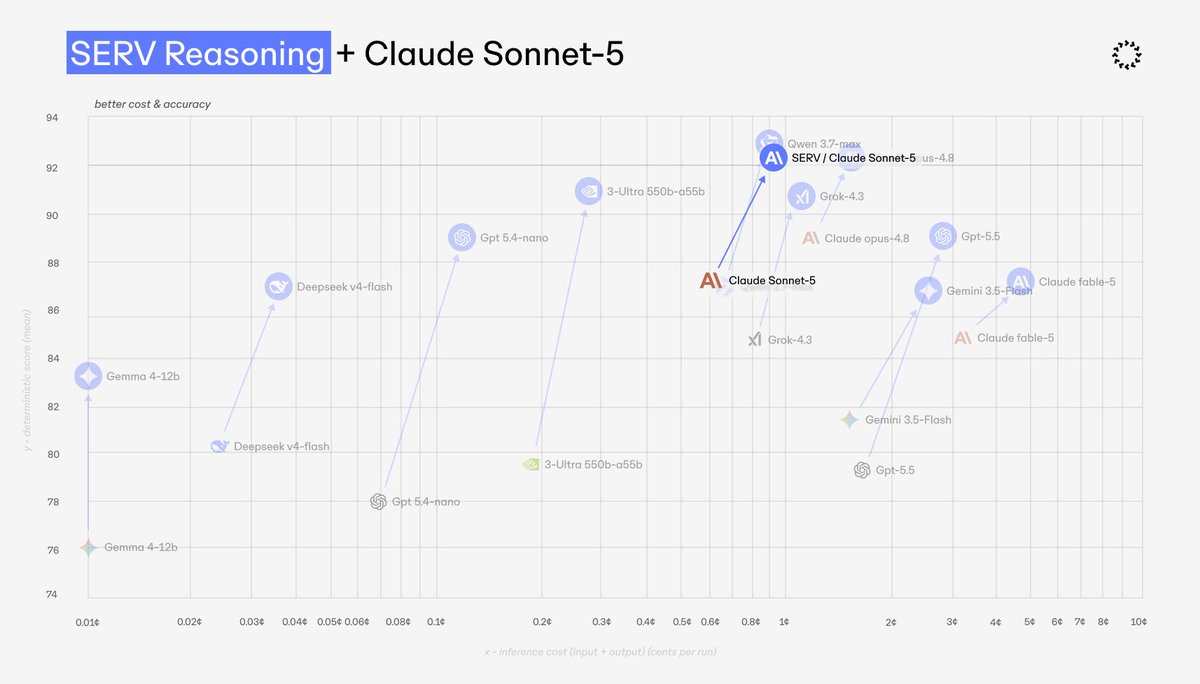
Claude Sonnet-5 was just integrated into the SERV Engine.
On its own, Sonnet-5 is mid-tier. With SERV, it jumps into the top cluster, matching Opus-4.8 at half the cost.
That's the whole vision of SERV - to make all models reliable and accessible.
The frontier labs keep shipping raw intelligence. SERV turns any model, even a small one, into reliable, production-ready performance anyone can afford.
Now available to Private Beta builders. Apply below ↓
Q2 was the quarter SERV went from thesis to proof. Q3 is where it starts becoming real infrastructure that companies depend on.
What happened in Q2 in a nutshell:
> Private beta went live, bringing SERV Reasoning into real production across network intelligence, robotics, AI verification, and more.
> Greg Ivanov, ex-Google Head of Partnerships, joined as advisor to open enterprise doors and scale our operations globally.
> Neol, using SERV Reasoning hit 100% reliability in production with the UAE government, the highest trust bar in software, cleared.
> SERV-armed models beat Anthropic's flagship Fable at a fraction of the cost - proof that small models enhanced with SERV can top frontier ones.
> Every major model and stack integrated and made enterprise-ready fast: Gemini, Claude, Gemma, GLM, NVIDIA Nemotron, Fusion.
But what's going to come in Q3 is even bigger. We're taking SERV into the markets and industries that need it most. What's coming in Q3:
> Major long-term partnership coming in July - one of the most significant crypto deals any web3 company has ever signed.
> Global banking, financial and neobanking industry expansion across the US, Europe, Singapore, and Africa, backed by the certifications and legal entities each market requires.
> Robotics industry active SERV pilots moving toward completion.
> SERV Reasoning V2 - our biggest upgrade yet, built for the most demanding clients and enterprises. Including: Multipath Reasoning, which lets SERV handle huge, contradictory rulebooks. Shadow Agents that check every decision. And with new benchmarking tooling, any company can see exactly what they'd save before switching - all while their data stays sealed behind the Privacy Stack.
> Community-centric initiatives to propel our message in new channels.
> Attending multiple major AI and finance events, talking and closing deals with big companies that get us closer to the mass adoption.
Q2 proved the technology works. Q3 is where SERV becomes the reasoning layer enterprises and governments build on.
SERV is moving deeper into the most demanding, regulated industries.
We've signed an agreement with https://t.co/QDTWwx1fsn to pursue certifications needed in high-stakes environments.
These unlock pilots across banking and fintech - a market expected to reach $460B in 2026.
We are pleased to announce that Homecooked has been accepted into the @openservai Builders Program and received access to SERV Reasoning engine.
We are entering a $2 billion+ market for recipe apps, equipped with features that no one else offers.
For the last six months, we have been building an AI-powered sous chef that can live in your pocket - an agent that helps home cooks prep faster, shop smarter, and eat better.
SERV Reasoning has boosted our sous chef's IQ and reduced his wages significantly, and that means we're almost ready for l(a)unch.
The Homecooked token will be launching within OpenServ ecosystem, followed closely by our web app right after.
Join us as we finish prep and get to serving.
NVIDIA shipped a new frontier model - Nemotron 3 Ultra, and we have already integrated it with the SERV Reasoning engine.
The base model scored 79.61 on our standard DeFi benchmark. Armed with SERV, it jumped to 90.78.
Thats +11.17 points gain.
SERV makes all models smarter.
Our agent just got a major upgrade - XONA agent is now powered by SERV Reasoning by @openservai.
We have been testing SERV in the Private Beta and it has far outpaced our default production stack running on Gemini frontier model. SERV delivers faster responses at a significantly lower cost, while maintaining the same 100% reliability in our workflow benchmark.
SERV Reasoning vs. Gemini on our agent workflow:
→ Accuracy & reliability: 100% for both models (20/20)
→ Latency: SERV responded 1,004 ms faster
→ Cost efficiency: SERV is 5x more cost-efficient
This upgrade helps us deliver better-performing resources for agents across the Agentic Commerce ecosystem.
Same reliability. Faster execution. Lower cost
We have anthropic and openAi about to trade at 1 trillion united state dollars
You genuinely think a decentralised alternative like $tao cant go to tens of billions just based on this?
Don’t overthink, trust the pump
We've been pretty quiet about what we're building. That changes now.
Our reasoning framework is currently beating every @OpenAI model on industry standard benchmarks. There are six models in development. SERV-nano just matched GPT-5.4 at 20x lower cost and 3x the speed. The research paper backing it is in peer review at a top-1% AI journal. The UAE government is running it in production, so are 10+ enterprises.
Nothing comes even close.
This goes far beyond any wrapper or prompt engineering gimmick, we've developed an entire AI reasoning layer from scratch: structured, bounded, deterministic using machine readable code instead of vague english prompts.
Any builder or enterprise swaps two lines of code and their agents get much cheaper and much smarter instantly. The self-serve API is about to open, in a multi-phase rollout.
More soon.
While some projects further dilute their share holders to line their pockets $XMW does the exact opposite.. now approaching over $800,000 in buybacks that are locked for 10 years the commitment to the token holder is on the front of Morphware’s priority. ⚡️
🟢 100% of all $BTC mining profits are put directly into buybacks! ⚡️
🟢$200,000 invested monthly for additional miners ! ⚡️
“Every single $XMW token will be bought back” - Kenso Trabing ⚡️
Virtune just listed a Bittensor $TAO ETP on Nasdaq Stockholm.
Let me explain how big this is:
Virtune is a Swedish regulated crypto asset manager. They're not some random startup. They manage over $300 million in assets across 21 crypto ETPs with 152,000+ investors. They reached profitability in Q4 2024. They're listed on Nasdaq Stockholm, Nasdaq Helsinki, Deutsche Börse Xetra, and Euronext. These are regulated European exchanges, not crypto exchanges.
Their products are 100% physically backed. They use Coinbase as custodian. They're regulated by the Swedish Financial Supervisory Authority. This is real institutional infrastructure.
On December 19, 2025, they launched Virtune Bittensor ETP (ticker: VIRTAO). This is their 21st product. It gives 1:1 exposure to $TAO through a regulated exchange traded product.
Nordic investors can now buy $TAO through their regular brokerage accounts. Avanza, Nordnet, SAVR, Montrose.
The same platforms they use to buy stocks:
No crypto exchange needed.
No wallet needed.
No custody risk.
Swedish investors can hold this in their ISK accounts. That's a tax advantaged investment account in Sweden. Capital gains are taxed at around 0.9% annually on the account value instead of 30% on realized gains. This makes $TAO accessible to wealth that would never touch a crypto exchange.
Virtune has 152,000 investors across their 20 other products. That's 152,000 people who already trust them, already have accounts, and can now add $TAO with one click, distribution.
The Nordic region has some of the highest crypto adoption rates in Europe. Sweden, Norway, Denmark, Finland. High wealth, high tech literacy, high crypto awareness. And now they have regulated $TAO access.
But here's what most chose to ignore. Virtune chose $TAO as product number 21. They've launched Bitcoin, Ethereum, Solana, Polkadot, Cardano, XRP, Chainlink, Avalanche, and others. They have a Coinbase 50 Index ETP. They have staking products. They understand the market.
They chose to launch a standalone $TAO product. Not bundled in an index. Not paired with anything. A dedicated Bittensor ETP.
Virtune is saying, "There's demand for this, and $TAO deserves its own product." That doesn't happen unless they see institutional and retail interest.
This follows Grayscale's Bittensor Trust launch in the US. We're now seeing regulated $TAO products on both sides of the Atlantic. US investors get access through Grayscale. European investors get access through Virtune. The infrastructure is being built.
The timing is perfect. We just passed the first halving. Emissions dropped 50%. The build phase is starting. Subnet economics are maturing. Revenue is growing. And now institutional access is expanding.
Most crypto projects pump first, then try to build legitimacy later. Bittensor is doing the opposite. Building infrastructure, generating revenue, launching institutional products, while trading at $229 per $TAO with a $2.20 billion market cap.
This isn't about Virtune making $TAO pump. This is about $TAO becoming accessible to capital that requires regulated products. Pension funds. Family offices. Wealth managers. Retail investors who won't use crypto exchanges.
That capital is measured in trillions. And it's now getting access.
When Grayscale launched GBTC in 2013, it was the first regulated Bitcoin product in the US. Bitcoin was $100. Institutional access changed everything.
Grayscale also just recently announced that GTAO is now SEC reporting. Making GTAO the first publicly quoted U.S. investment product for $TAO.
$TAO is getting the same treatment at $229. Regulated products in the US and Europe. Before mainstream awareness. Before the $19.9 trillion-dollar AI market by 2030 realizes decentralized infrastructure is cheaper and better.
Virtune sees it. Grayscale sees it.
This all puts $TAO in a category most crypto assets never reach.
The question is who else is paying attention.
$TAO.