At the risk of being kicked off X and blacklisted from Silicon Valley, I need to directly challenge three of the most influential voices of our age – @elonmusk, @joerogan, and @pmarca.
Their understanding of fighter aviation is misinformed.
In many areas they’re ahead of the curve – and have profoundly (positively) impacted my view of reality.
But when it comes to aviation dominance, they have work to do.
So – who in the world am I?
Although I compiled 1500 hours in F/A-18s, including 30+ combat missions and 300+ carrier landings, I’m actually one of them.
I tried to spearhead an innovation insurgency in the DoD before it was cool – risking my career in the midst of two failing wars to more closely link the Pentagon with Silicon Valley.
In 2012, I wrote passionately about the coming age of drone warfare alongside other reformers. I was laughed at…until Ukraine broke out.
I have deep reservations about the F-35 and the shortsighted approach to modern warfare institutionalists insist upon.
I believe in Defense reform and a rethinking of how we conduct war.
I’ve devoted my career to investing in these emerging technologies so that America retains its position as the most important secular driver of human flourishing in world history.
Heck, I even interviewed Marc Andreesen in 2016, in what was the most intellectually intense hour of my life.
And I intimately know fighter aviation – the good, bad, and the ugly.
So I can spot when simple statements miss deeper realities.
Here’s three things I’ll tackle:
1) The state of AI in manned aviation (Rogan)
2) The role of high-end fighters on the modern battlefield (Musk)
3) The underappreciated difficulties with thousands of unmanned, long-range platforms (Andreessen)
AI vs. manned fighters (Rogan callout)
In short, the DARPA AI vs human dogfighting challenge was great for PR but left much to be desired.
Here’s the dirty secret (and one I picked up on from reading open source reporting only):
The AI platforms were given the answer keys in ways that would never be available in the real world.
What do I mean?
Sensory input is critical in dogfighting. Take a situation where two fighters are “cross circle” from each other, neither having a radar lock on the other.
The only real-world inputs are visual sensors (eyeballs in the case of a human) that must perceive things like airspeed, adversary g’s, nose angle, etc. and then react to account for what the opponent is doing.
My understanding is that in the DARPA tests, the human aircraft data was fed, via datalink, to the AI aircraft – it had perfect information.
Of course it knew the perfect angle to place it’s lift vector (the key element of dogfighting) and quickly kill the human pilot.
In the real world, that information would never be sent to an enemy fighter. There are few, if any, 360 visual sensors that currently could be integrated to perfectly discern the necessary information to make “perfect” decisions.
Without that data feed, the AI aircraft cannot maneuver to a “kill” solution.
Add in hazy weather, sun, and all sorts of other environmental considerations and the problem becomes immensely more complicated.
We’re seeing this challenge across the AI-aviation ecosystem. There are 3+ companies trying to build full autonomy aviation stacks for the much easier commercial and cargo applications.
All are struggling to crack the code.
Will there eventually be a breakthrough? Of course – and I genuinely hope they do.
But the question is when.
My sense is we will not see true dogfighting AI in the short term – at least within the Davidson Window.
The relevance of high-end fighters (Elon callout)
I’m a long-time critic of the F-35 – not because of its capability, but because of its cost overruns, multi-mission approach, and 20+ year roll out period.
But now that it’s here, and in massive numbers, all the reports I’ve heard from every pilot who has flown it is that they would never want to go back to anything else.
It’s clearly filling a capability gap – addressing counter-electronic warfare, air-to-air engagement, suppression of enemy air defenses, and numerous other combat challenges.
The Israeli’s have used it for real – and the results over the past months speak for themselves.
This doesn’t mean that it solves all warfighting issues.
It doesn’t.
Drones are here and will continue to play an outsized role. But drones are relevant because we have likely dominance of the sky.
The enemy must go to a place where the US doesn’t have supremacy – and that is the arena of low-cost, attritable systems.
Adversaries do so because we’ve mastered more traditional approaches to warfare and we’ve left them to find new approaches.
There is deep risk here – we must adapt.
And the F-35 solves specific battlefield problems drones cannot yet address.
The F-35 has its shortcomings in range, payload and a host of other factors….but no drone has come anywhere close to filling those gaps (yet!)
Procurement vs. O&M in sustaining thousands of long-range aircraft (Andreessen callout)
As a battlefield commander, I would love to have thousands of low-cost, “loyal unmanned wingmen” to augment my high-end fighters on Day One of a conflict.
But here are the problems yet to be solved:
> There is a huge magazine shortage – thousands of systems don’t matter if you don’t have enough missiles to fire from them to clear the battlespace of enemy fighters. Give me thousands of AMRAMMs and aviation-modified SM-6s first. And give me enough so I can conduct operations for weeks and months…not just days.
> I’d want these systems when the flag goes up – but I don’t know what to do with them before then. If I procure 5000 of these Very Large Things and the war doesn’t happen for 2 years…or it never happens…where do I park them? How do I test them? How do I plan for and conduct routine maintenance on them while I’m waiting for war to happen?
The Procurement and R&D Budget of the DoD is about 33% of spend…Operations and Maintenance accounts for ~37% of spend.
Old things far outnumber New things. And New things become Old VERY FAST in DoD.
There is a reason that sustainment is a critical bottleneck – it’s hard to keep things flying and fighting after the new car smell wears off.
Quantity has a quality of its own at the moment of battle – but until then, it is a painful burden that must be sustained, incurring painful financial and manpower costs.
Conclusion
America needs defense reform badly. We need unconventional thinkers from Silicon Valley to provide new approaches and solutions. The current movement in that direction gives me hope for the protection of Western Civilization.
And operational complexities are such that shotgun blasts without deeper insight can miss hard truths that could drive generational change.
I hope Elon, Marc, and Joe keep shouting from the rooftop on these issues – and I hope they continue to add to their knowledge.
🇺🇸JEFFREY SACHS:
"It's very important to understand that World War II never ended with a treaty, and I think the United States was to blame.
The reason it never ended with a treaty is that the Soviet Union said, 'Germany killed 27 million of our people; we want Germany to be disarmed and neutral.'
Of course, Germany itself was divided into occupation zones at the end of the war in 1945.
The U.S. immediately came to the view, in the summer of 1945, that the next war would be with the Soviet Union.
Rather than making a peace agreement to end World War II, the U.S., along with the British and French occupation zones, merged, formed the Federal Republic of Germany, and rearmed Germany.
By the way, the fact is that they put a lot of former Nazis back in charge of leading armaments industries, and a few years later, Germany joined NATO.
This was, of course, both an affront and a threat for the Soviet Union.
NATO was never viewed as a defensive force.
The Soviet Union saw NATO as the next front in a continuing Western war against it.
There were periods of détente, for example with Nixon, and periods of tension, but there was never an end to World War II on the basis of a treaty.
When Mikhail Gorbachev said, 'I wanted to end the Cold War'—and be sure, he ended the Cold War—he ended it peacefully.
This needs to be remembered: it wasn't an American victory.
Mikhail Gorbachev said, 'I wanted the walls to come down.' Of course, Reagan wanted to do that peacefully together with Gorbachev, but it was Gorbachev's initiative.
I watched a lot of it firsthand, up close, in Central and Eastern Europe, as an economic advisor to the heads of governments involved in this.
Immediately, the question of German reunification arose.
In that context, there needed to be an agreement between the West and the Soviet Union for the legal end of the occupation of Germany.
German reunification was a legal event that was essentially the end of World War II—you needed the Soviet assent.
What did the United States and Germany say to the Soviet Union to get that assent? It was not ambiguous; it was not unclear.
They said, without any equivocation, 'We will have German reunification, and NATO will not move one inch eastward.'
Those were the words used by U.S. Secretary of State James Baker III directly to Mikhail Gorbachev on February 9, 1990.
Hans-Dietrich Genscher—on a tape you can listen to—said, 'When we say it won't move, we don't just mean within Germany; we mean anywhere to the east.'
It's so clear.
Of course, America cheats. Please understand this: America is a big power. It cheats. It tries to do what it can. It uses media and propaganda to get away with cheating—that's what big powers do, have no question.
A few years later, the United States claimed, 'Oh, we never promised that.' You can just read it in the documentation, which is available online in the National Security Archive of George Washington University.
So, in 1994, under Bill Clinton, the U.S. cheated.
They adopted a plan: NATO would expand eastward. And, by the way, not just eastward by 100 km or 300 km, but keep going east—all the way to Ukraine, all the way to Georgia, remember.
They wanted to go even beyond. I'm sure some crazy person in the United States said, 'Why not Kazakhstan? Why not Uzbekistan? Why not Armenia?'
Their idea in 1990—I know it—was, 'We won!'
Especially in December 1991, when the Soviet Union ended, the American 'strategists'—if you can call them that; it's a kind of euphemism because they are hardly good at strategy—said, 'We're alone. We're the most powerful country in the history of the world. We're more powerful than the Roman Empire. We're the world's sole superpower. We can do whatever we want.'
So that was the mindset, and cheating goes along with that mindset—the arrogance of power.
So, to make a long story short: yes, the United States started to expand.
Zbigniew Brzezinski, one of these strategists, explained very clearly in 1997, in his book The Grand Chessboard, why Russia would be unable to resist.
In a meticulously laid-out chapter, he asked the question: What if the U.S. pushes NATO? What if Europe keeps expanding eastward, crowds Russia, surrounds Russia—what can Russia do?
Brzezinski asked whether Russia could resist or if it would have to give in, and he concluded that Russia would have no choice.
He reached the conclusion, for example, that Russia would never form an alliance with China. He also concluded that Russia would never form an alliance with Iran.
You know, okay, theorists—this is playing games.
He compared the world to a chessboard.
By the way, the world is not a chessboard; it's not a poker game. It's the real lives of eight billion people.
American strategists are trained in game theory, which, by itself, in its name, gives everything away.
They treat the world as a game—bluff, raise, call—as if it's a poker match.
And you know what? They used other people's lives to do it.
They raised the stakes with Putin: 'We raise you.'
But whose lives were they betting on the table? The Ukrainian lives. Huh, not a good show."
Vamos, @RafaelNadal!
As you get ready to graduate from tennis, I’ve got a few things to share before I maybe get emotional.
Let’s start with the obvious: you beat me—a lot. More than I managed to beat you. You challenged me in ways no one else could. On clay, it felt like I was stepping into your backyard, and you made me work harder than I ever thought I could just to hold my ground. You made me reimagine my game—even going so far as to change the size of my racquet head, hoping for any edge.
I’m not a very superstitious person, but you took it to the next level. Your whole process. All those rituals. Assembling your water bottles like toy soldiers in formation, fixing your hair, adjusting your underwear... All of it with the highest intensity. Secretly, I kind of loved the whole thing. Because it was so unique—it was so you.
And you know what, Rafa, you made me enjoy the game even more.
OK, maybe not at first. After the 2004 Australian Open, I achieved the #1 ranking for the first time. I thought I was on top of the world. And I was—until two months later, when you walked on the court in Miami in your red sleeveless shirt, showing off those biceps, and you beat me convincingly. All that buzz I’d been hearing about you—about this amazing young player from Mallorca, a generational talent, probably going to win a major someday—it wasn’t just hype.
We were both at the start of our journey and it’s one we ended up taking together. Twenty years later, Rafa, I have to say: What an incredible run you’ve had. Including 14 French Opens—historic! You made Spain proud... you made the whole tennis world proud.
I keep thinking about the memories we’ve shared. Promoting the sport together. Playing that match on half-grass, half-clay. Breaking the all-time attendance record by playing in front of more than 50,000 fans in Cape Town, South Africa. Always cracking each other up. Wearing each other out on the court and then, sometimes, almost literally having to hold each other up during trophy ceremonies.
I’m still grateful you invited me to Mallorca to help launch the Rafa Nadal Academy in 2016. Actually, I kind of invited myself. I knew you were too polite to insist on me being there, but I didn’t want to miss it. You have always been a role model for kids around the world, and Mirka and I are so glad that our children have all trained at your academies. They had a blast and learned so much—like thousands of other young players. Although I always worried my kids would come home playing tennis as lefties.
And then there was London—the Laver Cup in 2022. My final match. It meant everything to me that you were there by my side—not as my rival but as my doubles partner. Sharing the court with you that night, and sharing those tears, will forever be one of the most special moments of my career.
Rafa, I know you’re focused on the last stretch of your epic career. We will talk when it’s done. For now, I just want to congratulate your family and team, who all played a massive role in your success. And I want you to know that your old friend is always cheering for you, and will be cheering just as loud for everything you do next.
Rafa that!
Best always, your fan,
Roger
🏋️ I made a Deadlift ETF with only companies with CEOs that lift weights or do fight sports (not just cardio)
It outperforms the S&P500 by 140% or 2.4x over the last 4 years!
Lifting weights = $$$
Credit: King Flum https://t.co/DKwilRCRKL
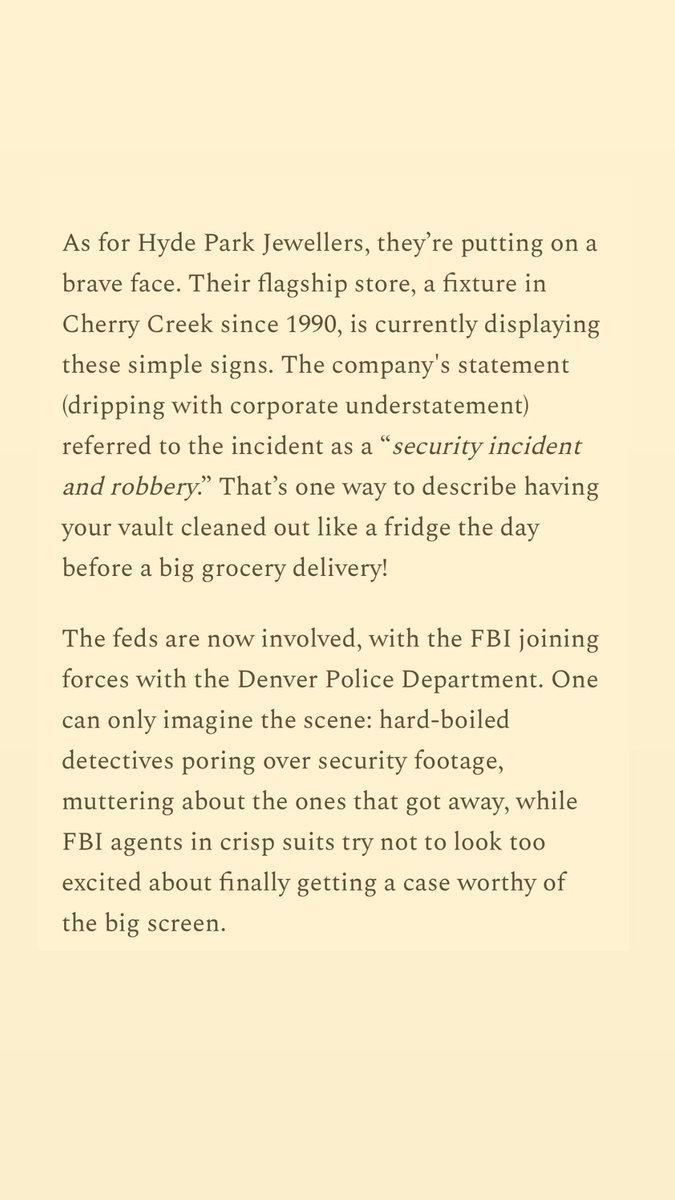
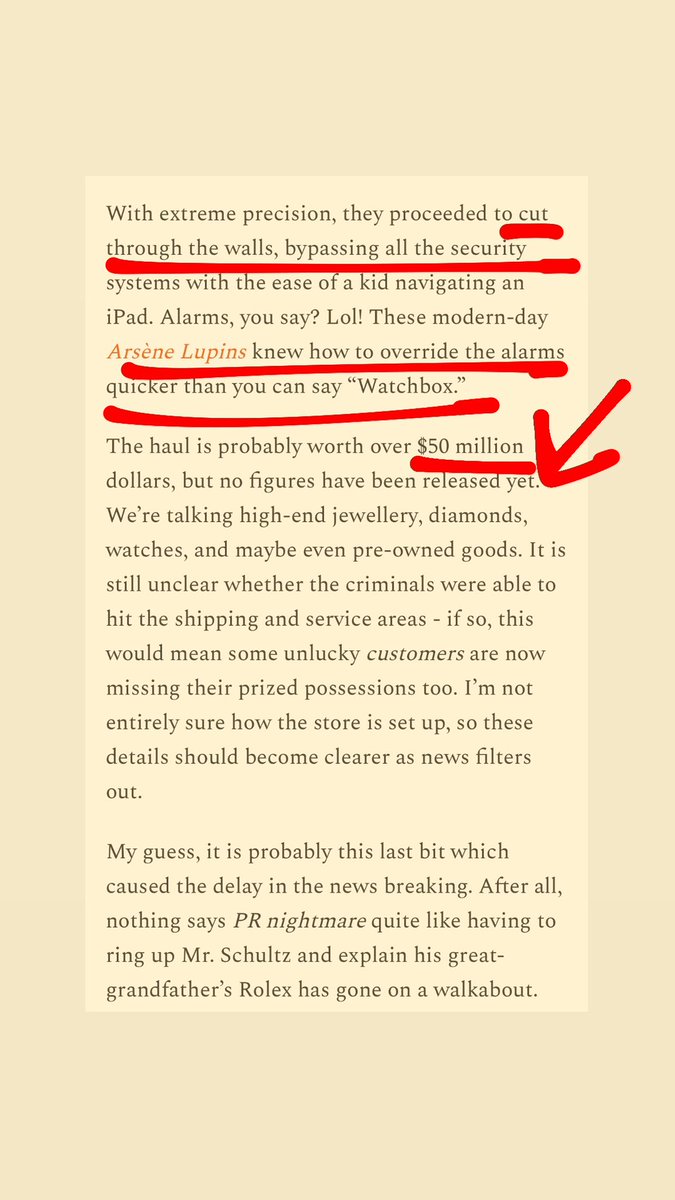
Rumor has it that the @hydepark_jewelers heist was one for the books.
This article by @kingflum confirms what I have been hearing …
The thieves came in through a wall during the night of 7/21 and 7/22
Say hello to GPT-4o, our new flagship model which can reason across audio, vision, and text in real time: https://t.co/MYHZB79UqN
Text and image input rolling out today in API and ChatGPT with voice and video in the coming weeks.
Philisophical question
Imagine a theoretical VR headset that could fully trick all of your senses with perfect fidelity... You put the headset on and see the highest resolution perfect visual of the expansive Grand Canyon or some beautiful natural wonder in front of you
If you could see perfect visuals and hear the birds chirping and feel the wind on your face and smell the grass feel the warm sun on the back of your neck and every sense is fully covered to the point where your brain is basically tricked into believing you're ACTUALLY looking at the Grand Canyon...
when you take the headset off... would you still want to go to the Grand Canyon?
1/ Just realized we recently passed the 30 year anniversary of Nathan Myhrvold's internal Microsoft memo "Road Kill on the Information Highway."
This 1993 memo is probably the most prescient set of 10-ish predictions ever written on the rise of the internet
THREAD: The International Court of Justice (ICJ) has issued a press release stating that it will this Friday “deliver its Order” in response to South Africa’s “Request for the indication of provisional measures”