https://t.co/o1HSLk99h2 is the only prediction platform that allows you set your odds.
YOU HAVE TOTAL CONTROL OVER YOUR PREDICTION.
3000 Naira registration bonus for the first 100 users.
Register TODAY.
YOU THINK YOU KNOW THE ANSWER? PROVE IT.
Don’t just argue about your predictions. Put them to the test on Makemouth.
Predict.
Play against real people.
Win when you're right
Ready to take the challenge?
#MakeMouthChallenge
Register on https://t.co/reUbSR1Upk.
This is a compilation of some past questions you might need for exams or Aptitude tests.
Contains Workforce, Dragnet, Access, HCP, FBN, GTB, UBA, PWC, KPMG, NNPC, Zenith, Mobil and few GMAT.
Share it freely.
Congrats to those shortlisted to take Totalenergies aptitude test
https://t.co/O9tTYLwCiY
@arts_from_khris @GeekyAdams@Olamdeen@NafdacAgency Changing the footer copyright every year looks somehow redundant. Why won't the developer just use normal automatic date function
Every web development interview I did asked me to explain "How the web works"
I fumbled in my first interview but I passed subsequent ones.
Here is how the web works and how you should answer that question:
There are powerful computers connected to the internet 24/7 called web servers.
These servers store a website's web pages, files, and data.
Each server has a unique address called an IP address. Eg is 192.158.1.38
But since IP addresses aren't exactly readable-friendly, domain names are human-readable addresses that are mapped to IP addresses.
To access a website, you use a web browser like Chrome, Firefox, or Safari - you enter the website's URL (Uniform Resource Locator), which is essentially the web address.
What is the difference between a URL and a domain name?
- A domain name is a part of a URL, specifically the part that represents the server's address. Example of a domain name: something(dot)com
- A URL is a complete address that includes the protocol, domain name, path, query, and fragment to specify the exact location of a server on the internet. Example of a URL: https://www.example(dot)com/path/to/resource?query=value#section
When you request a web page by entering a URL, your browser sends a request to a web server.
The server processes your request and sends back the requested web page as a response. This response includes HTML, CSS, JavaScript, and other assets necessary for rendering the web page
Web pages often contain hyperlinks (clickable text or elements) that lead to other web pages. When you click on a link, your browser sends a new request to the server, and the process repeats.
Search engines crawl the web by following links and indexing web pages
There are measures like SSL/TLS encryption and security certificates that help protect data during transmission and prevent unauthorized access to websites.
This is how the web works. Follow me @MichaelAsiedu_ for more content like this.
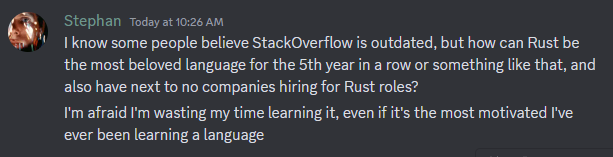
DO YOU SEE WHY I KEEP SAYING THIS OVER AND OVER AGAIN!?!?!
Do you see why I tell people that if their goal is to get hired, they shouldn't be listening to what is POPULAR but instead should be looking at the demand in their local markets.
Just had this message in the commit your code discord. So many beginners do this to themselves. It is amazing to find a language you like and enjoy using.
For a while, I had a lot of fun writing Flutter. I even did a workshop on it back in the day, BUT if you are trying to get your first job in tech, this is probably going to be WAY harder for you to do with tech that the companies aren't using.
Is this the most retweetable cool answer to say? No
Is it a real answer and maybe something you NEED to hear instead of what you would WANT to hear? 100%.
This applies to everything from Rust to Node.js.