Complete silence is unnatural, it hardly exists on Earth. Notice the photo shows a man sitting by the sea?
It's the Sound of Nature which regenerates the brain, not silence.
I don’t know why, and it doesn’t matter, but the investing gods don’t reward oversized positions at cost.
Start with a moderate investment. If the business is truly exceptional, it will still change your life.
“Don’t ever aim to find the multi-baggers. Just keep it really simple. “
“The hand of god will be on you if you try to earn 15% per year return. You’d be surprised how many stocks compound 35% then.”
“Only common sense makes money in the markets, not maths.”
- Sanjoy Bhattacharya
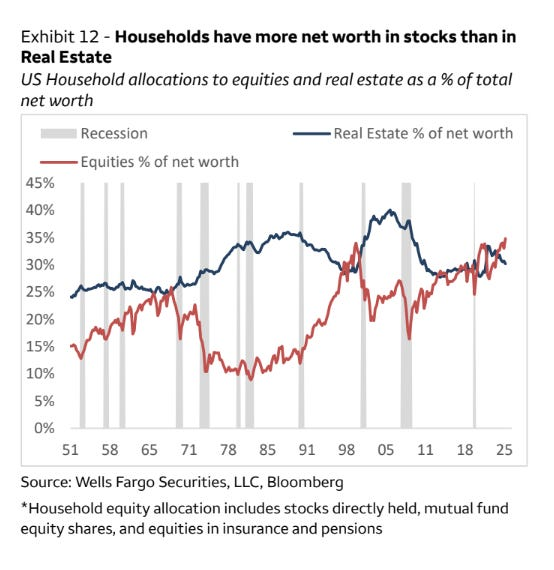
This is a very interesting chart, as household stock wealth being higher than real estate wealth has only happened in the late 60s and late 90s, the last two times the ensuing bear market lasted years.
Beary Burry
Nvidia is the world’s most valuable company, generating $120 billion of annualized net income selling highly engineered chips and software that have required decades to perfect.
So why have they felt it necessary to issue a rebuttal to short sellers like Michael Burry?
Three reasons:
1. It is difficult to sustain 75% gross margins when some of your biggest customers are unprofitable, and your chips are 80% of their costs.
2. Those unprofitable customers are dependent on investors to fund their losses. Investors can move in herds, and their confidence about AI has been made fragile by OpenAI’s "manifestly ridiculous" $1.4 trillion of compute commitments.
3. More broadly, Nvidia is unsure where value will land in the AI business. Anyone using the latest models knows how they can lower the cost of legal advice or reading an MRI. Our own work finds that reading an MRI costs $150 for a human doctor compared to $0.15 for an AI model. This 99.9% spread is the biggest we have ever seen in business. But who gets it? The chip maker? The model maker? An application maker? The doctor? The patient?
Nvidia’s real competitor is Google, which generates $140 billion of annualized net income and owns important assets across the full stack of AI: TPU chips; Gemini models; data from 3.5 billion humans using its services; and distribution across multiple surfaces like Search, YouTube and Cloud.
Nvidia’s strategy is to support its customers’ efforts to raise investor capital until their businesses capture enough of that 99.9% spread to be self-sustaining, and to hope that its own 75% gross margins are sustainable. A loss of investor confidence impairs this strategy, which why the rebuttal was issued.
Google’s strategy is to drive costs down across the full stack, to protect Search's advertising business and to generate profits wherever they end up landing. Its founders have said they are willing to bankrupt the company rather than lose in AI.
Investors chasing winner-take-all outcomes across the AI stack may be disappointed. Based on how unit economics look today, much of AI looks like a commodity business in which low cost wins.
Nvidia’s and Google’s strategies are in obvious conflict. Some investors will make a lot of money and others will lose a lot. More will be revealed as this unfolds. Pass the popcorn.
If we are going by "Inflation-Adjusted Pricing," using past price spikes is incorrect.
Inflation-Adjusted prices need to go by "Cost of Production."
The U.S. Dollar in 1980 would be worth $3.93 today, much closer to the cost-of-production increase than a $200 Silver price.
Animal impact has been a hot topic in many debates. Some say cattle are part of the problem. We say they are a necessary part of the solution.
Find a farmer raising good food and support them. It's more than a good tasting steak, it's rebuilding a system to heal our planet and our bodies.
The more detailed you describe physiological mechanisms or processes the more likely you are making mistakes.
All you need to know are the outcomes, let others argue over the 'science'. This protects you from fads which claim to be scientific.
Example: Does weight-training make you stronger? Yes. Does it do it via stimulating receptors, hormonal changes, microtears, etc., who cares. Current theories will change.
What is happening now has happened many times before, just not in our lifetime:
"Prudent men are wont to say - & this is not rashly or w/out good ground - that he who would foresee what has to be should reflect on what has been, for everything that happens in the world at any time has a genuine resemblance to what happened in ancient times." Niccolo Machiavelli