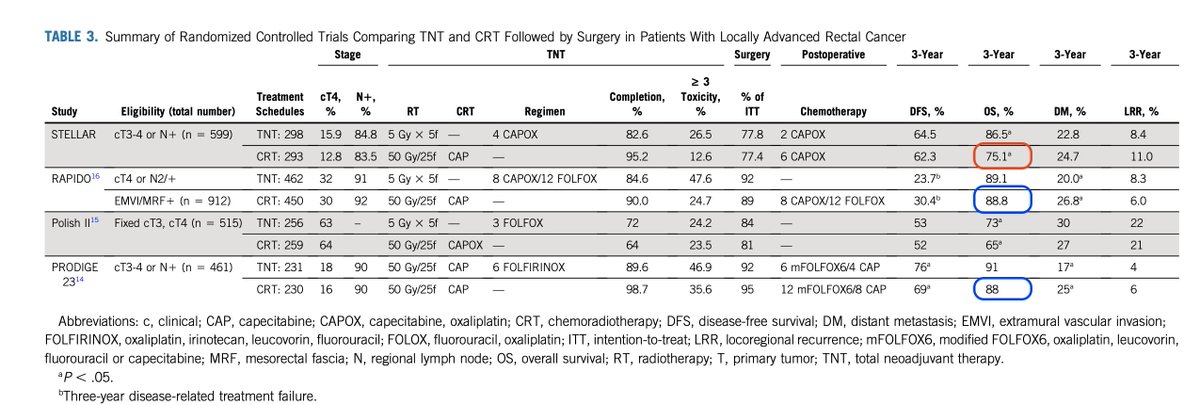
1. Primary endpoint of the trial for Non Inferiority of DFS of TNT compared to CRT, which trial met its end points, but secondary end points MFS and LRR were not met. OS was the secondary endpoint, which showed benefit in exploratory non-pre-specified analysis but not in the primary analysis. So modest benefit of OS advantage is may be due to underperformance of control arm in the trial with 3 year OS of 75%, comapred to nearly 88% in PRODIGE and RAPIDO trial.
2. OS advantage is due to post-recurrence survival benefit in TNT arm, biological reason is not defines=d, when both arm is receiving 6 cycles of CAPOX.
3. CRT vs TNT ? what youre prefernce
@ChandrakanthMv@DrRishabhOnco
Amivantamab in Recurrent/Metastatic HNSCC After Checkpoint Inhibitor and Chemotherapy: Pivotal Results From the Phase 1b/2 OrigAMI-4 Study.
Read the full article. https://t.co/SSGsOOykGx
🚨 New in JAMA Oncology: First systematic review and meta-analysis of second primary malignancies after T-cell–engaging bispecific antibodies in lymphoma and MM.
Key findings:
• 3.5% reported SPMs
• 2.2% treatment-discontinuing SPMs
• 1.4% fatal SPMs
https://t.co/76e9kmLIbD
Do you know which blood types are compatible with each other?
Biologist Karl Landsteiner classified people and their blood into three groups, now known as A, B and O, with a fourth group AB discovered soon after. He showed that to successfully transfuse blood, matching blood types was crucial: transfusions between compatible groups were safe, but mixing different types could be deadly.
Landsteiner was awarded the Nobel Prize in Physiology or Medicine 1930 for his discovery. During the rest of his career, Landsteiner continued investigating blood groups. In the 1940s, decades after his first discovery, he and collaborators discovered another blood group: Rh. Today, we know of over 200 minor blood groups, but the ABO and Rh systems are most important for determining blood compatibility.
Read more about safe blood transfusions: https://t.co/SQOpncoUqp
⭐️A milestone in #PrecisionMedicine 👉🏼Among patients with previously treated metastatic pancreatic ductal adenocarcinoma, the RAS(ON) inhibitor daraxonrasib led to significantly longer overall survival and progression-free survival than chemotherapy. Full phase 3 RASolute 302 trial results: nej.md/4nWaxvM
@ASCO@NEJM
75–95% of reclassified VUS ultimately become Benign or Likely Benign.
The future of genomic reporting is not reporting more variants.
It's reporting the right variants in the right clinical context.
𝗦𝘂𝗴𝗴𝗲𝘀𝘁𝗲𝗱 𝗥𝗲𝘃𝗲𝗿𝘀𝗮𝗹 𝗦𝘁𝗿𝗮𝘁𝗲𝗴𝗶𝗲𝘀 𝗼𝗳 𝗢𝗿𝗮𝗹 𝗔𝗻𝘁𝗶𝗰𝗼𝗮𝗴𝘂𝗹𝗮𝗻𝘁 𝗨𝘀𝗲 𝗳𝗼𝗿 𝗠𝗮𝗷𝗼𝗿 𝗕𝗹𝗲𝗲𝗱𝗶𝗻𝗴 𝗮𝗻𝗱 𝗯𝗲𝗳𝗼𝗿𝗲 𝗘𝗺𝗲𝗿𝗴𝗲𝗻𝗰𝘆 𝗦𝘂𝗿𝗴𝗲𝗿𝘆.
As shown in Panel A, reversal management depends on the urgency of surgery or the invasive procedure. Reversal management includes administration of oral or intravenous (IV) vitamin K with or without 4F-PCC, depending on the timing of the procedure (emergency or urgent), baseline international normalized ratio (INR) value, and presence (or absence) of active bleeding. For patients receiving direct oral anticoagulants (DOACs), the decision also depends on time to surgery. Decision making is informed by DOAC type, time since last dose, half-life, presence (or absence) of active bleeding, and renal function tests to estimate residual drug activity.
Panel B shows reversal strategies for patients presenting with major bleeding while receiving an oral anticoagulant. The reversal strategy of vitamin K antagonists includes vitamin K given intravenously or orally, combined with 4F-PCC and INR testing. Management of anticoagulant reversal of direct oral FXaIs is based on four key factors (shown as the 4Ts): type of bleeding, timing of the last dose, thrombotic risk, and need for invasive procedures in the next 48 hours that would result in the administration of UFH. These factors may facilitate the use of specific (e.g., andexanet alfa) or nonspecific (e.g., 4F-PCC) antidotes. The reversal of dabigatran is informed by three clinical variables (shown as the 3Rs) — the type of bleeding, time of the last dose of dabigatran, and preserved renal function.
Learn more in the Review Article “Antidotes for Anticoagulation Reversal” by Bianca Rocca, MD, PhD, and Hugo ten Cate, MD, PhD: https://t.co/XobqwMebfy
NEJM subscribers: Explore this article deeper with AI Companion.
BART trial from TMH Mumbai, India
Vedang Murthy et al, JCO, 2026
MIBC tends to recur locally after cystectomy. Adjuvant pelvic RT till date always was WEAK evidence [EAU guideline]
This trial from India - demonstrated LRFS benefit at 2 years with less than 5% of G3 toxicity with IMRT 👏
Highlight - No pelvic local recurrence
90% received chemotherapy - GC / MVAC & modified MVAC and no immunotherapy
With the advent of adjuvant IO, the optimal sequencing or combination of RT with immune CPIs is not yet defined.
Question - Baseline cT3-T4 - post NACT & surgery with ypT0N0 - does the LRFS benefit remain same ?
#OncoTwitter #MedTwitter #MedicalOncology #UroOncology #Bladder #RadiationOncology
@Uroweb@GUOncologyNow@BladderCancerUK@RadOncTMC@GTumors
JUST IN: @FDA approves adjuvant PD-L1 inhibitor Atezolizumab in Muscle-Invasive Bladder Cancer post surgery & ctDNA MRD (+) by @NateraGenetics Signatera CDx approved as companion diagnostic.
MRD-guided adjuvant therapy is moving into practice in Bladder Cancer!
FDA link: https://t.co/DPjLN6Ag2Z
Ever noticed how many AstraZeneca oncology trials are named after mountains, rivers, seas, and gemstones?
From PACIFIC to HIMALAYA, NIAGARA to TOPAZ — the names themselves are surprisingly memorable.
A fun look at the “nature-inspired” world of oncology trial naming 🌍💎🌊⛰️
Which trial name is your favorite?
#Oncology #MedEd #LungCancer #UrothelialCancer #HCC #BTC #MVOnco
Effect of one or two cycles of dual IO with nivolumab and ipilimumab in patients with dMMR rectal cancer (RESET-R): single-arm, phase 2 trial
cCR➡️100%💯
None of the patients underwent surgery or RT, and there was no recurrence at a median F/U of 16 mo.
https://t.co/wwSuPGQnkP
Vepdegestrant (PROTAC ER degrader) @US_FDA ✅ for HR+ metastatic breast based off #Veritac2 Ph III vs. (Fulvestrant) after CDK4/6i + AI:
- mPFS 5.0 vs 2.1 mos in ESR1m (HR=0.57)
- OS is immature
- Well-tolerated, low discontinuation
#bcsm@OncUpdates@OncoAlert


![YesMVchemoMed's tweet photo. BART trial from TMH Mumbai, India
Vedang Murthy et al, JCO, 2026
MIBC tends to recur locally after cystectomy. Adjuvant pelvic RT till date always was WEAK evidence [EAU guideline]
This trial from India - demonstrated LRFS benefit at 2 years with less than 5% of G3 toxicity with IMRT 👏
Highlight - No pelvic local recurrence
90% received chemotherapy - GC / MVAC & modified MVAC and no immunotherapy
With the advent of adjuvant IO, the optimal sequencing or combination of RT with immune CPIs is not yet defined.
Question - Baseline cT3-T4 - post NACT & surgery with ypT0N0 - does the LRFS benefit remain same ?
#OncoTwitter #MedTwitter #MedicalOncology #UroOncology #Bladder #RadiationOncology
@Uroweb @GUOncologyNow @BladderCancerUK @RadOncTMC @GTumors](https://pbs.twimg.com/media/HJFaoU3bkAA2e3f.jpg)




![YesMVchemoMed's tweet photo. BART trial from TMH Mumbai, India
Vedang Murthy et al, JCO, 2026
MIBC tends to recur locally after cystectomy. Adjuvant pelvic RT till date always was WEAK evidence [EAU guideline]
This trial from India - demonstrated LRFS benefit at 2 years with less than 5% of G3 toxicity with IMRT 👏
Highlight - No pelvic local recurrence
90% received chemotherapy - GC / MVAC & modified MVAC and no immunotherapy
With the advent of adjuvant IO, the optimal sequencing or combination of RT with immune CPIs is not yet defined.
Question - Baseline cT3-T4 - post NACT & surgery with ypT0N0 - does the LRFS benefit remain same ?
#OncoTwitter #MedTwitter #MedicalOncology #UroOncology #Bladder #RadiationOncology
@Uroweb @GUOncologyNow @BladderCancerUK @RadOncTMC @GTumors](https://pbs.twimg.com/media/HJFaoVCbkAArQMp.jpg)


