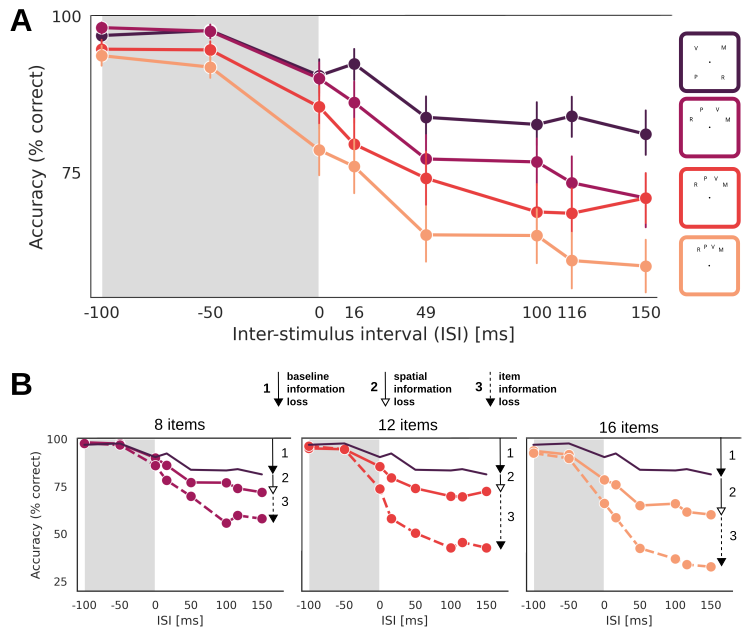
More on all this and on the different latencies involved in the readout from sensory memory represenations in the preprint --> https://t.co/NUqbOGTgFa
Many many thanks to @konigpeter@johndylanhaynes@IsSamTaf for this fun and unexpected journey :)
New priprint!
When I started my PhD (ages ago), I ran what I thought was a pilot for several iconic memory experiments down the line. This was interesting because iconic memory is (allegedly) linked to rich perceptual experience, and so I had many questions. 1/🧵
We also looked at whether availability is driven by array size or how crowded they are. We saw that crowding affects not only perception (i.e. encoding) but also memory decay. We suggest this is because it is harder to read out of crowded memory representations.
I'm seeing more & more people use partial correlation during model comparison to identify the contribution of a model to prediction *after controlling* for other models. However, the correct approach is *not* to use partial correlation. A brief explanation. 🧵 1/n
And it's done! The 2023 Workshop has officially ended 🎉 We are excited to have this amazing group of participants and keynotes join our ever-growing #MESEC community
How does our brain enable us to make sense of our visual world? 🗺👀🧠
Excited to share our latest work with @Chris_I_Baker and @martin_hebart : “Distributed representations of behaviorally relevant object dimensions in the human visual system”
https://t.co/fN1GK5Gjf0
🧵 1/n
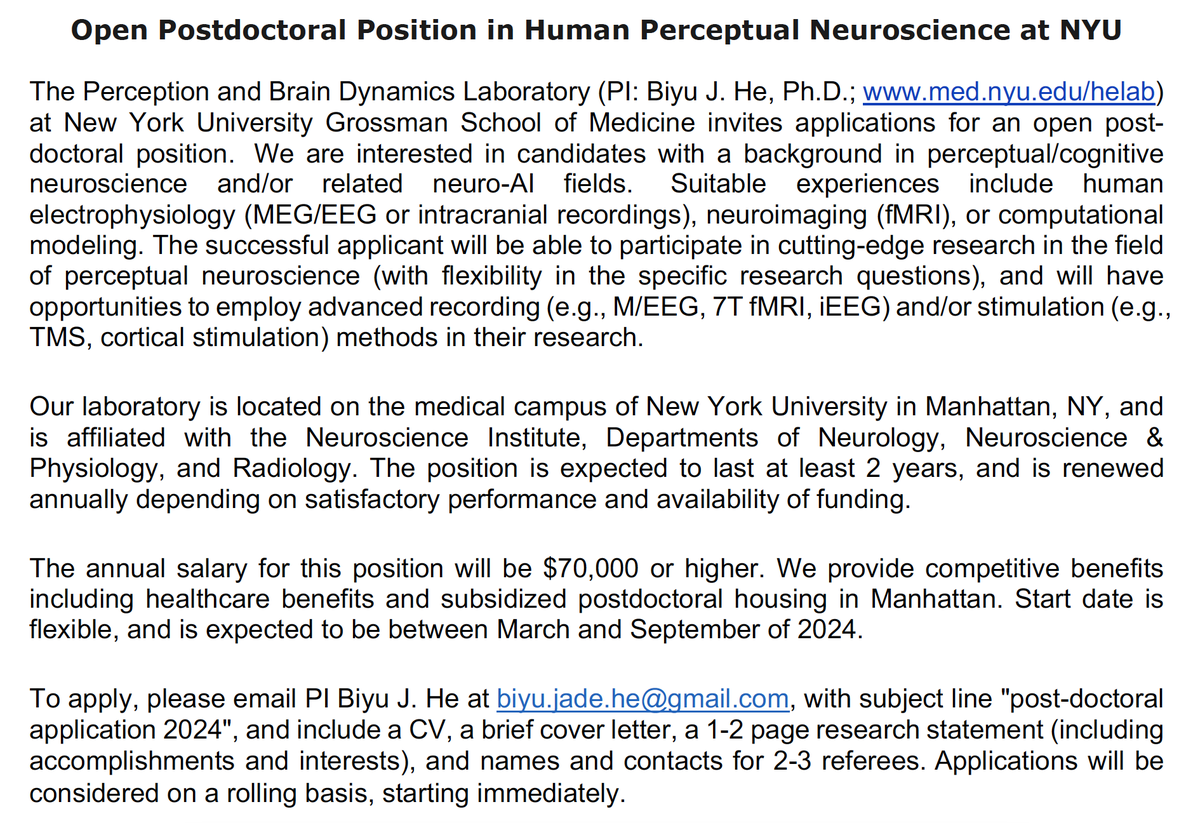
Our lab currently has an open postdoc position in the field of perceptual neuroscience.
Specific questions: w flexibility, and a focus on vision;
Techniques: open (fMRI, E/MEG, iEEG, stim, modeling);
Salary: $70,000 or higher (w excellent benefits);
Start date: flexible in 2024
Why are we conscious? Don't say "I know the answer". Instead, come help us figure out the best way of asking the question. To do so, join the fab @erc_experience team. Extra credit for a computational cognitive neuroscience background.
https://t.co/7ZPIhd8qn4
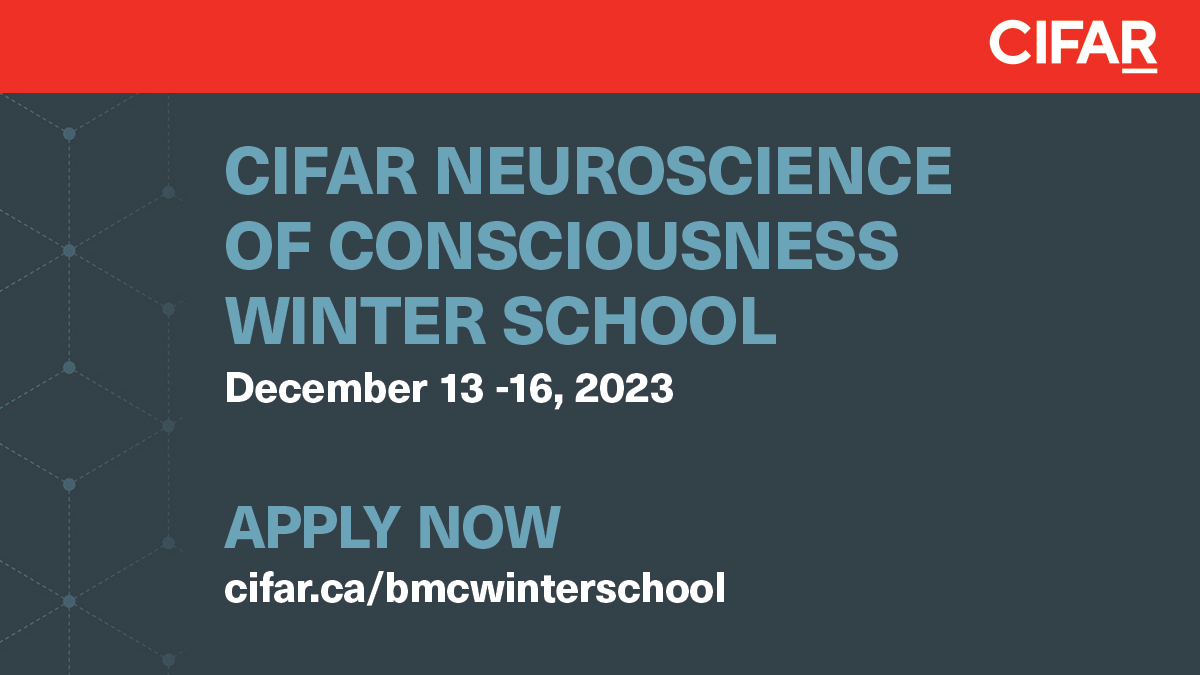
#CIFARWinterSchool is a fully-funded opportunity for senior PhD and post-doc students to spend three days immersed in learning and collaborating on cutting-edge consciousness research.
Learn more and apply by Oct 2: https://t.co/jKPj7l5UZs
@TempletonWorld
reminder! we are seeking a postdoc to join our group. projects are investigating higher order theories of consciousness with psychophysics, fMRI, ML, and other cool stuff.
priority deadline in NINE DAYS, Aug 31:
https://t.co/66ceuqGNDm
please spread the word!
📣 Applications for the 2024 Complexity Postdoctoral Fellowships are now open! If you’ve finished your PhD and are interested in transdisciplinary #research, consider applying for this unique #fellowship at SFI.
For more info and to apply see here 👉 https://t.co/DVNtyphmI0
Excited to share that we found modules in visual cortex for segmenting a visual scene into objects. Find more details in our paper just published in PNAS (https://t.co/gHnoWSNBKh) or the summary thread below: (1/8)
Applications for the MESEC workshop are still open! From 2-10th Sep: empirical questions in consciousness science, 5 stellar keynotes and 16 PhD/post-doc participants, a dreamy Mediterranean venue. Sounds enticing? There's still time to apply *by tonight*! ☀️
**2** days left to apply to the 2023 #MESEC Workshop in Corsica this September. Tailored for advanced PhD students and post-docs, all theories, methods, paradigms, and models are more than welcome and much appreciated🤗 Apply now >> https://t.co/wumb6eZnJB
Introducing https://t.co/zBDFUc48A0, a large language model (LLM) to assist neuroscience research. BrainGPT is trained on the vast neuroscience literature and can be used to optimize study design, detect anomalous results, and evaluate models against broad data patterns. (1/3)