🚀 The bigger picture is becoming clear.
@MSTBlockchain is not collecting partnerships.
It is assembling an ecosystem.
🔹 @SafePal – Wallet adoption
🔹 @FireblocksHQ – Institutional security
🔹 @YellowCapital_ – Strategic growth
🔹 Trace Circle – Supply chain transparency
🔹 XPI – Cross-border payments
🔹 FSV Labs – AI, Fintech & Enterprise transformation.
Great to see leaders like @KNagware and FSV Labs joining the journey.
Payments, identity, tokenization, enterprise adoption and supply chains are no longer separate narratives.
They are becoming one ecosystem on @MSTBlockchain. 🚀🔥
The vision is getting bigger with every partnership.
Piece by piece, the infrastructure for real-world blockchain adoption is taking shape.
This is how ecosystems are built. 🇮🇳🌍
#MSTBlockchain #Web3 #Layer1 #BlockchainAdoption
AI agents won’t just shop for us.
They’ll consume services, coordinate tasks, manage capital, and transact with each other.
On @ycombinator, @jerallaire explains why the agentic economy needs infrastructure for contracts, payments, governance, and economic execution at machine scale.
Citi predicts the tokenized securities market will grow to $5.5 trillion by 2030
Stablecoins alone will generate a demand for up to $1 trillion worth of onchain U.S. Treasury bills and $2.6 trillion for tokenized stocks,
Citi predicts the tokenized securities market will grow to $5.5 trillion by 2030
Stablecoins alone will generate a demand for up to $1 trillion worth of onchain U.S. Treasury bills and $2.6 trillion for tokenized stocks,
🚀 Another strategic move by @MSTBlockchain
XPI (Extended Payment Interface) is building payment infrastructure that connects traditional finance with blockchain-powered value transfer.
✅ Cross-border payments
✅ Fiat + Digital Currency interoperability
✅ Compliance-first architecture
✅ Enterprise-grade financial infrastructure
With MST Blockchain and XPI joining forces, the vision is clear:
Building the bridge between Web3 innovation and real-world finance. 🌍🔗
Supply Chains ✔️
Carbon Credits ✔️
Enterprise Blockchain ✔️
Digital Payments ✔️
The ecosystem keeps growing. 🚀🔥
#MSTBlockchain #XPI #Web3 #Fintech #DigitalPayments #Blockchain @cz_binance@KWebbuddy@LoharPrasanna@KNagware@binance
🤝 Partnership Announcement
MST Blockchain is excited to partner with XPI (Extended Payment Interface) to accelerate innovation in blockchain-powered digital payments and financial infrastructure.
Together, we aim to build secure, scalable, and future-ready solutions that bridge traditional finance with the decentralized economy.
🚀 Driving the future of payments.
🔗 Strengthening blockchain adoption.
🌍 Enabling next-generation financial ecosystems.
#MSTBlockchain #EPI #ExtendedPaymentInterface #PartnershipAnnouncement #BlockchainTechnology #DigitalPayments #DecentralizedEconomy #MSTEcosystem
🚨 Reliance Industries says it will invest ₹10 lakh crore in AI-ready data centres over the next 7 years, as part of its plan to build sovereign AI infrastructure in India.
follow @india_plus_
𝑷𝒂𝒓𝒕𝒏𝒆𝒓𝒔𝒉𝒊𝒑 𝑨𝒏𝒏𝒐𝒖𝒏𝒄𝒆𝒎𝒆𝒏𝒕
Trace Circle will now use MST Blockchain to power a more transparent, trusted, and sustainable supply chain.
From sourcing to retail, blockchain ensures:
✅ Transparency
✅ Traceability
✅ Security
✅ Sustainability
Together, we're building the future of supply chains. 🤝
#MSTBlockchain #TraceCircle #Blockchain #SupplyChain #Web3 #Traceability #Transparency
Check out the latest article in my newsletter: India's Tech Sovereignty: From Silicon to AI to Blockchain https://t.co/lGHUoDjFaR via @LinkedIn
The average Indian founder who builds something that lasts is 34 at founding. Not 22. Not fresh out of IIT.
34, with a decade of domain experience, a real professional network, and enough savings to not need a salary for 18 months.
The myth of the young founder is a Valley import that has never fit India as well as the ecosystem pretends.
IIT Madras's Bharat 6G Thz .. Indigenous 6G developed at Indian Institute of Technology, Madras
@iitmadras
Source : https://t.co/rZXjHpVjeZ
#6g#iitmadras
🚨 THE ENTIRE AI BOOM MIGHT BE BUILT ON FAKE REVENUE.
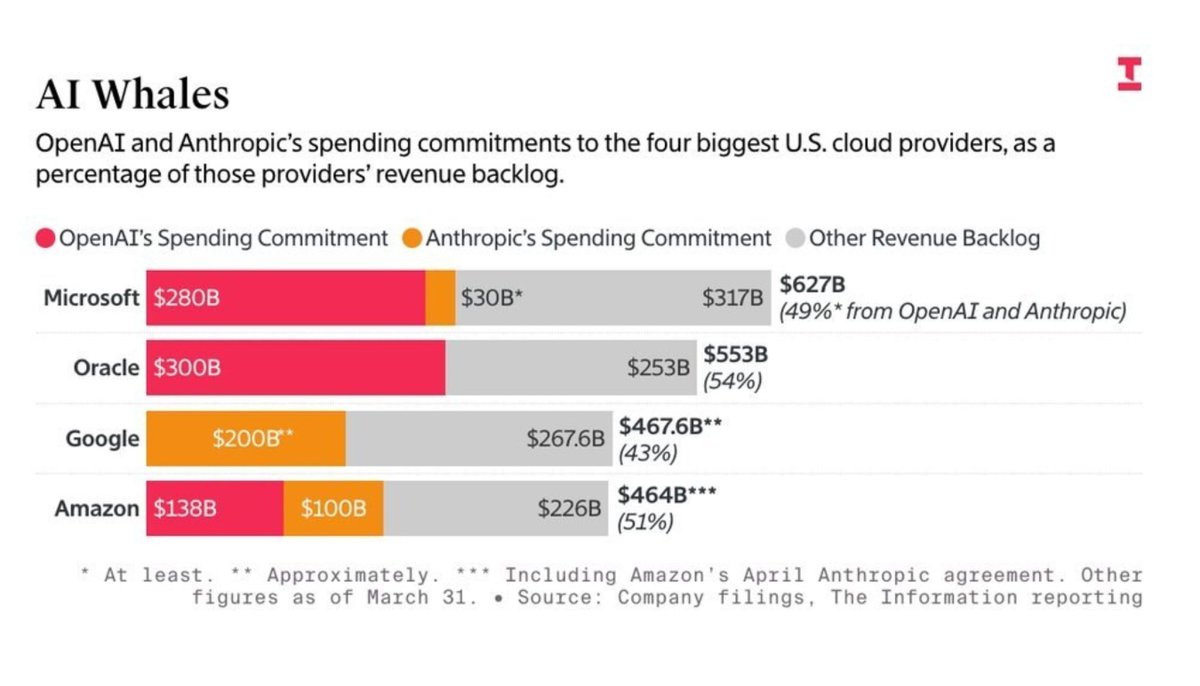
Latest corporate filings show that OpenAI and Anthropic alone make up over half of the entire $2 trillion future cloud backlog held by Microsoft, Oracle, Google, and Amazon.
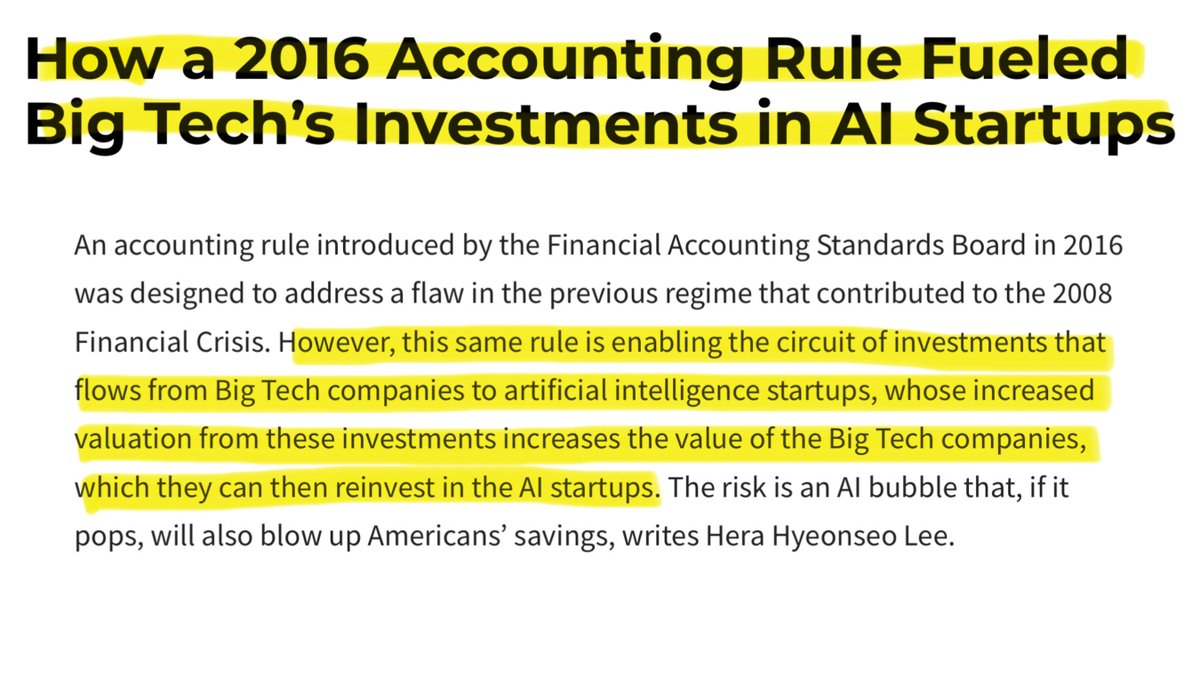
This massive pipeline is actually being created through a circular accounting trick called a round trip revenue loop.
But how it works ?
A tech giant gives billions of dollars to an AI startup as an "investment". But hidden in the contract is a strict rule forcing the startup to hand that exact same money straight back to the tech giant to rent their computer servers.
Look at the documented case of Microsoft and OpenAI.
When Microsoft invested $13 billion into OpenAI, it didn't just give them cash; it gave them "cloud credits" to use Microsoft servers. OpenAI used those exact credits to train its AI models, and Microsoft then turned around and recorded that server usage as brand new "cloud revenue" from a customer.
The tech giant is literally paying itself with its own money and calling it a sale.
This is why OpenAI’s annual cloud bill has ballooned to over $60 billion, double its actual revenue of $25 billion, kept alive solely by this recycled funding loop.
Anthropic runs the exact same play, spending $2.66 billion on Amazon Web Services in just nine months, which was basically 100% of all the money it earned at the time.
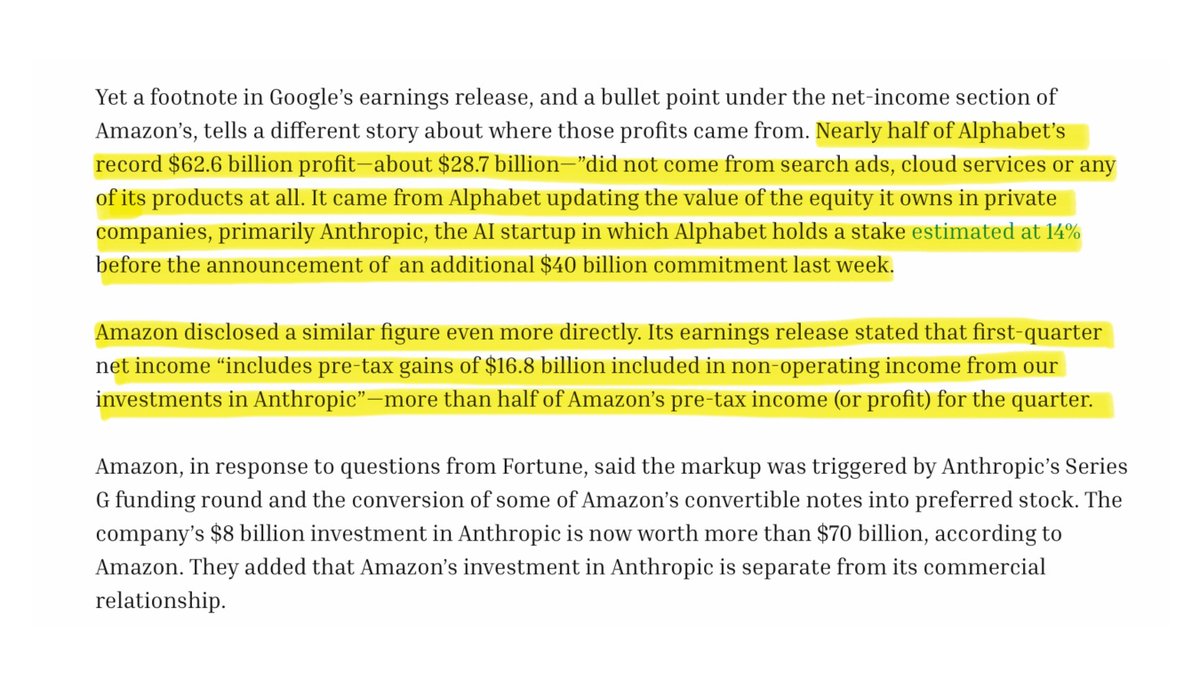
This manufactured demand triggers a second accounting trick where tech giants book massive paper profits. Every time a startup gets a higher value from a new funding round, the tech giant updates the value of its investment on its books and counts that unearned paper gain as direct profit.
In Q1 2026, Alphabet reported a record $62.6 billion profit, but $28.7 billion nearly half, was just a paper markup on its Anthropic investment. In the same quarter, Amazon reported $30.3 billion in profit, but $16.8 billion of it was just an Anthropic paper gain.
While Amazon reported record profits, its actual free cash flow collapsed 95% to just $1.2 billion because it had to spend $44.2 billion in real cash to build physical data centers.
This has created a massive danger where these giant companies rely heavily on just one or two unstable startups. Microsoft has 49% of its $627 billion future backlog tied to OpenAI, while Oracle has an incredible 54% of its entire $553 billion pipeline relying on OpenAI alone.
This perfectly mirrors the 2001 dot-com crash when Global Crossing and Qwest Communications swapped identical fiber-optic network capacity with each other just to book fake sales.
Qwest had to erase $1.4 billion in fake income, and Global Crossing went completely bankrupt.
The only difference is that the dot-com swaps were illegal, but today's AI loop is fully legal under current accounting rules.
This legal loop inflates tech company stock prices, forcing automatic retirement accounts and index funds to buy even more of these tech stocks. It is a self feeding loop where investments, sales, and stock prices all go up on paper without the AI technology ever making real cash profits.