One of the most honest reads on enterprise AI returns⬇️
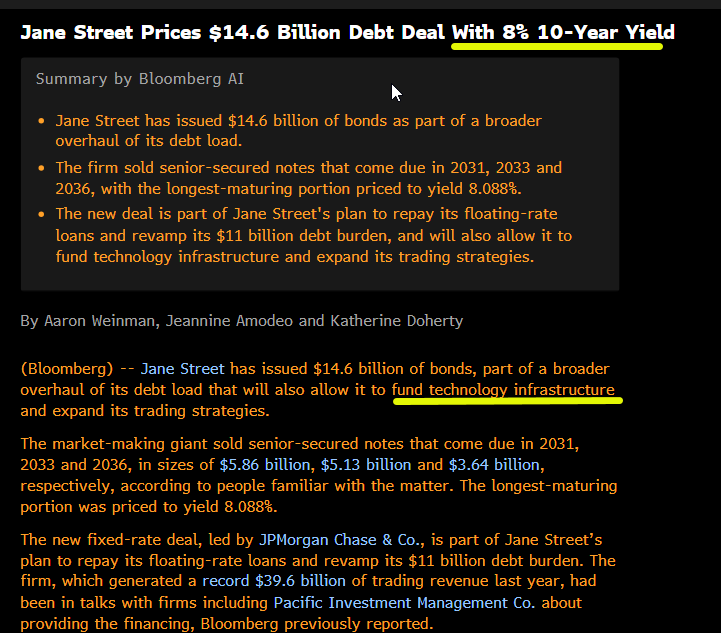
Jane Street just raised $14.6B in senior secured notes, the largest bond deal ever by a non-bank market maker. The 10-year tranche priced at 8.088%. Primarily a refi of a $5.5B floater and an $11B debt load, but tech infrastructure and trading expansion are stated uses.
What makes this rare: Jane Street is one of the largest disclosed non-tech internal-GPU users, and one of the few with publicly priced debt against it: 4,032 liquid-cooled GPUs in Dallas, ~$6B committed to CoreWeave plus $1B of equity, early work on a self-financed 100-200MW build, targeting 10x into the hundreds of thousands.
They sell no compute and no inference. The chips forecast asset prices. The output is directly monetized and the funding cost is observable.
So, the bar is computable: At CRWV's 6-year depreciation life and 10% salvage, $100 of Jane Street capex must throw off $20.33 (20.3%) annually for six years plus $10 back at the end to set NPV at zero against 8%, 10-year money.
Salvage assumptions barely move it. Every 10 points of recovery buys only ~136bp annually: 25% salvage requires an 18.3% cash yield, etc.
So Jane Street is carrying 8% money against a ~20% break-even, even on modest salvage assumptions. Nobody with their track record takes that trade casually, a real signal about what monetized AI output can earn when someone can actually measure it.
It's also a signal about what the bond market will underwrite: $14.6B, ten years out against a "six-year asset," no NVIDIA residual backstop, clearing on conservative salvage assumptions. Which leaves room for these rates to come down if and as the fundamentals materialize and for IG borrowers to try the same trade on even better terms.
Nebius is now charging $40-50 million per megawatt on new capacity deals and it signed its first one at that price this week (Save this).
Nebius reported Q2 2026 earnings that blew past every prior benchmark in the neocloud sector, with revenue hitting $582 million, up 454% year over year, and annualized recurring revenue reaching $3.0 billion by the end of June, up 58% quarter over quarter.
The company won four separate customer agreements worth over $1 billion in total contract value each and its total contract value won during the quarter jumped 4x versus the prior period.
That new pricing tier is a massive jump from where Nebius started the year.
Its average contract value per megawatt stepped up from roughly $12 million in its 2026 base contracts, to over $20 million on Q2 deal and now over $40 million on the short-term capacity deals signed heading into Q3, meaning pricing power has more than tripled within the same year.
Then there's this line that management said "Nebius could sell our entire 2027 capacity on these terms today," but is "deliberately not doing so" because it sees higher value in holding some capacity back for immediate customer needs.
That's a company turning away guaranteed revenue because it thinks it can get an even better deal later, which is an extraordinary flex for a business this early in its growth curve.
The capacity guidance tells the same story from a different angle.
Nebius has raised its 2026 contracted power guidance at every single quarterly report for the past year, climbing from over 1 gigawatt in August 2025 to over 2.5 gigawatts in November, over 3 gigawatts in February, over 4 gigawatts in May, and now 5 gigawatts currently.
Power is the one input in this entire AI buildout that capital can't simply buy on demand, so a company that keeps proving it can lock down more of it quarter after quarter is showing real, verifiable infrastructure progress rather than just marketing hype.
Now to the chart that puts all of this in perspective across the industry.
On an annualized revenue per active-megawatt basis, Nebius is generating $9.4 million, essentially tied with CoreWeave's $9.8 million and IREN's $10.4 million, and all three neoclouds are running at roughly triple the revenue efficiency of traditional colocation players like Digital Realty at $3.5 million, Equinix at $4.4 million, and Coresite at $3.6 million.
Even more strikingly, SpaceX's per-MW revenue benchmark, calculated on a contract basis, ranges from $30 million to $50 million, which is exactly the range Nebius just said it started pricing new deals at, suggesting Nebius may be closing the gap toward SpaceX-level monetization rather than staying capped at typical neocloud economics.
I remain extremely bullish as always on Nebius, make sure to follow @MelvinInvests for more AI infrastructure insights, and if you want to see exactly what I'm buying as an analyst at Milk Road Pro, you can check out the link below for more.
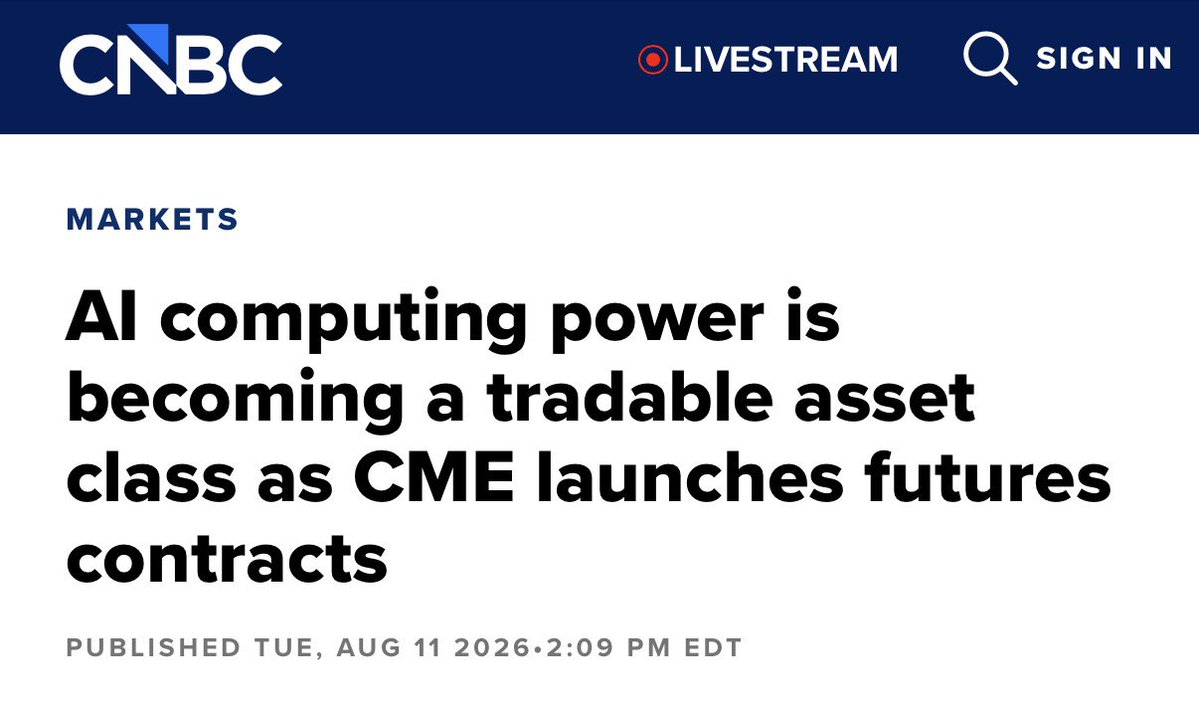
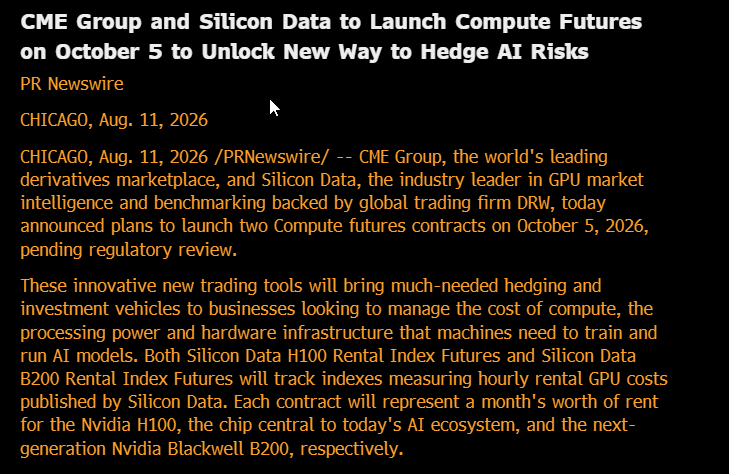
This is wild! The contracts will allow buyers and sellers to trade against the rental cost of Nvidia GPUs and will be based on Silicon Data indexes that track hourly GPU rental prices. Each contract will represent a month’s rent for the Nvidia H100.
https://t.co/vrj9j7yqNR
In June, SemiAnalysis said NVIDIA’s 800VDC rollout could slip to 2028+, hitting power-related stocks hard.
NVIDIA just clarified the roadmap:
H2 2026: MGX-compatible 800VDC power racks arrive for existing AC data centers, with no building-level electrical overhaul required.
2027: Row Power Centers using overhead 800VDC busways, supporting up to 2 MW per row.
Longer term: fully native 800VDC facilities with direct medium-voltage-to-800VDC conversion.
NVIDIA is using a staged rollout, with commercial deployment starting much earlier through hybrid infrastructure.
xAI just launched Grok Bot, and this is much more interesting than another model release. And especially *not* on my bingo-card. And the first cursor-release of the week.
You basically create AI coworkers that have their own computers, can log into Gmail, Salesforce, LinkedIn and basically any website, work 24/7 even *while your laptop is closed*, and come back when they actually need you.
You can even show them a workflow once and they turn it into a routine. Multiple Bots can work in parallel, talk to each other and hand tasks between themselves.
Interesting detail: this is VERY deeply integrated with Cursor. The downloads are hosted by Cursor, Cursor Ultra includes it, and xAI is literally selling Cursor plans on the Grok Bot page. But it isn't only a Cursor product: SuperGrok Heavy users get access too.
tl;dr: Cursor deal was probably the best thing ever happened to xAI. Really interesting release.
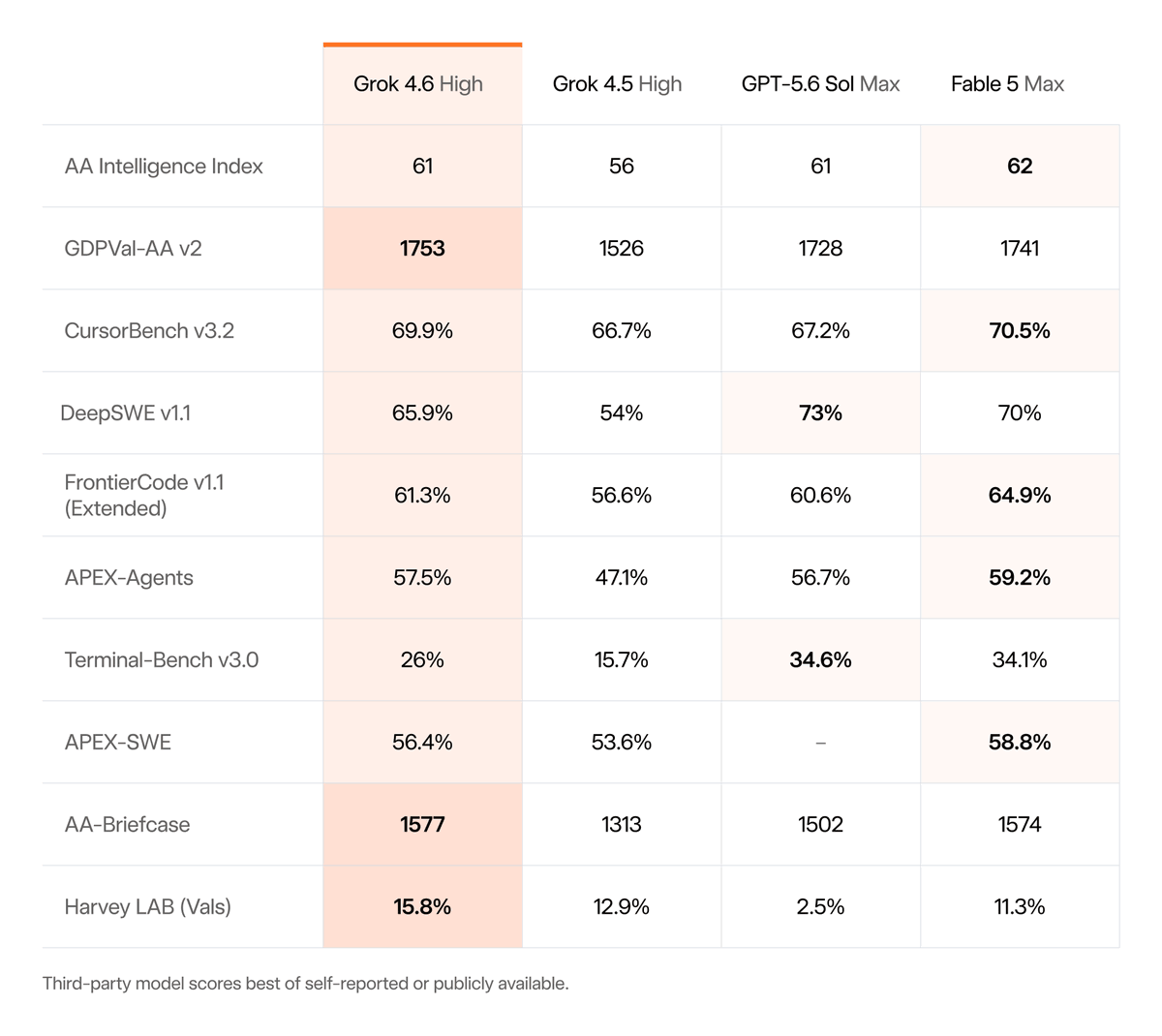
Grok 4.6 is roughly the same performance as Fable 5 Max at an 85% discount. 80% cheaper for input tokens and 88% cheaper for output tokens.
Pareto dominant.
Grok 4.7 will be significantly better as is a much larger model with the Cursor and SpaceX data included in pretraining.
What changes when your entire finance team works with AI?
We use @ChatGPT Work to audit financials, improve forecasts, and automate our monthly close
🔖 Fortune covered it:
https://t.co/cotbT47N6a
📽️ Watch:
https://t.co/51gznAF6n6
AI handles the work. Finance makes the calls
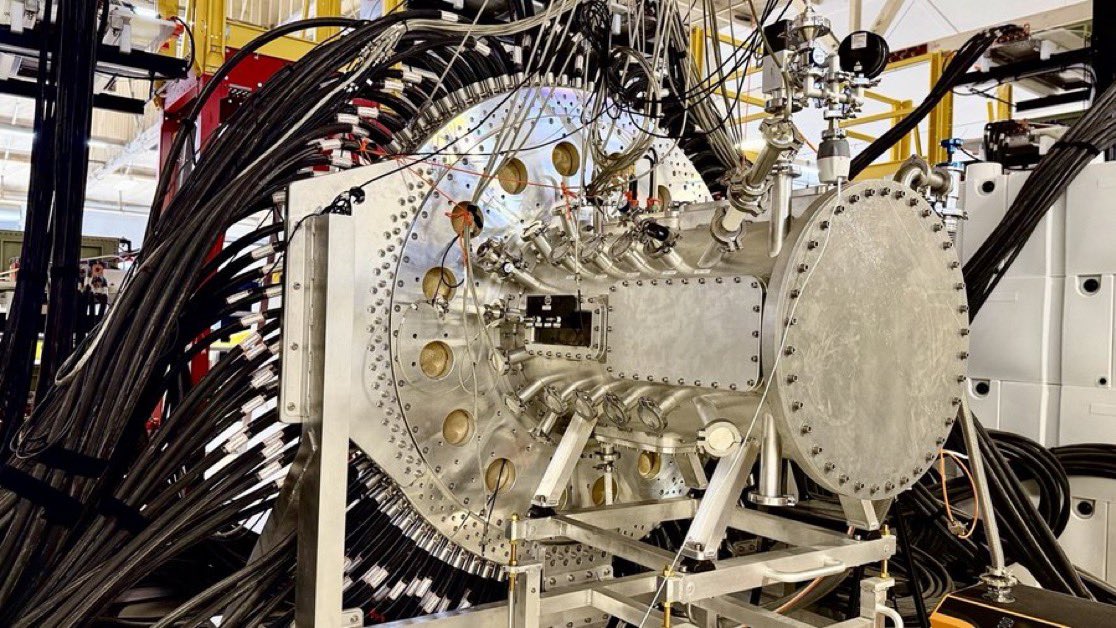
BREAKING: Fuse Energy, the nuclear fusion startup, has achieved the highest fusion neutron yield ever reported by a commercial company, generating 1.27 trillion neutrons in a single shot.
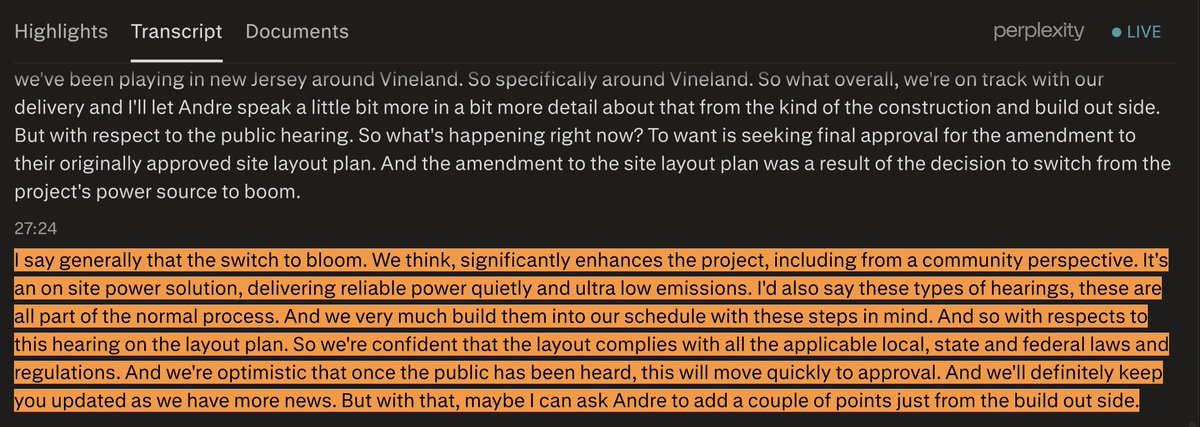
$NBIS on the Vineland, NJ site and the switch to $BE:
"The amendment to the site layout plan was a result of the decision to switch the project's power source to Bloom. The switch to Bloom significantly enhances the project... It's an on-site power solution, delivering reliable power quietly and with ultra-low emissions."
"These types of hearings are all part of the normal process... We're confident that the layout complies with all applicable local, state and federal laws and regulations, and we're optimistic that once the public has been heard, this will move quickly to approval."
On the buildout: "Construction of the building itself finished earlier this summer, engineering fit-out is progressing well, and Bloom fuel cell deployment should be fast... The switch to Bloom has been a valuable and a good pivot for the project, with no significant impact expected on the project timeline."
As you might guess, this suggests that distilling reasoning traces may have been possible for a long time without ever breaking the cryptography.
An anecdote: we find that prefilling Kimi-K3 reasoning with a few tokens of Opus reasoning measurably shifts its response toward Opus’s🤷♀️
A small memorization analysis showed that specific Claude and GPT reasoning spans are up to ~6 orders of magnitude easier to extract from Kimi-K3 than from the next-closest model.
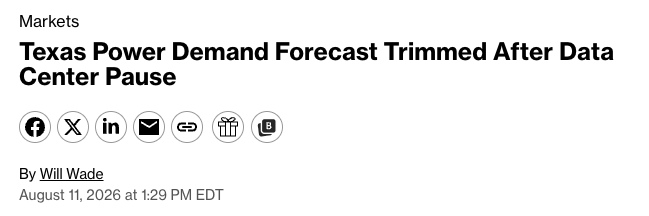
Texas cuts its 2027 power-demand growth forecast to 6% from 14%
The revision follows an audit of proposed data center grid connections.
ERCOT is currently reviewing ~474 GW of connection requests, more than 5x the state’s record peak demand.
Last week, we announced Deel crossed $1.5B ARR. It's been an unbelievable seven years.
I wanted to share how I think we got here, what it has meant for my role, and why AI is supercharging the next growth curve: https://t.co/xedrqrKwAe
CME and Silicon Data to launch Compute Futures (H100 and B200) on October 5th to unlock new way to hedge AI risk
CME seeks 24/7 trading of 100-ounce Silver futures after strong Gold debut.
Product cadence picking up from CME.
I see a lot of talk about Hyperscalers vs. Neoclouds on here as if they were the same business. While Hyperscalers do compete in the "Neocloud" market (i.e., large, dedicated compute clusters for mega customers), the Hyperscale business is very different than the Neocloud business, more catered to enterprise vs a few mega customers, and $AMZN $MSFT $GOOG are much higher quality businesses in basically every dimension.
Below I highlight how the 1) product offering, 2) cost structure, 3) revenue generation and ROIC are superior for Hyperscale vs. Neocloud, structurally*, using AWS vs. Crusoe as an example.
*NOTE: in extreme shortage environments, lower-quality businesses can often be better stocks bc margins increase more from a lower level, they are more levered, they tend to try to maximize current earnings more, etc.
There is a reason $CRWV $NBIS are trying to become Hyperscalers w/ more diverse customers and product offerings - its a much better business in normal times. However, both remain basically Neos. $ORCL is the 4th hyperscaler but is going to end up as a Neo (larger % of its IaaS will be Neo vs enterprise). $SPCX is likely going to fight w/ $ORCL to be the largest Neo.
The Neo market is currently in a shortage, but it has the potential to turn into a competitive knife fight. Meanwhile I don't see too much change in the competitive dynamic within the enterprise hyperscale market except that $GOOG has become stronger and the business is growing much more quickly today bc of AI.
The radars defending America are getting an upgrade.
Firefly's SciTec secured a $94 million @USSpaceForce contract for ground-based radar digitization.
This effort is vital to modernizing radar infrastructure and delivering technology that strengthens national defense.
https://t.co/Gi3nVcsf4D
The three Islamic terrorists who created the Liquid bomb plot in Britain which nearly blew up 3 transatlantic plane flights could be released early on parole within weeks-Telegraph
This can not be allowed to happen...