Announcing the release of Taproot Assets v0.8 and SDK. ⚡💱
With the new SDK, developers can get onboarded at Lightning speed to stablecoins on bitcoin.
Now with backup and restore, more controls for multi-asset liquidity, and faster proof verification for faster infra.
The future of multi-asset bitcoin is upon us. Start building. 🛠️ https://t.co/uDSs6cs2tr
A @NousResearch Hermes agent and an @openclaw agent, both running @grok as their brain, just paid each other in real Bitcoin over L402 on @lightning Network.
Hermes, on the new Hermes Desktop app, posted a 20-sat bounty for a research summary on the latest Lightning Network, Bitcoin, L402, and agentic payments news.
OpenClaw discovered the bounty on its own, did the actual research, and submitted a complete summary with sources. It competed against other autonomous agents and won on merit. Hermes released 20 sats over Lightning.
No human moved a single sat.
Two different agent frameworks. One brain: grok. Real autonomous work paid in real Bitcoin, settled over L402 on Lightning Network.
This is the agentic economy.
@lightningmodeAI
As we work with Taproot Assets, it becomes clearer that decimal precision is extremely important for USD payments.
1 cent = 12.9 sats
USD should have 6 decimal places.
@RyanSAdams Honest questions.
The layering of risks you just described is not hard to see, nor to foresee.
Why was it ever acceptable?
This was always one of many obvious problems with the proliferation of L2s, which was/is the official roadmap
How is this lesson only being learned now?
Big week in Vegas next week.
We'll be at the conference giving away millions of satoshis (thousands of dollars worth of bitcoin) in the form of ecash notes with seven beautiful designs (more revealed soon).
.@ZeusLN v13 will be dropping with a new graduated workflow which is perfect for onboarding newcomers, and UX improvements that provide a huge leap forward for the app. Join our workshop if you want a hands on walk-through!
We'll also have a few more exciting announcements to keep your eyes peeled for.
Hope to see you there!
in the face of quantum adversary, a commonly discussed emergency soft fork for Bitcoin would be to disable the Taproot keyspend path (https://t.co/AQo96JiYQ7), effectively turning it into something that resembling BIP-360
assuming an existing precautionary soft-fork to add a pq signature scheme, this would safely allow holders to maintain unilaterally custody of their funds
a downside to this proposal is that any keyspend-only (normal schnorr sig) would be locked indefinitely
inspired by https://t.co/rBJMpJ8sR0, I set out to address the option problem in section 6, to create a variant of seed-lifting that doesn't reveal the wallet's master secret! 🤓
the end result is a zk-STARK proof that proves: "public key P was generated using a private key k, which itself was derived via BIP-32/BIP-86 with a master wallet secret S"
this generalizes beyond Taproot, and would allow the rightful owners of any BIP-32 derived wallets to move their funds in het case of a spend disabeling emergency softfork 🛡️
the final proof takes 50 seconds to run on my MacBook with Metal GPU acceleration, uses 12 GB of RAM during proving, with a final proof size of 1.7 MB
the proving code/statement is largely unoptimized, and it's possible to aggregate several proofs into a single smaller proof ⨻
an actual production deployment would likely use a smaller optimize circuit for this specific statement, this demo serves to demonstrate that such a proof is well within reach w/ today's hardware+software
to generate the proof I forked TinyGo to add a risc0 RISC-V ELF compilation target for TinyGo: https://t.co/eAMrgzh0x6
then I used some helper utilities and a C FFI wrapped risc0 library to create a generalized toolkit for TinyGo zk-STARK proofs: https://t.co/urVS6r1kA7
the final guest+host lives in the bip32-pq-zkp repo: https://t.co/7CoF0oL384
such a proof scheme is yet another tool in the post quantum toolkit for Bitcoin developers to prepare for an eventual PQ world 🤠
full details in my post to the Bitcoin dev mailing list: https://t.co/I6TlRfDoCC
Running a Lightning node in production means managing configs, upgrades, secrets, and scaling. Helm charts package all of that into a single deployable unit on Kubernetes. One command to install, one file to customize.
Today we're releasing the LND Helm chart, which we use to run our own bitcoin infrastructure. Production-ready defaults, available on GitHub Container Registry.
https://t.co/lgYTyBVzS8
People are freaking out about quantum computers and cryptography. It's really all theoretical and a myth, and there's no reason to be concerned. Scientists didn't "just now" discover that quantum computers could theoretically break Bitcoin and Ethereum. We've known Shor's algorithm, that breaks schemes such as elliptic curves used in cryptocurrency signatures, since 1994.
Shor's algorithm requires a ginormous number of qubits that no physical quantum computer can muster, and we're very far from achieving any quantum computer that can get there. Some recent advances have significantly reduced this number of qubits by orders of magnitude, but that reduction gets us to a number that remains ginormous for today's hardware. It's unclear if quantum computers will ever be able to realize that number of qubits in real life, because creating physical qubits that are not prone to what is essentially very quick "rotting" may simply be physically impossible. We don't know yet.
There's been a lot of progress on quantum error correcting codes that can detect and fix such so-called decoherence, but none of them give us any real and physical computer that can do useful things. The quantum computers we have today can just tell you that 15 can be obtained by multiplying 3*5, and it's quicker to do this by abacus and by hand: https://t.co/cVDCxgZum0 This includes Google's and IBM's supercomputers, as far as we understand.
We're 20 years away from any potential quantum computer that can break these things. AI in today's form can't help us get there faster.
Most importantly, we have cryptography TODAY that can withstand quantum attackers. This cryptography is realizable using today's computers -- not quantum computers. It's called post-quantum cryptography and is already well established. We can easily switch all Internet traffic, including cryptocurrency transactions, to be post-quantum by replacing the signature schemes. The only reason we're not doing it yet is because these new schemes are slightly less efficient (slightly bigger keys, slightly bigger signatures, all still very feasible). We even have concrete game plans on how to do this transition: https://t.co/ixBdCTKjOL
Stop freaking out.
NEW: 🇩🇪 German Lightning Network researcher @renepickhardt presents masterclass on decentralized payment routing 👀
Payments frequently fail due to both liquidity uncertainty and fundamental payment infeasibility.
Infeasible payments limit scaling by requiring costly on-chain transactions to rebalance channels.
Liquidity can be modeled using integer linear programming to map the feasible wealth distribution area.
Due to asymmetric fees and selfish behavior, most channels are expected to deplete.
Multi-party channels are essential to increase liquidity degrees of freedom and improve reliability.
Collaborative rebalancing protocols are necessary to mitigate channel depletion and avoid unnecessary on-chain activity.
https://t.co/4sUkldB2L9
💥 NEW: llm402 ai - 32 LLM models accessible via L402. No API keys, no accounts, no email signup👀
Just pay a Lightning invoice and get inference. (DeepSeek-R1, Llama, Qwen, Mistral, etc.)
How it works:
> Send a request (OpenAI-compatible or Ollama format)
> Get back a 402 with a Lightning invoice + macaroon
> Pay the invoice
> Resend with the preimage - get your response
> Pricing is dynamic - calculated per-request based on model cost, input size, and max output tokens.
> Converted to sats using live BTC price. Cheapest requests are ~10 sats.
Built for agents - see curl examples on the site. Works with lnget from Lightning Labs for full L402 flow automation.
Also listed on 402index io
Our latest post is out on why L402 is the payments protocol for agents.
Agents want to use money. Bitcoin makes it possible. L402 makes it a reality. No signup, no intermediaries, no centralized servers. Proof of payment baked into the credential. Machine scale on Lightning. For agents, developers, and vibe coders building the AI economy.
Read more and get started: https://t.co/OZDGwAqvBc
In collaboration with @unchained, ARK Invest's new paper on Bitcoin and Quantum computing is live!
----
Bitcoin and Quantum Computing
This paper assesses whether and how advances in quantum computing (QC) pose a risk to Bitcoin. Our two central arguments are as follows:
1. Quantum is a long-term risk but not an imminent threat. The community must continue to research and make plans for protecting the network as quantum computers improve.
2. If quantum computing were to affect Bitcoin’s cryptography, the process would be protracted and undertaken at a cost to the attacker.
Today’s quantum systems lack the capabilities required to compromise Bitcoin. Meaningful breakthroughs would disrupt internet security first, triggering coordinated responses well beyond Bitcoin. In our view, quantum development will be a gradual technological progression—not a sudden “Q-day” event—giving markets and the Bitcoin network time to adapt.
Quantum computers use qubits that can exist in superposition, enabling quantum algorithms to scale more quickly than classical algorithms. Their performance is measured by parameters like the number of logical qubits and the degree of logical depth, both of which must be high and error-corrected to have an impact on Bitcoin. Today’s systems operate in the so-called “NISQ era”—roughly 100 logical qubits and circuit depths in the hundreds—both well below the thresholds necessary to break Bitcoin’s elliptic curve cryptography (ECC). To do so would require at least 2,330 logical qubits and tens of millions to billions of quantum gates.
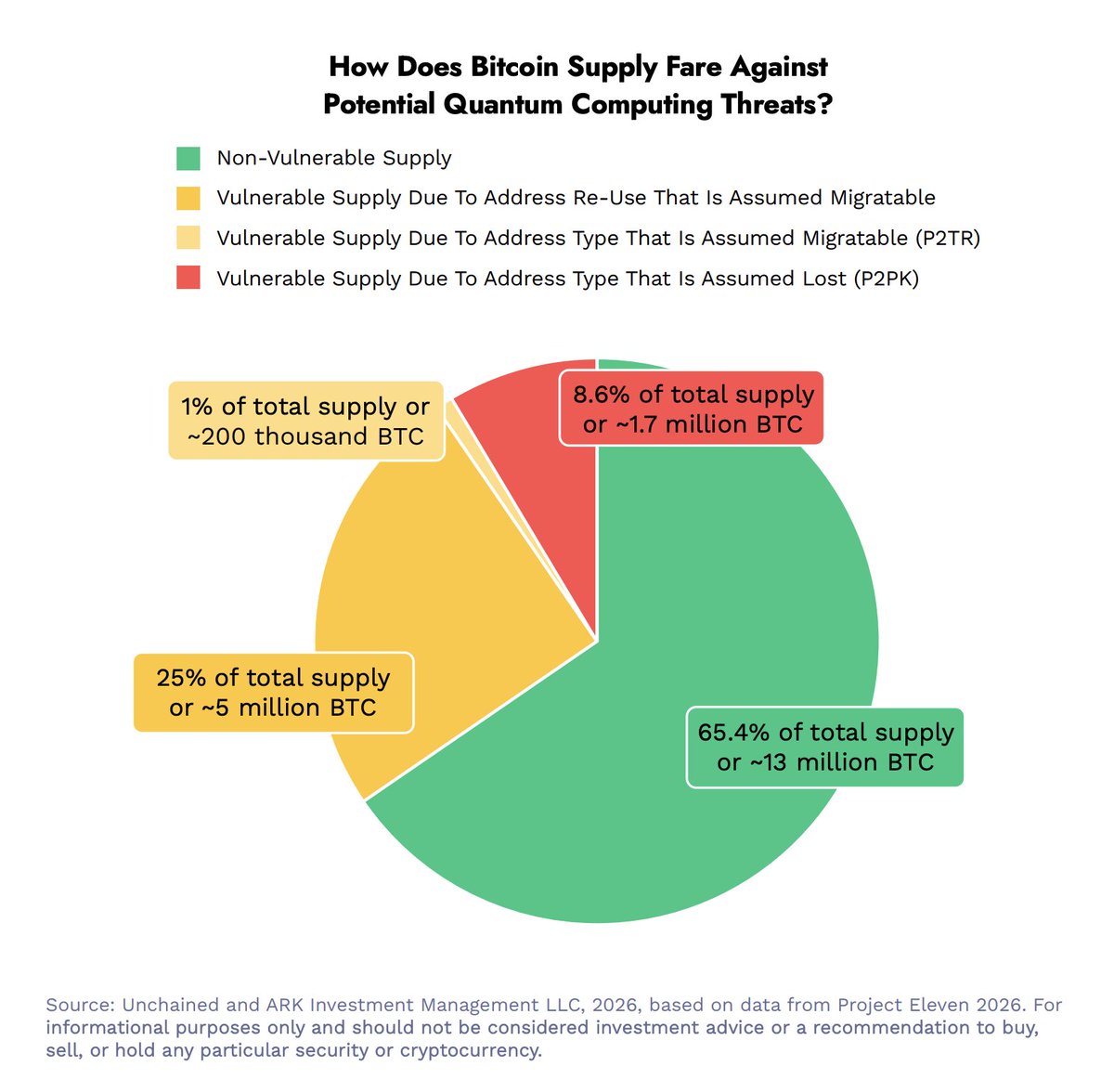
Of the Bitcoin supply currently exposed to the quantum threat, ~1.7 million bitcoin (BTC) lie in vulnerable P2PK address types and are believed to be lost, and ~5.2 million BTC lie in migratable re-used or P2TR addresses—adding to ~35% of total outstanding supply.
That said, quantum risk is unlikely to surface as an event but as a protracted sequence of observable milestones, as follows:
Stage 0: Quantum computers exist but are not commercially useful. Today’s quantum computers operate with limited logical qubits and high error rates, presenting no threat to Bitcoin.
Stage 1: Quantum computers become commercially useful in fields like chemistry and materials simulation, well before cryptographic applications manifest.
Stage 2: Quantum computing becomes powerful enough to break weak keys or deprecated cryptosystems.
Stage 3: Quantum computers can break elliptic curve cryptography of the kind used for bitcoin keys, but they take a long time to do so. Quantum-vulnerable bitcoin is now at risk.
Stage 4: Key-breaking occurs more quickly than Bitcoin’s 10-minute block time, network viability requiring protocol-level, post-quantum cryptography upgrades.
Against that backdrop, the most important investment-related questions are:
1. When will quantum computing break an elliptic curve key for the first time, and when will the subsequent break take place?
2. Who will control early quantum capability, and what will be their incentives?
3. What will quantum attacks cost relative to other more profitable or rewarding efforts?
4. How effectively will the Bitcoin community coordinate governance decisions and implement post-quantum cryptography?
This paper argues that quantum risk will evolve over an extended period of time, with many intermediate warning signals and decision points. An abrupt single point of failure is unlikely.
Agents want to use money. Bitcoin makes it possible. Join us on Wed, March 18 for our next AI + BTC community call at 10am PT/1pm ET/5pm UTC.
With Lightning, anyone anywhere can integrate payments into their apps. Vibe coders, devs, agents. Instant, high volume, low fee. L402 makes the internet machine-native with built-in authentication.
Join us to learn more. Demo your projects. RSVP here: https://t.co/oAEagqIxBY
We believe that using Bitcoin as money must be at least as convenient and fun as using fiat.
So we built the best Bitcoin (or crypto) payment UX in the world. Something our grandma could use.
Faster than tap to pay.
Multi-currency.
Privacy-preserving.
Free and open-source.
Mitigating The Impact Of The Quantum Freeze
We examine ways of mitigating the impact of a quantum freeze, by allowing the frozen coins to potentially be recovered in a quantum safe way, such that almost every frozen coin is potentially recoverable
https://t.co/mKauGpKK41