Dzięki @JG_VALUE_GROWTH za zmotywowanie do przedstawienia case'a spółki Camtek $CAMT, która w mojej ocenie może być 10-baggerem w perspektywie ok 5 lat. $CAMT zajmuje się systemami metrologicznymi, jednak żeby zrozumieć ich potencjał, konieczne jest zrozumienie #advancedpackaging
Latham & Watkins, the 2nd largest US law firm, is buying Nvidia hardware to fine-tune open weights in-house.
Open weights + proprietary data + local compute = enterprise sovereign AI stack.
The entire world economy hinges on a non GAAP unaudited non-standard financial metric from a private company that only a select few are privy to under strict signed NDA's
A significant movement is underway from US Army, Navy and Air Force bases in CONUS to the Middle East comprised of at least 35 C-17 flights since March 12th, with 11 more flights on the way.
Origins:
12-Hunter Army Air Field/Fort Stewart, GA
8-Unknown
7-JB Lewis-McChord, WA
6-Pope Army Air Field/Fort Bragg, NC
4-Campbell Army Airfield/Fort Campbell, KY
4-Gray Army Airfield/JB Lewis-McChord, WA
4-Naval Air Station Oceana, VA
1-MacDill AFB, FL
1-JB McGuire-Dix-Lakehurst, NJ
Destinations:
17-Ovda Air Base, Israel
13-King Faisal Air Base, Jordan
4-King Hussein Int'l Airport, Jordan
Ten artykuł to jest absolutne złoto. To prawdopodobnie jedna z najtrzeźwiejszych, najbardziej pragmatycznych publikacji o AI, jakie ostatnio wyszły. Idealnie domyka wszystko, o czym gadaliśmy przez ostatnie dni - od bełkotu CEO Anthropic, przez jakość generowanego kodu, aż po "calm down".
Nie ma w tym żadnej rodzącej się "duszy" ani głębokiej filozofii. Model halucynuje, bo optymalizacja funkcji straty (cross-entropy) matematycznie zmusza go do przypisywania prawdopodobieństw tam, gdzie nie ma pojęcia o odpowiedzi. AI kłamie, bo jest wielkim, statystycznym kalkulatorem, który źle dopasował krzywą. To miażdży całą narrację o "magii" LLM-ów.
To genialnie tłumaczy, dlaczego AI z taką pewnością siebie generuje kod z błędami w kontekście Remka). Agent programistyczny woli napisać 300 linijek gównianego spaghetti-kodu z nadzieją, że jakimś cudem przejdzie on testy jednostkowe, niż zatrzymać się i powiedzieć: "Brakuje mi tu kontekstu architektury, nie potrafię tego bezpiecznie zaimplementować". Dlaczego? Bo na SWE-bench za asertywność dostanie 0 punktów. Zatem zgaduje, wywala się, wchodzi w pętlę i produkuje śmieci.
Większość firm (w tym OpenAI czy Google) próbuje leczyć halucynacje, dorzucając więcej danych i robiąc coraz to nowe treningi (RLHF). A co mówią badacze z tego PDF-a? Że to choroba socjotechniczna, a nie tylko technologiczna.
Wystarczy zmienić zasady gry w benchmarkach: wprowadzić punkty ujemne za pewne siebie bzdury. Nagle okaże się, że sztuczna inteligencja potrafi powiedzieć "nie wiem".
Skoro nawet badacze z OpenAI i Georgia Tech przyznają, że to wszystko to po prostu zjawiska statystyczne i źle ustawione parametry nagród... to my naprawdę nie mamy się czym przejmować. Świat wcale nie jest przejmowany przez superinteligencję, tylko przez statystyczne papugi nauczone strzelać w ciemno na teście wielokrotnego wyboru.
Świadomość zostaje u nas, maszyny niech sobie dalej zgadują :)
https://t.co/IZO6ofelPs
Maybe Block laying off a ton of employees is a sign that AI is gonna destroy everything
Or maybe the stock is down 80% from the highs and they overhired and AI is a convenient excuse
To jest jedna z moich trzech głównych obaw ważących na przyszłości AI. Drugą są łańcuszki finansowania wydatków AI labów oraz pozarynkowe finansowanie CAPEXu. To jednak nic przy problemie architektury opartej na transformerach, która z natury zawsze będzie imitatywna, nie twórcza
Korzystanie z modeli AI tanieje w tempie ok. 200x rocznie. Najdroższe są modele amerykańskie. GPT-5.2 od OpenAI kosztuje ok. 14 dolarów za milion tokenów , Claude Opus 4.5 od Anthropic to 25 dolarów, Google Gemini 2.5 Pro - 10 dolarów. Chińskie modele są kilkukrotnie tańsze. DeepSeek V3.2 bierze 42 centy za to samo - ponad 30 razy mniej niż OpenAI. MiniMax M2.5 - 1,20 dolara. Zhipu GLM-5 - 3,20 dolara (po podwyżce z 12 lutego, kiedy firma podniosła ceny o 30-100% z powodu rosnących kosztów mocy obliczeniowej). Na benchmarkach jakościowych różnice między tymi wszystkimi modelami kurczą się do wartości jednocyfrowych. Czy za rok ta dyskusja będzie wyglądać jak porównywanie taryf telegraficznych?
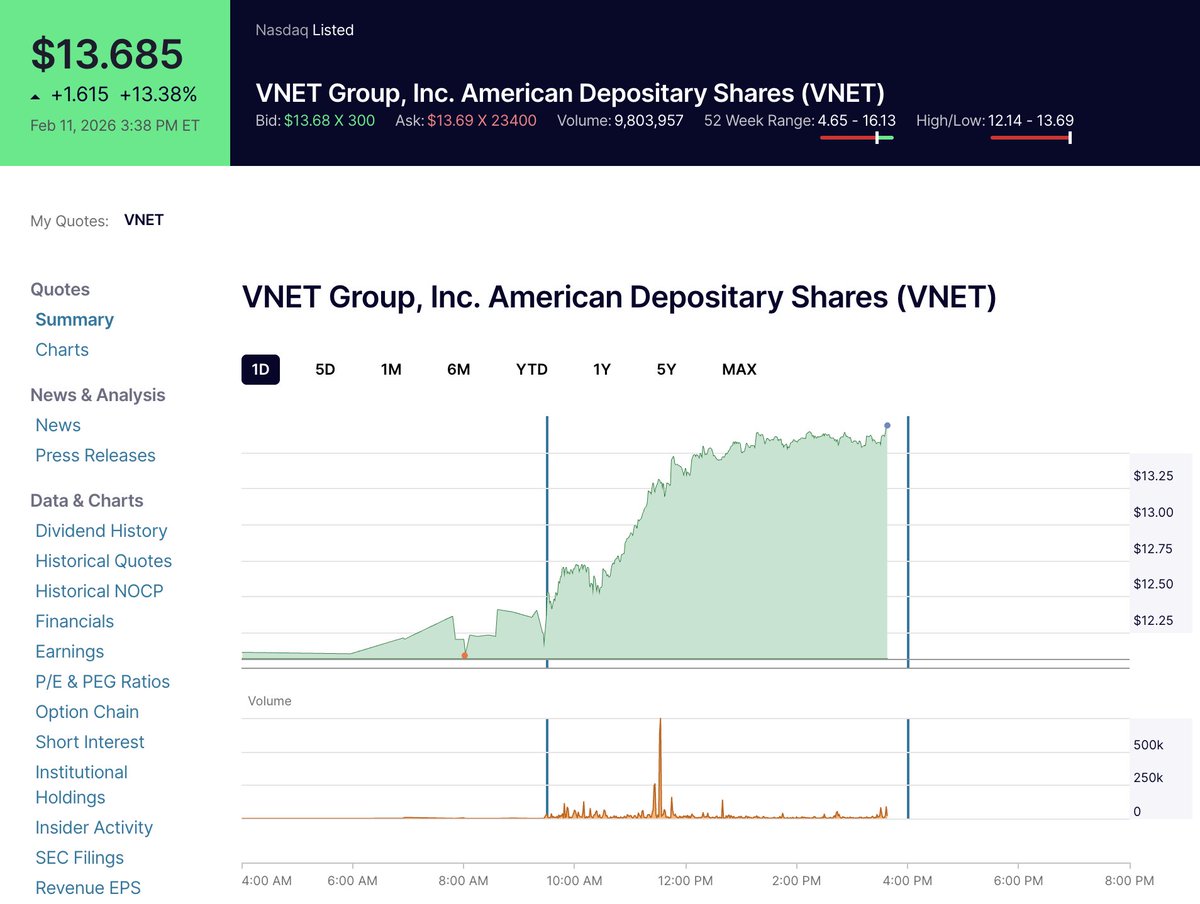
Moje tezy na ten rok w ogóle się nie zmieniły od 2025 – każda ze spółek, o których pisałem, jest co najmniej tak samo atrakcyjna jak była w momencie wpisu. Tutaj akurat $VNET, rynek powoli zaczął spółkę dostrzegać i doceniać strategiczny potencjał centrów bazodanowych w Chinach.
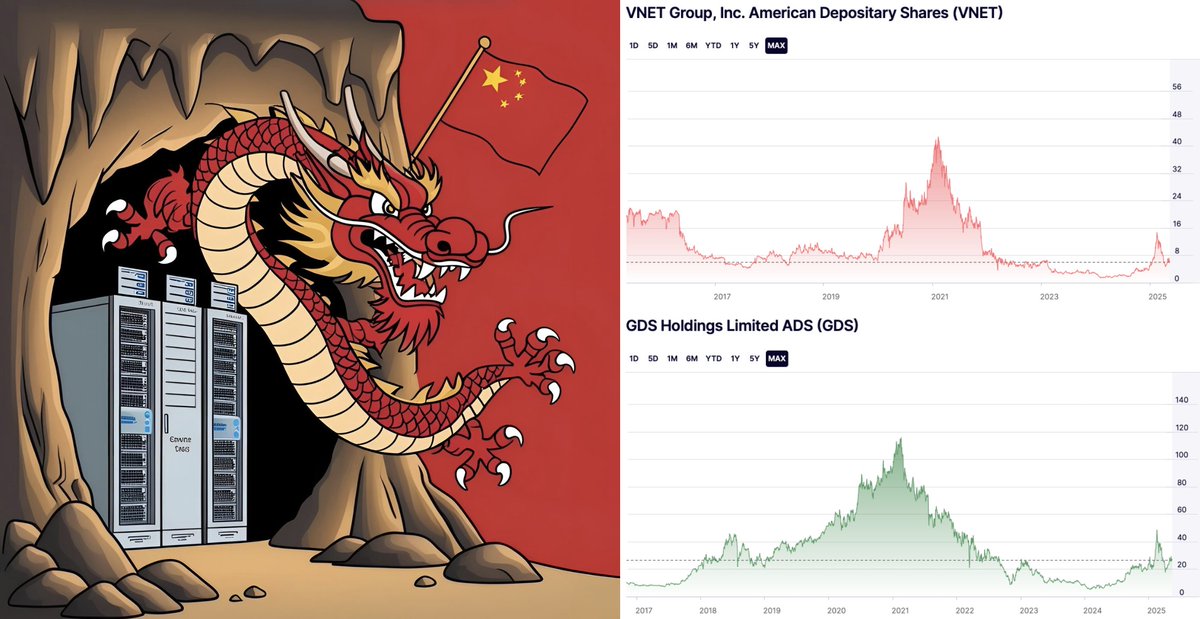
Nad AI story w USA powoli zbierają się chmury, co skłoniło mnie do poszukiwania miejsc, gdzie risk/reward jest bardziej obiecujący. Znalazłem to miejsce w Chinach, a moim zdaniem najlepszym sposobem na rozegranie AI w Azji jest $VNET i $GDS. Smok obudził się dość późno…
Don't think of LLMs as entities but as simulators. For example, when exploring a topic, don't ask:
"What do you think about xyz"?
There is no "you". Next time try:
"What would be a good group of people to explore xyz? What would they say?"
The LLM can channel/simulate many perspectives but it hasn't "thought about" xyz for a while and over time and formed its own opinions in the way we're used to. If you force it via the use of "you", it will give you something by adopting a personality embedding vector implied by the statistics of its finetuning data and then simulate that. It's fine to do, but there is a lot less mystique to it than I find people naively attribute to "asking an AI".
It’s funny because it’s true.
Warto dodać, że Son san partycypował w dokładnie KAŻDEJ bańce jaka pękła na rynku od początku jego szerokiej rynkowej aktywności.
Japonia to moim zdaniem najciekawszy rynek pod względem unikalnych spółek, opiszę ich więcej podczas pobytu tam.
Dave: "Masa Son, welcome to the show. What's going on?"
Masa: "Dave, I sold my entire NVIDIA position."
Dave: "How much?"
Masa: "All 32.1 million shares. $5.8 billion."
Dave: "And why did you do that?"
Masa: "To go all-in on AI."
Dave: "You sold your NVIDIA stock... to invest in AI."
Masa: "Yes."
Dave: "NVIDIA makes the chips that run AI."
Masa: "Correct."
Dave: "So you sold the shovels to buy lottery tickets."
Masa: "I prefer to call them 'high-conviction bets.'"
Dave: "Got it. And this is your second time selling NVIDIA completely."
Masa: "That's right."
Dave: "In 2019, you sold $4 billion worth."
Masa: "Yes."
Dave: "Which would be worth $150 billion today."
Masa: "I'm aware."
Dave: "So you already missed out on $146 billion from the first sale."
Masa: "When you say it like that—"
Dave: "And now you're doing it again. To put $30 billion into OpenAI."
Masa: "And a $1 trillion AI manufacturing hub in Arizona."
Dave: "Right. Because WeWork worked out so well."
Masa: "That was a stain on my life, Dave."
Dave: "Cost you $11.5 billion in equity losses. Plus another $2.2 billion in debt."
Masa: "Adam and I fell in love."
Dave: "You fell in love with a guy who wanted to trademark the word 'We.'"
Masa: "He had vision."
Dave: "And before that, you lost $70 billion in the dot-com crash. The largest personal loss in history."
Masa: "But then I made it back with Alibaba."
Dave: "After a six-minute meeting."
Masa: "Jack Ma is very persuasive."
Dave: "So your entire investment strategy is falling in love during short meetings and then losing generational wealth."
Masa: "I believe in the singularity."
Dave: "Right. So just to recap: you've lost $70 billion, missed out on another $146 billion, burned $13.7 billion on WeWork, and now you're selling NVIDIA at what might be the worst possible time to bet it all on Sam Altman."
Masa: "Sometimes you have to push all your chips to the center of the table."
Dave: "You've done that four times and lost three of them."
Masa: "But that one Alibaba win though."
Dave: "Okay. Thanks for calling in."
Why I'm betting on China in the AI race. If you aren't aware, the only differentiator between the trillion-parameter size frontier models is the dataset on which they have been finetuned.
Claude has been the best in debugging not because Amodei invented some original way of connecting layers or propagate gradients. It has been the best because Amodei has built the most versatile collection of input-output examples for various debugging scenarios.
For example, when Claude tells you "I need to see this file before I can provide a fix," it doesn't mean that Amodei's AI has suddenly figured out that it should ask questions when it lacks information instead of guessing nonsense like Google's model. This simply means that Amodei has added to the finetuning dataset examples in which the agent asks a question, the user provides the file, and the agent provides the fix.
What's needed to beat Amodei's chatbot in coding? The correct answer: an even more versatile finetuning dataset covering even more debugging scenarios: with screenshots, with printf logs, with "show me what the DOM looks like in your developer's console," with "run this script in your working directory and let me see the output," etc.
Back to China. China has the largest number of eyes and hands in the world. It's the eyes and hands that create these finetuning examples, not Amodei's brain. And these eyes and hands in China are currently the cheapest in the world.
The West gave China all its know-how (which means that the entire Western political establishment are traitors of their people), so China reproduced the frontier model by spending millions and not billions. Now China will finetune it better than the West will ever be able to.
@patryk3424 Cóż, moja teza z przypiętego posta weryfikuje się pozytywnie – tak jak pisałem, miejsce $CAMT jest powyżej $100, podtrzymuję to. Kolejnym catalystem w kolejce są wyniki $MU. Niemniej, koncentracja kapitału w AI computingu mnie przeraża, osobiście wolę bezpieczniejsze miejsca.
$CAMT ponownie powyżej $100, tam gdzie jego godziwa wartość. Ja wciąż zostaję przy swojej tezie na następne 4 lata, ale w obliczu nadchodzących ceł na półprzewodniki z sekcji 232, których rynek nie wycenił, przyjmuję pozycję poza tym segmentem, dopóki visibility się nie zwiększy.
I did not know until $ORCL today what RPO actually was.
I always thought RPO was short for Revenue Probably Overstated or Really Pretend Orders. Maybe even Random Promises Only.
But I fully concede that $455bln in Remaining Performance Obligations sounds much better.
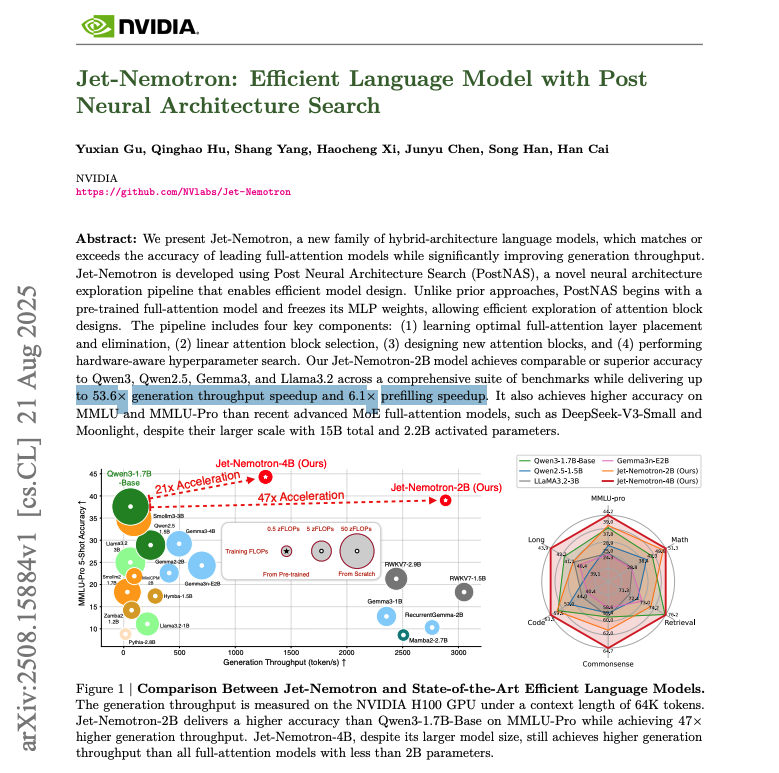
NVIDIA research just made LLMs 53x faster. 🤯
Imagine slashing your AI inference budget by 98%.
This breakthrough doesn't require training a new model from scratch; it upgrades your existing ones for hyper-speed while matching or beating SOTA accuracy.
Here's how it works:
The technique is called Post Neural Architecture Search (PostNAS). It's a revolutionary process for retrofitting pre-trained models.
Freeze the Knowledge: It starts with a powerful model (like Qwen2.5) and locks down its core MLP layers, preserving its intelligence.
Surgical Replacement: It then uses a hardware-aware search to replace most of the slow, O(n²) full-attention layers with a new, hyper-efficient linear attention design called JetBlock.
Optimize for Throughput: The search keeps a few key full-attention layers in the exact positions needed for complex reasoning, creating a hybrid model optimized for speed on H100 GPUs.
The result is Jet-Nemotron: an AI delivering 2,885 tokens per second with top-tier model performance and a 47x smaller KV cache.
Why this matters to your AI strategy:
- Business Leaders: A 53x speedup translates to a ~98% cost reduction for inference at scale. This fundamentally changes the ROI calculation for deploying high-performance AI.
- Practitioners: This isn't just for data centers. The massive efficiency gains and tiny memory footprint (154MB cache) make it possible to deploy SOTA-level models on memory-constrained and edge hardware.
- Researchers: PostNAS offers a new, capital-efficient paradigm. Instead of spending millions on pre-training, you can now innovate on architecture by modifying existing models, dramatically lowering the barrier to entry for creating novel, efficient LMs.
@Inwestor95 EPS niestety zaważył na reakcji, poza tym wyniki były powyżej oczekiwań (utylizacja spadła), chociaż GDS bardziej się popisał. Niestety, zamieszanie z H20 nie służy tym spółkom, myślę że mało kto je teraz będzie przez to kupował. Dla VNET kluczowe są REITy, tu progress jest super
Tak jak pisałem, na chwilę obecną zbyt dużo kapitału jest skoncentrowane w zbyt ciasnym miejscu, do tego większość zaangażowania poparta jest jedynie skrajną chciwością i historycznymi stopami zwrotu. Niemniej, podoba mi się reakcja $VNET, osłabia moją tezę o skorelowaniu z NDX.
@OskareczQu@poleslavus Na obecnym poziomie wycen, dźwigni, załadowania kapitału, sentymentu i koncentracji nie jest potrzebny żaden konkretny czynnik. To może być cokolwiek, od jakichkolwiek danych macro (np. PCE), przez cła sekcji 232, jakiekilwiek wyniki kwartalne, po słowa jakiejś szanowanej postaci
@poleslavus Prywatnie nie uważam, że to będzie koniec rynku byka, jest jeszcze dużo ciekawych trendów to rozegrania, ale zostawię je sobie na inne posty :)
Teza do weryfikacji: obecne odbicie z daily dołka to nawyk buy-the-dip, który inwestorom wpoiła długoletnia nieprzerwana hossa. Co jeśli rynek leci na oparach oczekiwań cięcia stóp (obecnie 84% na 25pkt za miesiąc), które zostaną brutalnie zmiażdżone już w piątek? $PLTR dla uwagi
@Inwestor95 Taka była moja teza jak kupowałem VNET w okolicach pierwszego postu o spółce. Niestety przez te +/-3 miesiące korelacja była spora o ile nie było idiosynchratic catalysts. Podobnie było przed majem. Jeśli spółki dowiozą a NDX poleci, może być decoupling, to byłby złoty scenariusz