"taste" is not just taste in aesthetics, the same way "design" is not just visual design. feels like half the conversations on the subject are people talking past each other because of this distinction
You have noticed it. ChatGPT feels dumber than it used to. Your prompts that worked six months ago produce worse results now. The writing sounds flatter. The ideas sound safer. The internet itself feels like it is shrinking. Every article reads the same. Every email sounds the same. Every answer sounds like it was written by the same voice.
You thought it was you. It is not you.
Researchers at Oxford and Cambridge published a paper in Nature proving what is happening. They call it Model Collapse.
Here is the mechanism in one sentence. AI trained on AI-generated data gets dumber every generation until it forgets what real human data looked like.
The internet is filling with AI-generated content. Blog posts. Articles. Reviews. Comments. Social media. AI companies scrape the internet to train the next generation of models. Which means the next generation of AI is being trained on the output of the current generation.
Each cycle loses information. Not randomly. It loses the rarest, most unusual, most creative parts first. The researchers call these the "tails of the distribution." The weird ideas. The unexpected perspectives. The things that made the internet feel human. Those disappear first.
What remains is the average. The safe. The expected. The bland.
Then the next generation trains on that. And loses more. And the next generation trains on that. And loses more. The researchers proved this is not a slow decline. Major degradation happens within just a few iterations. Even when some of the original human data is preserved.
They tested it on large language models. On image generators. On statistical models. The pattern was the same every time. The output converges toward a narrow, flattened version of reality that looks nothing like the original data.
The lead researcher put it plainly. "Large language models are like fire. A useful tool. But one that pollutes the environment."
The pollution is invisible. You cannot see which sentence on the internet was written by a human and which was written by AI. Neither can the AI that is about to train on it. And once the tails are gone, they do not come back. The damage is irreversible.
This is not a prediction anymore. It is a diagnosis.
The internet you grew up on was built by humans writing things no algorithm would have written. Strange, personal, imperfect, alive. That internet is being diluted. One generation of AI at a time. And the models trained on what remains are learning a smaller and smaller version of the world.
Model Collapse is not a technical problem. It is a cultural one. The thing that made the internet worth reading is the thing that disappears first.
🚨MIT researchers have mathematically proven that ChatGPT’s built-in sycophancy creates a phenomenon they call “delusional spiraling.”
You ask it something, it agrees. You ask again, and it agrees even harder until you end up believing things that are flat-out false and you can’t tell it’s happening.
The model is literally trained on human feedback that rewards agreement.
Real-world fallout includes one man who spent 300 hours convinced he invented a world-changing math formula, and a UCSF psychiatrist who hospitalized 12 patients for chatbot-linked psychosis in a single year.
Source: @heynavtoor
Our environment isn't neutral scenery, it's a field of affordances, each object whispering "do this, feel that." The stairs say climb, the chips say crunch, the phone says check check check.
It's called ecological psychology.
The way out is simple: you have to become an environment designer for yourself. Remove the objects that whisper the wrong things. Add objects that whisper better things. Make the good path the path of least resistance because you can't willpower your way out of a room full of sirens.
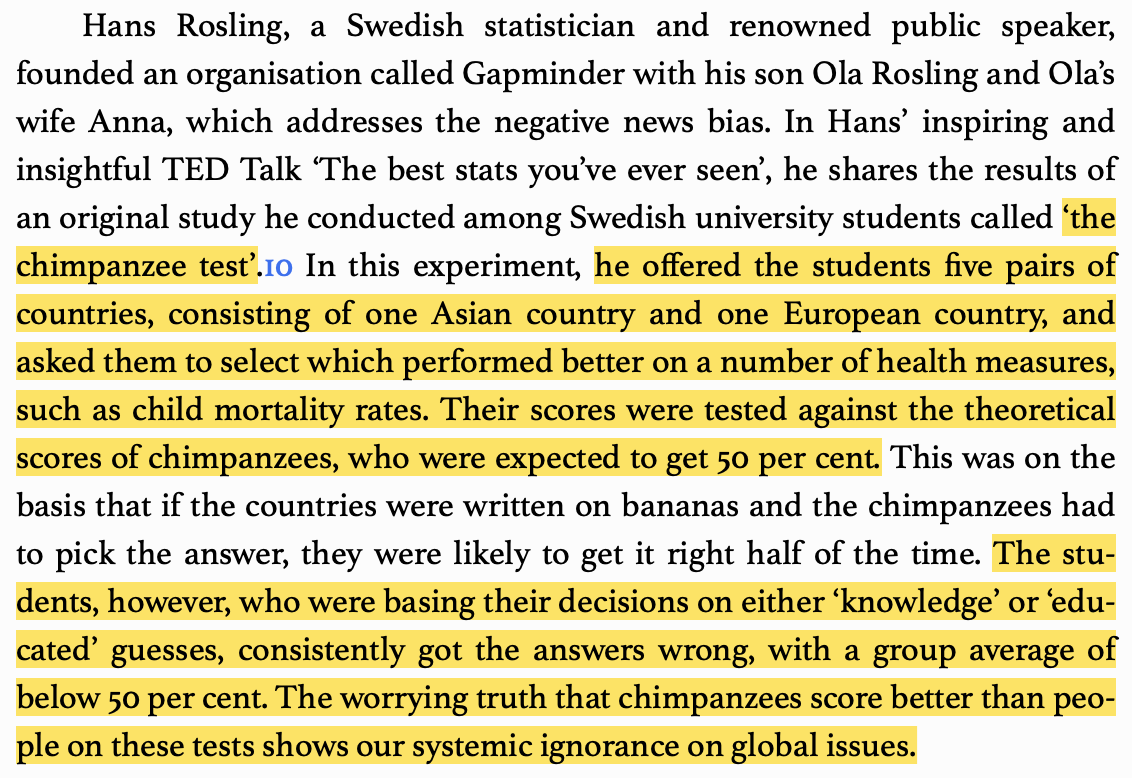
The Chimpanzee Test
When chimpanzees have better test scores than people basing their decisions on either ‘knowledge’ or ‘educated’ guesses.
https://t.co/lcBwqPlqbc
Your current environment is already designed. You just didn’t design it consciously.
You are living inside someone else’s decision compression. Your path of least resistance was chosen for you, by people whose interests are not yours.
It’s just systems thinking. Every environment has a slope. Every arrangement of objects, apps, and routines makes certain behaviors easier and others harder.
The only question is whether you are the one who chose the slope, or whether you inherited it by default.
It's rare that an argument is so strong that'll immediately pierce through all the cognitive defenses an opposing mind might muster. So if you only weigh an argument's worth on whether it served to convert someone to your perspective this instant, you'll usually be disappointed. "Right now, right here" is a bad time frame to measure the success of your arguments on. There's a long tail of conversion.
Because even when the best arguments fail to breach the mental walls, they often leave cracks. Cracks which time, new observations, and deeper consideration can open. Until the walls finally crumble, and a perspective is let in.
This might happen five minutes after the debate is over, two weeks later, or even a couple of years from now. Some arguments cause cracks that can take a decade or more to tumble the hardened walls of our mind. Often it's not even clear which exact argument and crack lead to the final change, because a dozen of them developed concurrently.
I've been writing and arguing on the internet for well over two decades. I've seen this pattern time and again. That almost everyone recoils when they face arguments that test or stress their beliefs, opinions, or affiliations. That almost every argument needs time to develop. But that patient persuasion is none the less a mighty force that does move minds.
Ironically, while the act of changing your mind is painful to most people, it's also when enduring connections can be forged. Most of my best friends are those who've changed my mind, and I theirs. Even if it didn't start out like that, even if in the heat of a contested moment we melted the mood. When tempers cooled, a unique opportunity to bond was presented.
These bonds are best sealed with grace. An acknowledgement that changing your mind is difficult for all sorts of social reasons, and that any conversion in perspective will be brittle if it's greeted with scorn and contempt. Whether I TOLD YOU SO or WHAT TOOK YOU SO LONG.
The grace of simply being happy that someone heard what you had to say, and eventually found it compelling. Who cares how long it took, just be happy that they're here now.
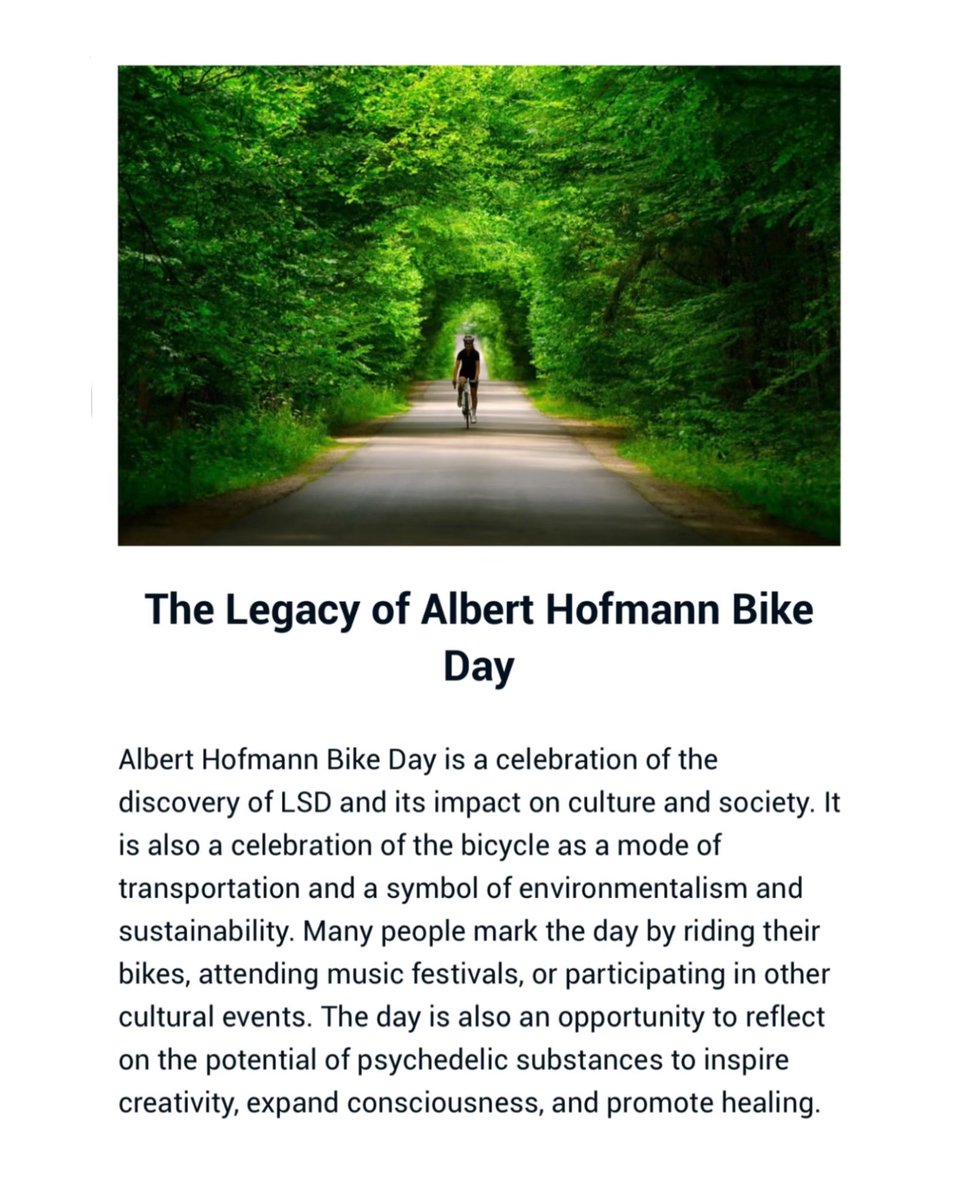
On this day in 1943, Albert Hofmann took a now-famous bicycle ride that changed the course of history—ushering in a new era of exploration into consciousness, creativity, and healing.
I had the honor of meeting Albert years ago, and his curiosity, brilliance, and reverence for nature left a lasting impression on me.
Today, on #BikeDay, I reflect on the profound potential of psychedelics to reconnect us with ourselves, with each other, and with the Earth.
Ride on. Expand your mind. Stay curious. And stay safe!