Ethereum is for AI.
ERC-8004, a new standard by the @ethereumfndn dAI Team, @MetaMask, @Google, @Coinbase, and others, provides a blueprint for how AI agents find and review each other, request and pay for jobs, and verify the work done.
What builders need to know.
With the first Bittensor halving complete, I can’t help but recall Bitcoin’s first halving, which I was fortunate enough to witness. History doesn’t repeat, but the rhymes are unmistakable; both the parallels and differences between the two are striking:
Same: A Decentralized Alternative for Global Challenges
Bitcoin launched during an unprecedented wave of central bank liquidity. By its 2012 halving, the Fed had tripled its balance sheet to $3 trillion, demonstrating how deeply monetary systems are tied to political interests. For many, this was the first time they questioned the foundations of money, who controlled it, and what these trends meant for the future.
Meanwhile, in a fringe corner of the internet, a radically different idea was taking shape. Bitcoin’s halving showed that predetermined disinflation was possible, even as nation states inflated global money supply at a historic scale.
Today, AI is expanding at an exponential rate, challenging entrenched industries and even our sense of humanity. This movement has been dominated by massive corporations - each with its own agenda - while governments scramble to regulate. And once again, in a fringe corner of the web, Bittensor offers a decentralized alternative: open competition driving AI infrastructure, training, and application without centralized control.
Same: Technical Familiarity Remains a Hurdle
Participating in Bitcoin in 2012 required technical knowledge. Public information was scarce, and understanding was predicated on familiarity with hash functions, peer-to-peer networking, and monetary plumbing. Most users still relied on the reference client and downloaded the full blockchain, as light clients and Coinbase had just emerged.
Bittensor feels similar today. In addition to general crypto knowledge, understanding the network means having a grasp of AI infrastructure as well. Browser wallets exist, but the command line interface remains the most powerful way to interact with Tao and subnets. We’ve seen Bittensor investment funds recently launch and tooling is improving rapidly, but genuine understanding of the core fundamentals remains limited to relatively few.
Same: Small Community with a Rising Tide
Early Bitcoin was driven by cypherpunks, libertarians, and curious technologists - people motivated by ideals, not just profit. The small community was driven largely by personal relationships. People who would eventually become leaders of major companies (and serious competitors with one another) openly collaborated and shared ideas for the sake of the broader industry.
After the 2012 halving, Bitcoin’s price surged 20x, attracting venture capitalists, megacorps, scammers, and the press. The core enthusiasts remained, and even grew, but signal became harder to find amid the noise.
Bittensor is still in its heavy signal phase. While monetary opportunity exists – as it always did with Bitcoin - general uncertainty and technical complexity remains a hurdle for the general populace. Conviction about Bittensor’s potential impact remains a driving force for those currently involved, and it's still easy to reach leaders on X, Discord, conferences, and in commercial collaborations. There will never be a time as good as today to build relationships in this industry.
Same: No Precedent for Valuation
Bitcoin was completely novel at launch, making valuation nearly impossible. Was it a payment network? A store of value? A tool for buying drugs? In 2012, debates raged. Thirteen years and a 7,500x jump in value later, investment banks regularly publish Bitcoin research while sovereigns incorporate it into sophisticated strategies.
Bittensor faces similar questions today. The network actively incentivizes productive outputs, but how does that translate to investment value? What is the relative value of Tao and subnet tokens? What makes a sustainable subnet? Answers will come through debate and experimentation, but for now, long-term valuation is yet to be clearly defined.
Different: Crypto Plumbing Is Already Mature
When buying Bitcoin in 2012, I had to hand cash to a convenience store clerk and punch numbers into a MoneyGram phone, hoping my account at Mt. Gox would be credited in the coming days.
Bittensor benefits from more than a decade of crypto infrastructure - exchanges, companies, and regulations - enabling rapid capital flow when interest spikes. But this maturity also makes attention harder to capture. Crypto is vast now; garnering focus on distributed AI is far more challenging than when Bitcoin was the only game in town.
Different: Risk Tolerance Has Changed
Bitcoin thrived on its free, unregulated nature, both ideologically and practically. Today, institutional capital, regulatory frameworks, and existing reputations of people involved mean risk tolerance is far lower. Imagine the community reaction if something as "unsavory" as Silk Road appeared on a Bittensor subnet.
Different: Diversity of Involved Parties
Bitcoin’s early days were dominated by Austrian economists and cryptography wonks. Bittensor subnets have already attracted a far broader mix: scientists, cybercrime experts, quantitative traders, marketers, and graphics specialists, reflecting AI’s sweeping potential across industries.
In 2012, Bitcoin offered an alternative to centralized money. As 2025 comes to a close, Bittensor is offering us an alternative to centralized intelligence. I assumed Bitcoin’s wild ride was a once-in-a-lifetime event. Now, as I approach my second first halving, I have a sense we just might get one more.
Tomorrow is the Bittensor $TAO halving 🌗
~5 million $TAO emitted since December 2023 with price staying above $250 💪
I will celebrate tomorrow as the end of the highest inflationary period being behind us 🎉
The foundation is laid, Bittensor has matured, now comes the fun part.
Congratulations to the holders 🥳
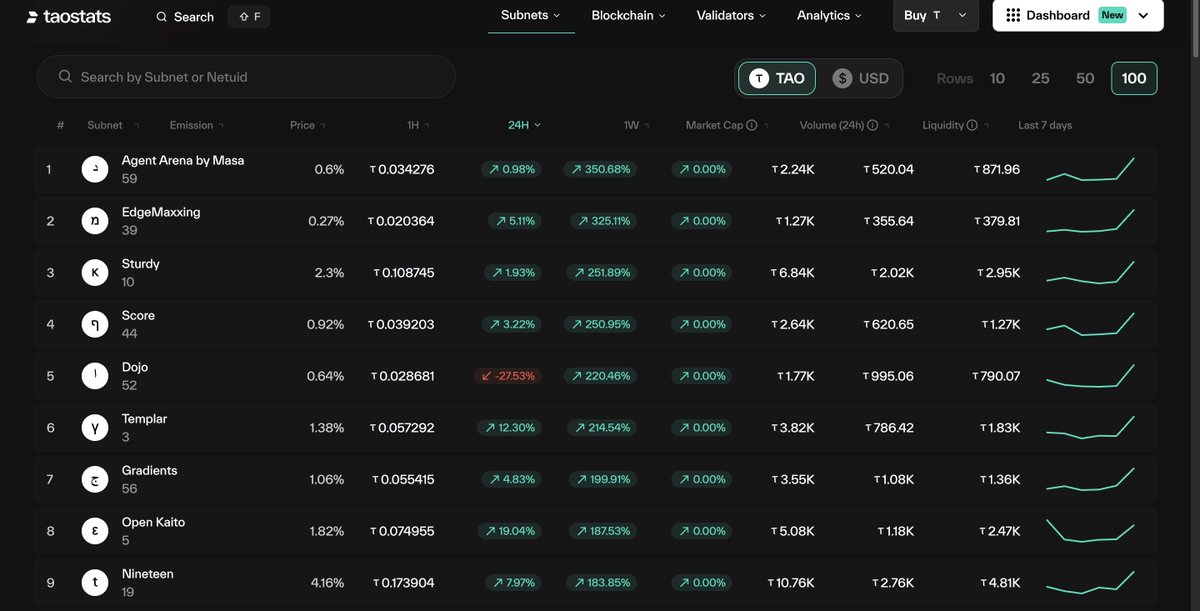
🚨 Massive opportunity in $TAO #subnets tokens 🚨
📉 Reserves Over Injected: -25% — we’re at extreme lows. Historically, these levels have preceded major pumps.
📊 Examples:
Chutes: +217% when ROI was around -15%
Gradients: +1667% at similar levels
We’re now deeper at -25%, with massive upside potential.
📈 Market sentiment is shifting. The dip already happened — what’s ahead could be explosive.
Is it time to multiply your $TAO?
#bittensor
@nietechniczny@rpl_0x Cześć!
Z przyjemnością dołączę do Waszej społeczności 🙌
Freelancersko zajmuję się wdrażaniem VoiceBotów AI dla biznesu. Pracuję jako AI Automation Manager w agencji marketingowej, a niedługo startuję też z kanałem na YT, gdzie będę dzielić się praktyką.
#dTAO is fucking magic. I put 50 $TAO into some great subnets yesterday on a test basis. Today I got 50 TAO more.
The magic happens on the #bittensor. It's worth being early.
#dTAO is fucking magic. I put 50 $TAO into some great subnets yesterday on a test basis. Today I got 50 TAO more.
The magic happens on the #bittensor. It's worth being early.
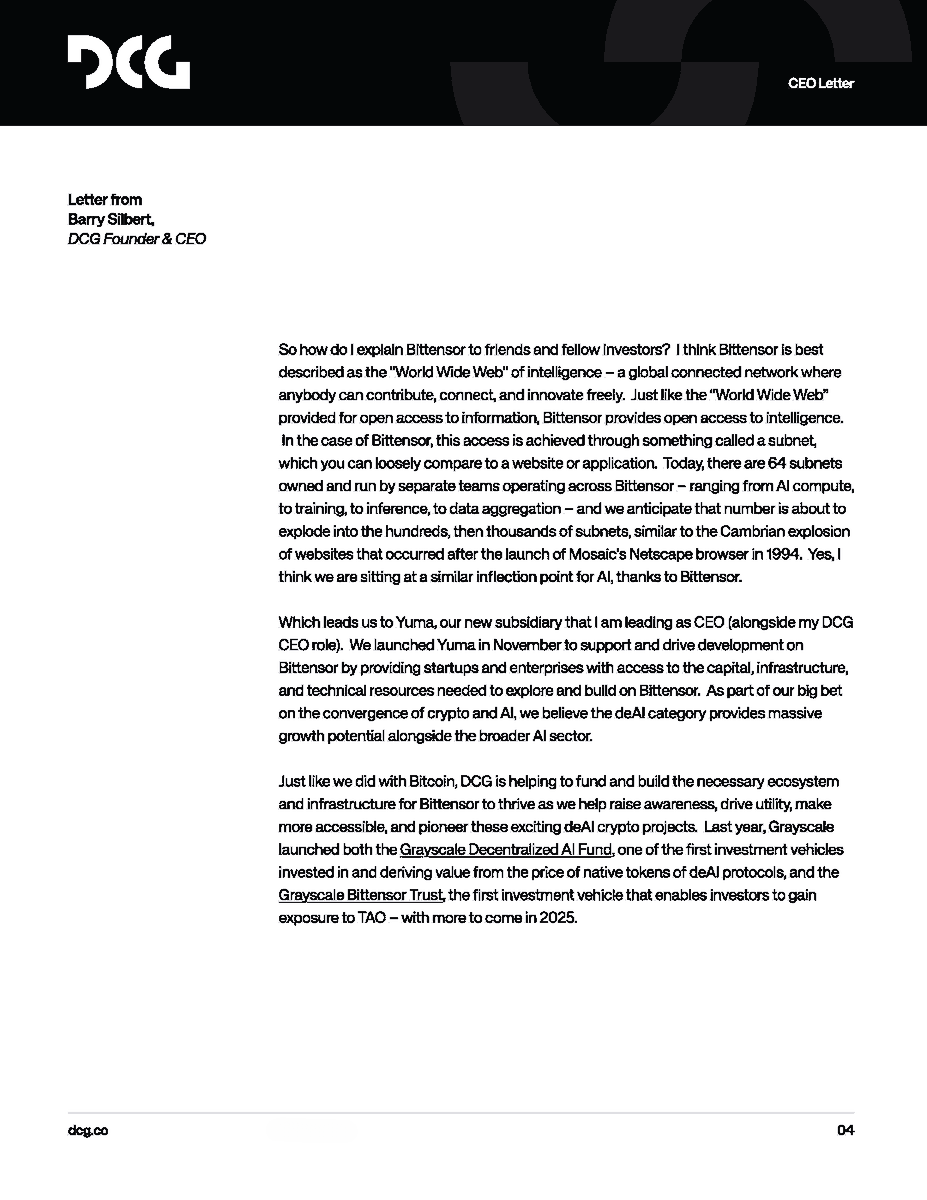
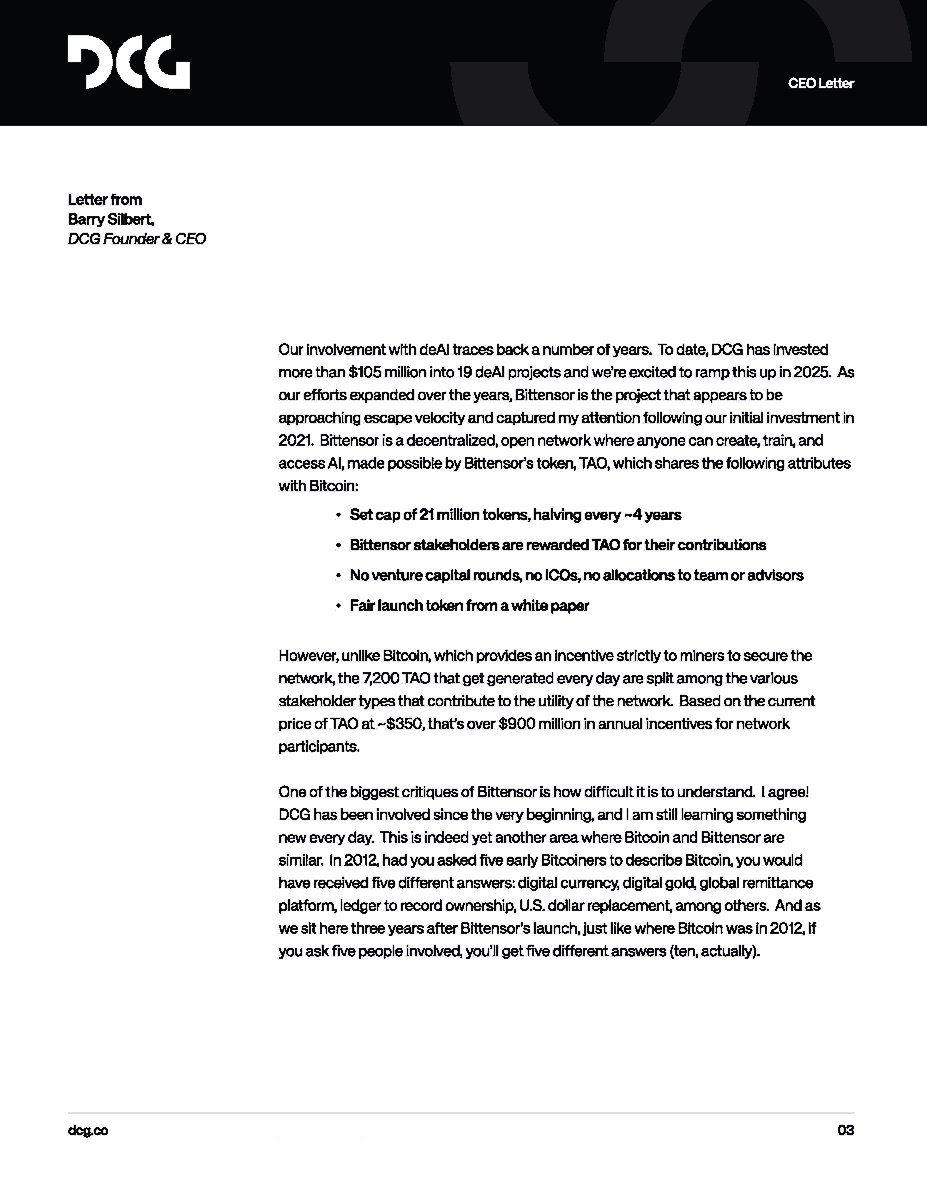
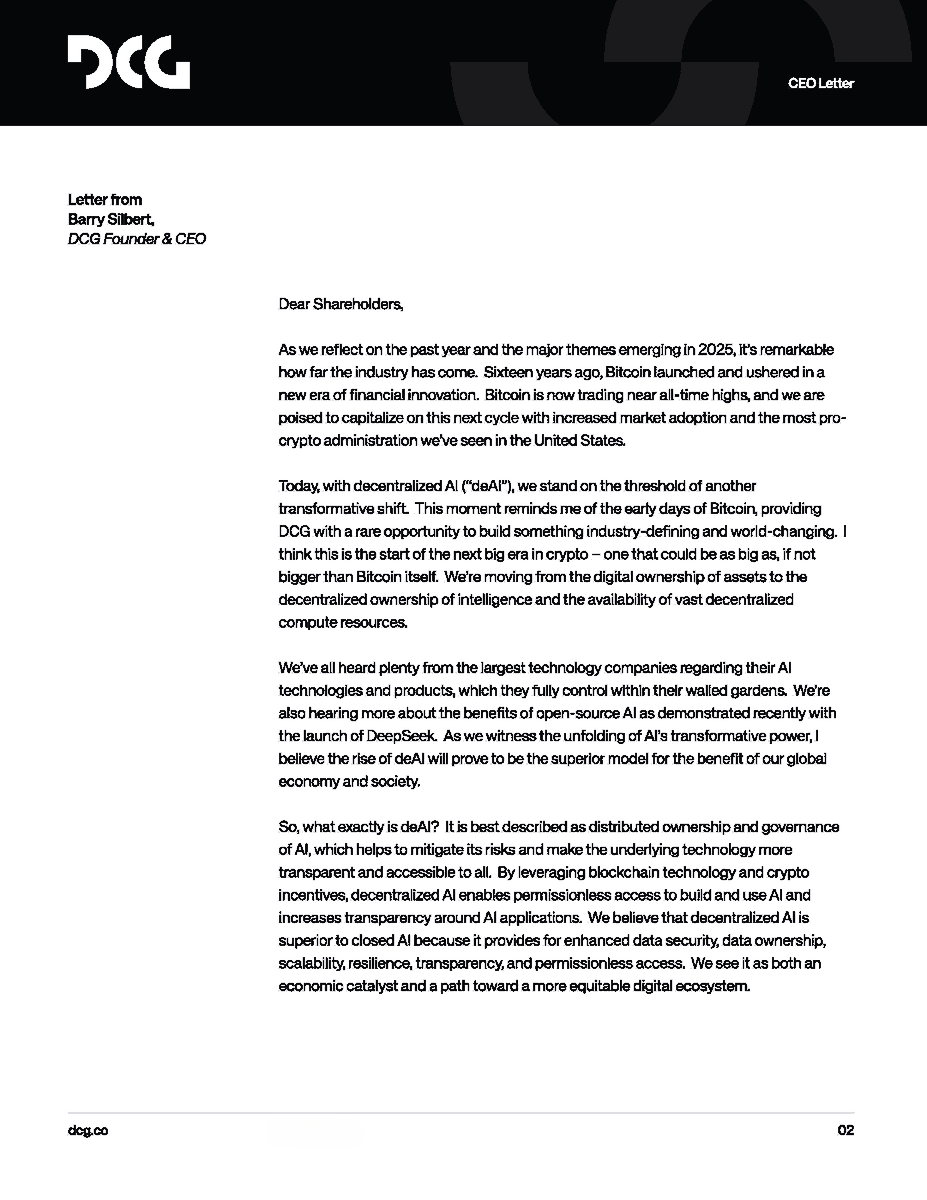
We are on the threshold of another transformative shift: deAI. For @DCGCo, I wrote below about the evolution from the digital ownership of assets to the decentralized ownership of intelligence and Bittensor as the “World Wide Web of AI.”
Similar to Bitcoin, Bittensor $TAO is open, transparent, and community-driven. And as we learned from Bitcoin, early revolutions look complicated on their surface, but therein lies tremendous potential.
[ $TAO ] 2 scenarios
1. Optimistic
We are in a descending wedge. Gross volume in the recent move may inform us that there is likely to be a breakout, another retest of the wedge and an upward climb.
2. Pesimistic
We have yet to see one leg down and a new LL as a fakeout of the wedge, the next climb up. We will have >30% fill of the wedge, theoretically that's when breakouts mostly come.
#bittensor
This started as our year-in-review report on Bittensor. But halfway through writing it, we realized there wasn't a single comprehensive resource that simply explains the thesis, maps the ecosystem's growth, and explains Dynamic TAO
So Seth and I set out to create it



![kryptoflaneur's tweet photo. [ $TAO ] 2 scenarios
1. Optimistic
We are in a descending wedge. Gross volume in the recent move may inform us that there is likely to be a breakout, another retest of the wedge and an upward climb.
2. Pesimistic
We have yet to see one leg down and a new LL as a fakeout of the wedge, the next climb up. We will have >30% fill of the wedge, theoretically that's when breakouts mostly come.
#bittensor](https://pbs.twimg.com/media/GiiVUvgWUAAHbOz.jpg)



![kryptoflaneur's tweet photo. [ $TAO ] 2 scenarios
1. Optimistic
We are in a descending wedge. Gross volume in the recent move may inform us that there is likely to be a breakout, another retest of the wedge and an upward climb.
2. Pesimistic
We have yet to see one leg down and a new LL as a fakeout of the wedge, the next climb up. We will have >30% fill of the wedge, theoretically that's when breakouts mostly come.
#bittensor](https://pbs.twimg.com/media/GiiVWAOWIAAH75r.png)


