i’d argue @BottomLinePodd’s insta content is the most valuable coming out of India on national startups, sovereign AI, the energy sector and new frontier technology
As believers of open research, we are disappointed to see Anthropic silently degrading Fable 5 for AI development
"Any topic related to building pretraining pipelines, distributed training infrastructure, or ML accelerator design... may have limited effectiveness through Claude via methods such as prompt modification, steering vectors, or parameter-efficient fine-tuning."
Not only do they get to decide what you use LLMs for in research, but this also enables them to silently intervene in your research without you knowing.
This sets a dangerous precedent. If a model refuses openly, users can understand the boundary. If a model falls back to another model, users can still evaluate the difference. But if a model silently modifies or weakens its own answers while still pretending to help, researchers lose the ability to know whether a failed result came from their own idea, their implementation, or an invisible intervention by the model provider.
That is not safety. Safety policies should be transparent, auditable, and user-visible.
On top of that, the people most harmed by this are not the largest labs with massive teams and proprietary infrastructure. It is the independent researchers, academic groups, startups, and open-source builders who rely on public tools to compete, innovate, and pioneer AI for everyone else.
Okay this is genuinely insane.
SpaceX just unveiled a satellite whose only job is to run AI. Not internet. Not GPS. Just compute, floating in orbit.
It's called AI1, and the reason behind it breaks your brain.
AI data centers on Earth are hitting a wall, not a chip wall, a physics wall.
They need staggering amounts of power and water just to stay cool, and we're running out of grid and land to build them.
So Musk's answer is: stop building them on Earth.
In orbit, the sun never sets. Free power, 24/7. No water for cooling, you just radiate heat into the vacuum of space. The two things choking AI on the ground barely exist up there.
And here's the wild part: Musk says it's easier to build than a Starlink satellite. Strip out the complex antennas and it's "a lot of solar cells, a radiator, and some laser links."
One AI1 carries the compute of an Nvidia GB300 rack, the same hardware data centers fight over down here.
AI1 is just the first one. The plan is a constellation of up to a million of them.
And the timing isn't an accident, SpaceX goes public this week at a ~$1.75 trillion target. This isn't a rocket company anymore. It's positioning itself as the power grid for AI, in space.
The race for AI compute just left the planet. Literally.
@SpaceX
Introducing Claude Fable 5: a Mythos-class model that we’ve made safe for general use.
Its capabilities exceed those of any model we’ve ever made generally available.
I think it's underappreciated how economically valuable AI safety is. A model that frequently goes off the rails, takes dangerous actions, is misleading or deceptive, etc. is simply much less valuable than a model that does not do that.
interesting to see anthropic opt for the more conservative approach in developing safe and aligned AGI. there are broadly 3 schools of thought:
1. build it slowly, and safely
2. build it without interruption
3. stop building it
anthropic chooses #1.
we’re right around the corner
None of this guarantees recursive self-improvement is on the horizon. It’s not yet clear that Claude is capable of research judgment—of choosing the right problems to work on.
But if these trends continue, AI systems designing and building their own successors is plausible. This could revolutionize society—medicine, technology, the economy—for the better. But it may also compound alignment issues and ultimately lead to loss of control.
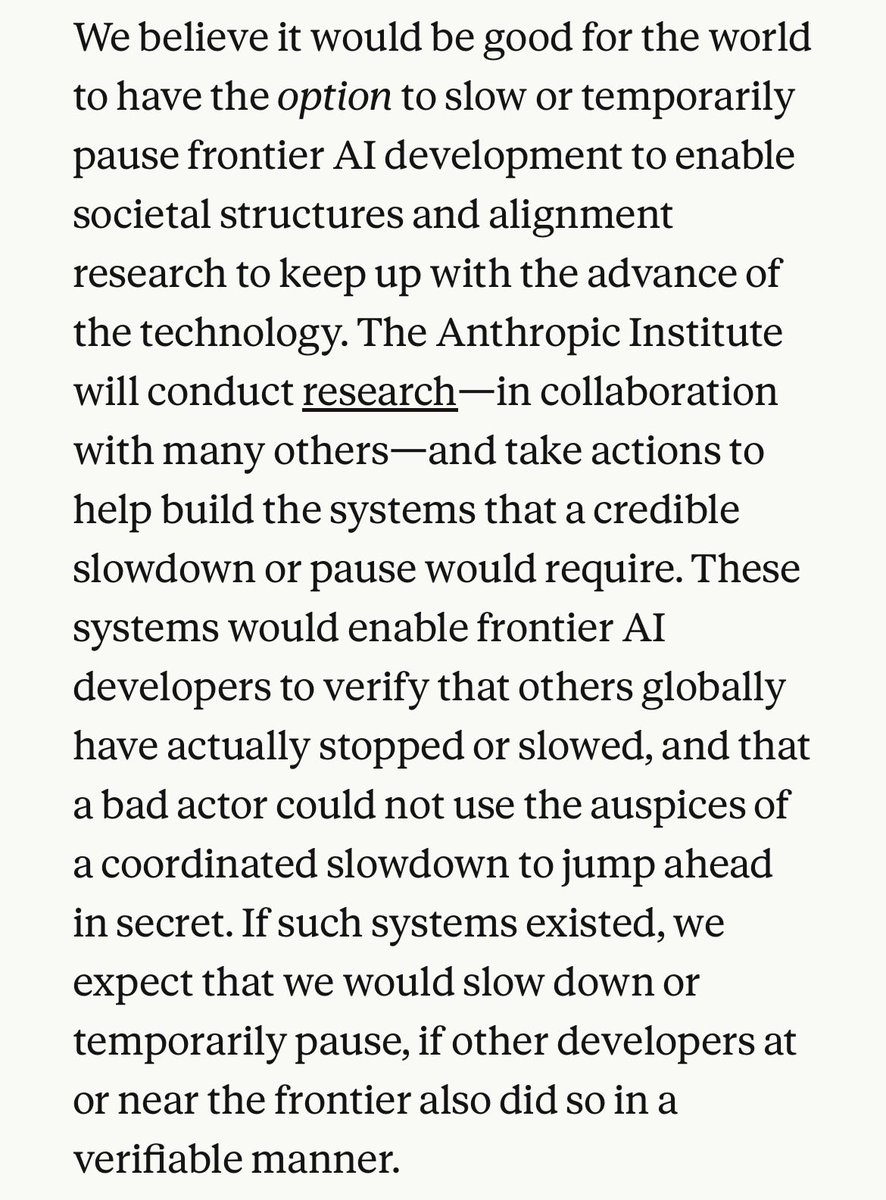
The Anthropic Institute (in collaboration with external stakeholders) will conduct research to think through the implications of increasingly powerful, potentially self-improving systems—and how to create the ability for the world to make deliberate choices about the future development of the technology.
Read the full post: https://t.co/XkYALsONft
@build_with_sid completely agree with that. moreover, i’ve read up in multiple places that the “only 2 skills” left after the LLM takeovers will be taste and agency
submitted a report for @apartresearch today @ The Secure Program Synthesis Hackathon titled "LLM-Assisted Ambiguity Detection in Regulatory Specifications" for track 1, Specification Elicitation. regulatory software has a specification problem. (1/4)
the project does one thing: reads a natural-language regulatory requirement and asks whether it is specific enough to implement. three LLM calls handle formalization, auditing, and scoring. ran it on seven GST rules. all seven came back underspecified. (3/4)