The Rich Getting Richer,
https://t.co/CScvrC3dtN
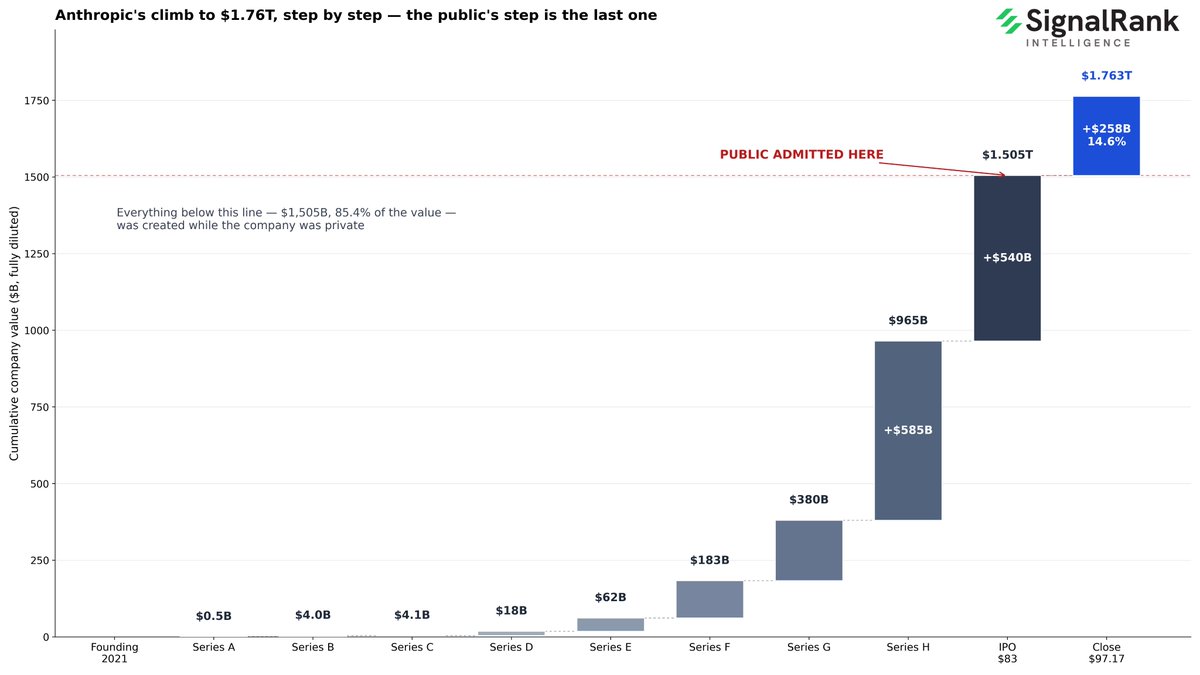
1. The public was allowed in at $83. The insiders got in at $1.12. Same company. One group is up nearly 80x. The other is up 7%, and anyone who bought at Thursday’s close is already losing money.
2. $980 million made $76.8 billion. $93.5 billion made $6.7 billion. The public put in almost 100 times the capital and got less than a tenth of the gain.
3. You were not outsmarted. You were locked out. Nobody offered ordinary investors Anthropic at Series B. Declining a risk is one thing. Being barred from taking it is another.
4. Investor protection worked perfectly. It protected the public from an 80x return. The accredited-investor rules keep ordinary people away from early losses and early fortunes alike.
5. An IPO is not democratization. For many early holders, it is the exit. The public’s entry point is the insiders’ liquidity event. Open ownership at Series B, through listed funds anyone can buy, or stop calling this access.
“Jensen Shouldn't Have Resigned.” Keith Teare’s argument: boards must weigh the shareholder risk of removing a leader, not just the pressure to act.
https://t.co/F573HdEggD
@credistick 85.4% of value growth went to private investors compared to todays close, 14.6% went to the public. This is not democratization. @SignalRank - B entry yields 86.7x. A was 377.3x
@credistick 85.4% of value growth went to private investors compared to todays close, 14.6% went to the public. This is not democratization. @SignalRank - B entry yields 86.7x. A was 377.3x
@credistick 85.4% of value growth went to private investors compared to todays close, 14.6% went to the public. This is not democratization. @SignalRank - B entry yields 86.7x. A was 377.3x
@credistick 85.4% of value growth went to private investors compared to todays close, 14.6% went to the public. This is not democratization. @SignalRank - B entry yields 86.7x. A was 377.3x
More venture money does not necessarily mean more risk-taking. If it all crowds into a few high-profile companies, who backs the startups just beginning their journey?
https://t.co/F573HdEggD
Keith’s argument on Anthropic’s IPO: hold the line on a valuation grounded in performance, rather than hand institutions a gift. A view on pricing—not a prediction of returns.
https://t.co/F573HdEggD
Can a party promise to grow wealth and share it more widely while opposing the infrastructure that helps create it? The data-center debate needs a growth plan.
https://t.co/F573HdEggD
Infrastructure needs resilience, not just upgrades. This week’s air-traffic disruption is a reason to ask what happens when one component fails.
https://t.co/F573HdEggD
Kudos to @kteare for being balanced, logical, and focused on the business aspects vs. politics etc. I just wish the others would stop leaning over to politics because it's just so tiresome.
Are We Losing Our Nerve?
1. We’re losing our nerve at the wrong momentThe technology keeps rewarding ambition, while boards, investors, companies and politicians are each choosing caution. Nerve isn’t recklessness. It’s making a considered commitment before the evidence is complete.
2. Nvidia’s board acted before the facts were inAccepting Jensen Huang’s resignation before the independent investigation reports erased more than $855B in value. With 60 direct reports and no named successor, the board had already neglected continuity, which is a fiduciary duty too.
3. Anthropic’s IPO is a fall in mood, not in the businessExpectations slid from $2T to about $1.4T. Even so, that’s well above the $952B spring round, at about 17x an $81B revenue run rate. The bear case to take seriously is McCormick’s, about $900B in compute commitments, not the headline drop.
4. Venture capital is caution with a bigger checkSeries A dollars are up 60% to $42B while deal counts stay flat. Funds on their fourth raise or later took 88.2% of US fundraising, and first-time funds took 4.5%. Capital crowding into consensus companies concentrates the risk it is trying to avoid.
5. China builds data centers in a year; America spends four on paperworkA campus in Inner Mongolia delivered 120MW within a year at about one-fifth of US cost. A US environmental impact statement takes nearly four years on average. Tunguz says the US could be importing AI tokens by 2028–2030. Pay-your-way rules, yes. Moratoriums, no.
https://t.co/AzKYWWqtBK
AI could change health and education profoundly. Progressives need a plan for ownership, growth and sharing wealth—not just bans and moratoriums.
https://t.co/9xCEWsEn0m
One share for every citizen, held for life. No selling. No transferring. It expires at death. That is the ownership rule I propose for a Human Wealth Fund.
https://t.co/9xCEWsEn0m