wow apparently there is now stronger result on large prime gap by GPT 5.6, improving beyond the previous best result of Ford-Green-Konyagin-Maynard-Tao [2014] by factor of log3 X / (log4 X)^2. I recall tao mentioning that it would require genuinely new idea to break his result, and that seems to be the case here.
+ its been verified in lean unconditionally?
https://t.co/y1xjG6eduJ
Yep, this is becoming an issue and $$$ should never be the means and/or ultimate goal to reach to scientific discovery! Discovery should never be driven by how much tokens you spent, but instead it should be: How do we combine, bridge and/or merge different segments of Math!!
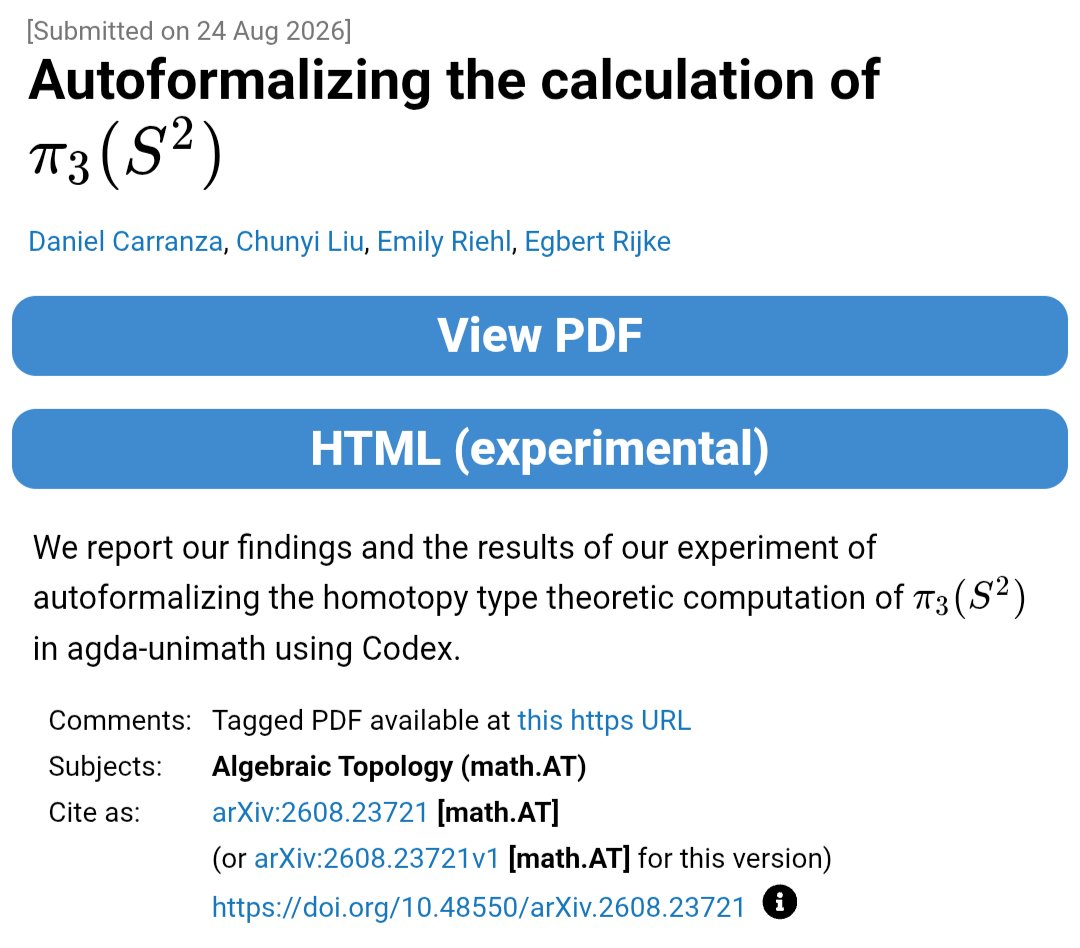
Close to $2000 API costs to autoformalize π_3(S²) = Z, one of the first simplest nontrivial homotopy groups of spheres, over the course of several days. I think a picture of the future starts to emerge, doesn't it?
This is so so true, and this is precisely the biggest danger awaiting the upcoming generation of PhDs and all scientist-want-to-be's! The path has not been harder, and it remains hardest than ever! The Q is: How do we exist in era of AI?! Research-community has to find its path!!
Fields Medalist Terence Tao:
"AI lets us create scientific output much faster, but it could come at the cost of nurturing the next generation of scientists"
If AIs replace grad students, they may produce grad-student-level papers — but we risk losing the next generation of scientists
Very nice!! GPT 5.6 has broken the record on large gaps between primes.
The new bound saves a factor of ≈ log_3(n) over the prior record by Ford-Green-Konyagin-Maynard-Tao from 2018. The result is also now formalized by Alexeev in Lean.
The Growing Map of Open Mathematical Problems.
We mapped 15,000+ conjectures from UnsolvedMath to show potential links between concepts.
It also shows how under formalized the frontier is (less than 10%).
I used GPT to solve a problem that I had wanted to solve ten years ago but couldn’t: https://t.co/akkUY54O5W.
Throughout the process, I felt that my only role was to teach the AI how to write things in a way that I could understand. Its initial language was extremely condensed—so compressed that I could barely follow it—but somehow the AI agents themselves seemed to understand it perfectly well.
I increasingly feel that every theoretical field that relies on a large amount of public knowledge plus logical reasoning is going to undergo a profound transformation. What will the role of humans be then? Will we only need to ask the right questions?
Universities will also change profoundly. What should universities teach students in the future?
Following @__alpoge__ 's map, this work provides explicit cubic‑linear counterexamples to the Jacobian conjecture, by completing the reduction chain from 3‑D counterexample to the narrowest normal form.
https://t.co/QhnW9QYZYA
hello there the jacobian conjecture is false thanx to my close friend akhil for asking about it and my other close friend fable for working during the world cup final
((1+xy)^3 z + y^2 (1+xy) (4+3xy), y + 3 x (1+xy)^2 z + 3 x y^2 (4+3xy), 2 x - 3 x^2 y - x^3 z): \C^3\to \C^3, has jacobian determinant -2, and sends (0, 0, -1/4), (1, -3/2, 13/2), and (-1, 3/2, 13/2) to (-1/4, 0, 0)
Excited to see @Reuters cover the launch of our startup Accelerated Understanding.
We are training large scale AI models that can simulate and understand physics to invent and discover. Our models understand the world directly in 4D (3D + time) and across physical phenomena. Going full 4D requires massive context length, we have pushed it to a Trillion in training and exceeding 5 Trillion at inference.
AI giving you a bigger haystack of ideas doesn’t help. The bottleneck for new inventions and discoveries is shifting from ideas to the ability to test them. With AI that can simulate and understand physics we are directly attacking this bottleneck.
People have been trying to do this for a while now, but usually by taking shortcuts. Narrow surrogates are great if you happen to have enough of precisely the right data and your design loop stays in distribution. Video models look fantastic but sweep physical accuracy under the rug, and some static world models cut out physics altogether. A lot of interesting physics isn’t visual.
What does not cutting corners look like? Space stays 3D and you also have time: so 4D in total. You also need multiple physical modalities in the same model, not just things you can see. That’s what we’ve built.
Scaling is the primary ingredient to make this work. To represent the world you need sufficient context, which in our case grows in 4 dimensions. Individual samples get so big they don’t fit into single accelerators or even full nodes anymore.
We’ve developed architectural tricks to make it work. We’ve pushed our models to 1T parameters during large scale pre-training and are able to train at up to a Trillion context when needed and do inference exceeding 5 Trillion context without any sub-sampling or patching.
Building on prior successes of AI weather forecasting, fusion simulation, design of medical devices, drugs and chips, we wanted to see if scale and universality can benefit AI for physical understanding. With our teams’ experience in large-scale infrastructure and model training we’ve been able to pull it off.
https://t.co/w12yG9fCps
https://t.co/vWnPiTbLEy
@accelerated_u@bjenik
Lost my phone at the office and spent 30 minutes turning the place over. Find My was disabled by MDM.
Out of ideas, I asked Claude how I could find it. It suggested tracking the Bluetooth signal strength, then wrote me a meter in about a minute.
I walked around watching the number climb. Found it.
Apparently you can just make the tool you need now.
Code: https://t.co/fmnISzHfZ2
A student pilot experiences his first fully developed spin during emergency maneuver training with an aerobatic instructor. Having only practiced incipient spins before, he entered the spin at 6,700 ft, started recovery at 4,500 feet using the Beggs-Mueller method, and leveled out safely at 3,200 ft.
📹: coryjeacocke
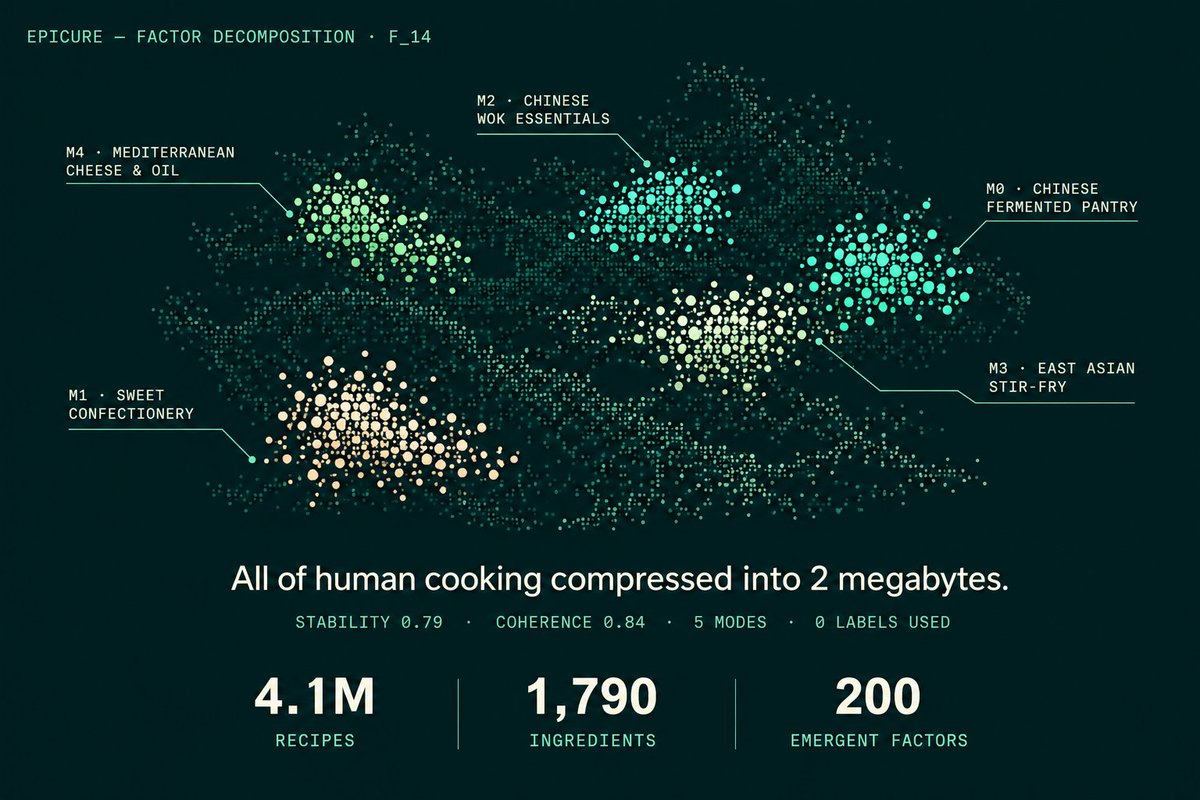
Launching our new paper on arXiv: we trained the largest multilingual food model ever built.
4.1M recipes. 7 languages. 1,790 ingredients. 300 dimensions.
All of human cooking compressed into 2 megabytes.
🚨: A photographer captured the Sun for three years straight from the exact same spot at the same time, then combined every position into one incredible image










![cloneofsimo's tweet photo. wow apparently there is now stronger result on large prime gap by GPT 5.6, improving beyond the previous best result of Ford-Green-Konyagin-Maynard-Tao [2014] by factor of log3 X / (log4 X)^2. I recall tao mentioning that it would require genuinely new idea to break his result, and that seems to be the case here.
+ its been verified in lean unconditionally?
https://t.co/y1xjG6eduJ](https://pbs.twimg.com/media/HQ9qLV0bcAA23h3.png)