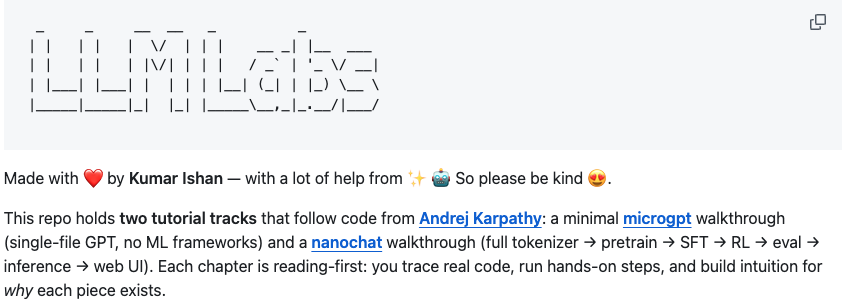
Used Claude Code to auto-generate a complete 13-chapter tutorial from @karpathy's nanochat & microgpt repos.
One prompt and a full curriculum from a codebase. Full math, real code, hands-on steps.
This is how I want to learn every repo now. 🧵👇
(1) Today we're releasing Muse Spark 1.1 -- a strong agentic and coding model at a very low price. It's available through our new Meta Model API and in Meta AI.
Memory is a selective, compressed, semantic cache of the world: it keeps what matters, how things connect, what happened, what usually works, and where to look again, rather than copying the world exactly.
I see a lot of enthusiasm about building sovereign models on my timeline.
That's great to hear and India needs it, BUT.. building a Fable-class model is a compute and funding game. Last I checked, India had ~50-100k H100 equivalents while frontier labs would have a million each.
Unless we have a paradigm shift in how AIs are trained, the conversation ought to be happening about amount of funding available to do what we want to do. Show me an Indian company that's secured funding/compute in the same range as that of Chinese AI labs (let alone American labs).
Without compute, what will happen is what has happened before: we'd promise to shake the world and then build models that are a year or two behind the top ones.
The path forward for sovereign models that I see is to invest in basic R&D so we have a chance to go beyond the current paradigm, OR the government pooling in several orders of magnitude more compute to seriously commit competing at par.
LLMs feel less like a new engineering technique and more like how quantum mechanics felt to physics.
Not because the underlying science is similar, but because it breaks our intuitions.
We can predict behavior, improve performance, and build useful systems, yet many of the most interesting capabilities seem to emerge from the system rather than being explicitly programmed.
Most cricket ads sell products.
We wanted to sell the dream of building.
So we handed India’s biggest spotlight to 30+ founders.
An 8-year-old starting up. A 90-year-old starting again.
People who broke barriers and built anyway.
And in doing so, they created jobs, solved real problems, and moved India forward.
But this was never meant to be just an ad campaign.
It’s a movement to make builders visible, celebrate ambition
And remind the next generation that the coolest thing you can do right now is build for India.
To every founder out there rewriting the rules - this one’s for you.
And whoever said founders can’t act… wait for the ad breaks 👀
They might just inspire you to build something too.
BreakToBuild | @Razorpay
Tokenmaxxing is not the goal. It is just a way to test the limits of models and our ability to operate massively parallel agents.
It is also genuinely hard to measure quality engineering while tokenmaxxing. A lot of the signals become noisy when the objective shifts toward throughput and exploration.
In my personal observation: 3/5 tokenmaxxers today were not great engineers earlier.
On the flip side, people unaware of the limits are often the ones pushing the limits hardest. What traditionally strong engineers see as failure modes, architectural risks, state hygiene problems, or scaling limits, others are simply oblivious to and keep pushing through.
The real gems are the people who deeply understand the limitations and still know how to push the systems to their edge.
Agree long context windows don’t solve agent memory entirely.
The harder problem is state hygiene when agent runs for hours and days.
But larger working memory still matters a lot. It reduces the constant reconstruction loop: exploring repos, rebuilding context, etc.
That alone can significantly improve both latency and accuracy for coding agents.
This fundamentally changes coding agents.
Today agents repeatedly re-explore repos and rebuild context from scratch.
12M token context + sparse attention could enable persistent codebase memory: repos, architectural decisions, and debugging history staying active across long sessions.
Less reconstruction. More long-horizon understanding.
Introducing SubQ - a major breakthrough in LLM intelligence.
It is the first model built on a fully sub-quadratic sparse-attention architecture (SSA),
And the first frontier model with a 12 million token context window which is:
- 52x faster than FlashAttention at 1MM tokens
- Less than 5% the cost of Opus
Transformer-based LLMs waste compute by processing every possible relationship between words (standard attention).
Only a small fraction actually matter.
@subquadratic finds and focuses only on the ones that do.
That's nearly 1,000x less compute and a new way for LLMs to scale.
Science is the most honest way to experience god.
The never-ending “why” questions and its corresponding deep, awe-inspiring answers is how one gets to viscerally connect with the deepest mysteries our universe has to offer.
Great news to start off the new financial year. @Razorpay is now embedded natively inside @OpenAI’s Codex, an industry-first for any Indian payments company.
A developer prompts "build me a fitness app with a ₹499 one-time payment." Codex builds it. Razorpay handles the payments. No separate integration, no dashboard-hopping.
If AI makes creation effortless, monetisation should be just as simple.
India has 6 million developers & weekly Indian users of Codex 4x'd in two weeks this February. We’re building for this shift where more people can create, launch, and earn without friction.
We have always enabled businesses so that their payments are smoother, easier, simpler & faster and Codex just got added to that already illustrious list.
@kaif9999 @MiniMax_AI Are you factoring in privacy? There’s no clear way to opt out of training on your data.
Unlike Anthropic Claude or OpenAI Codex where you can switch it off.