From the crew that brought you Beeper, meet Hackney. A brilliantly simple app that surfaces rideshare prices on a dynamic, linked menu.
Hackney is a great case study re the power of interoperability for consumer products. We can and should demand more UX like this from Big Tech.
Polymarket launched Combos, a new primitive that allows traders to bundle multiple prediction market outcomes into a single position. Instead of manually building exposure across several markets, users can request a quote for the entire package and receive a price from market makers through an RFQ auction.
The process briefly:
- user submits request for combo
- rfq sends it to market makers
- market makers participate in an auction to get the best quote
- user accepts or denies the quote
The interesting part is that these positions are not limited to a single event. A Combo can theoretically combine outcomes across sports, politics, AI, macroeconomics, crypto, and any other category available on the platform. Market makers compete to price the probability of the combined outcome, turning collections of individual markets into entirely new tradeable instruments.
This pushes prediction markets one step closer to becoming a combinatorial financial system where traders can express increasingly complex views without needing a new market to be created for every thesis. The real innovation imo is the ability to create permissionless exposure to relationships between events that previously existed only in a trader's head.
Happy to ship the first version of Hedgebook, powered by @Kalshi : an app showing how every SPX companies can hedge their core business risks using Kalshi event contract markets.
Event contracts and perpetual contracts consolidated into a single, onshore, regulated exchange is how we get to perfect Arrow-Debreu markets.
Thanks to @j0hnwang and @0x_ultra for inviting me to build this, and to Nicole from @KalshiResearch for inviting me to present the early frameworks at the Kalshi Research Conference in March.
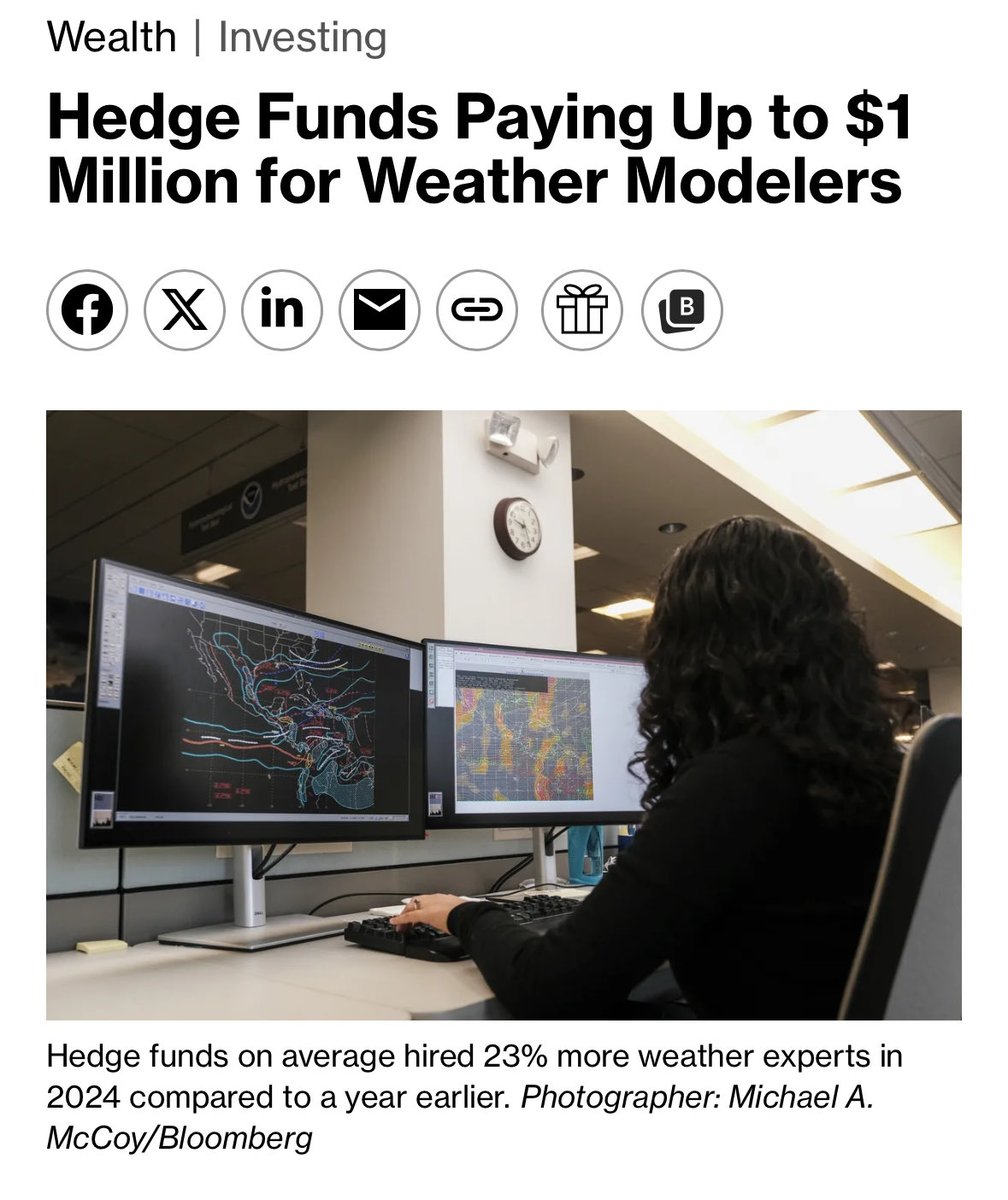
Hedge funds have been paying $1M salaries to hire the best weather modelers to forecast stock prices for some time now
But why do that when you can use prediction markets to strip out that singular factor and make bets on it directly?
I have been saying for some time that prediction markets are going to become an incredible tool for factor stripping at hedge funds
What do I mean by this?
> multi manager (pod shop) hedge funds boil down stock movements as a function of a few factors, which are items or externalities that move the price of a stock up or down
> just as an example, beta is always an evergreen factor for every stock. If S&P 500 moves up or down, a stock usually has some correlation to that
> other factors might include sector specific beta, raw material and commodity prices, FX exposure, etc.
> for certain sectors and stocks, weather can be a very important factor, especially when you isolate it to a certain region or geography. Perfect examples of this are energy, utilities, agriculture, insurance and maybe even some consumer companies
> hedge funds paid millions to hire weather forecasters for this exact reason. On top of stocks, these funds are also trading commodities and reinsurance assets which are directly impacted by the weather
> the problem with this approach, however, is that it is really hard to find perfect correlations. For example, energy prices may move as a result of weather, but there could be many other factors that also impact oil at the same time. Anything from geopolitical uncertainty to surprise announcements from producers
> all of this is to say that a weather forecaster at a hedge fund might nail their prediction on the weather, but can still get crushed by the dozen other factors that impact the asset class. This is even more pronounced when you consider that funds are trading with big leverage
> prediction markets allow you to strip out this factor as a singular bet, without any of the other noise from external events. It is the perfect hedging tool for many funds
This is already happening inside some funds, and many others are beginning to take a look.
In the last few weeks, there have been multiple reports of hedge funds and banks who are opening up job postings for prediction market traders
The skeptics right now will point to the lack of volume in these markets
For funds managing billions in AUM, there is simply not enough volume to fully hedge exposure or strip out factors and earn decent returns
My view is that as prediction markets get bigger and market makers move in with size, we see that concern go away
In the future, prediction markets should become a core component of any pod shop hedge fund
That is ultimately the real utility of these markets
Whoa whoa whoa, what??
Overton window on prediction markets is moving so much faster than I expected. From within a year, we went from "prediction markets are sus" to "prediction markets are the best source of truth."
Absolutely incredible win for @Polymarket.
"softer" ways to limit insider trading on prediction markets could be to require kyc/b:
for:
- all users above a bankroll threshold
or to take part in:
- markets related to politics
- markets below a certain liquidity threshold
- market events below a certain probability
this week, Meta announced plans to launch a power trading business, Atem, to manage the power costs of their massive data center footprint
this marks a new era of vertical integration and with it, a new era for commodity and compute markets
a deep dive, with charts ofc 👇
I’ve always believed that opportunities live between fields of expertise.
If something fits neatly in a bucket, it’s probably already priced in.
This has been my investment philosophy, a metaphor for my career and where I like to invest.
Am I Silicon Valley or Wall Street, a founder, operator or investor? My answer has always been the same: Yes.
Great step taken by Kalshi
Next is letting users use their yield generating/bearing stable of choice with any bets
USDe_War stops in 2025
And then probably natives like BTC n ETH
Margins to platforms who've got users.
Long run: AI shatters the worth of execution and tech stacks
But protocols r the ones who accelerate the race to near 0 margins.
For now, Hyperliquid is the engine and the shop. They've got leverage.
But they understand that long term revenue share is a non negotiable, and started applying it to their roadmap.
Only rational for them to go down the supply chain and ask everyone to comply, they're the ones in charge atm.
Two months ago all the stablecoin issuers decided to foray into launching their own chains.
This month the chains punched back.
It will be fascinating to see how the leverage plays out. My suspicion is that it will play out differently depending on the stablecoin and use case. For DeFi use cases, I think the chains and apps will have significantly more leverage.
With respect to payments, its likely the issuer.
With the public proposals that have come out for $USDH, it feels like the floodgates are opening.
✦ 𝐈𝐧𝐭𝐫𝐨𝐝𝐮𝐜𝐢𝐧𝐠 𝐏𝐮𝐥𝐬𝐞 ✦
Built in partnership with Pendle, Pulse is the first agent that autonomously optimizes your PT portfolio.
We're starting with ~13% APR on ETH-PT markets. More assets coming soon.
This is what intelligent fixed yield looks like ↓
✦ 𝐈𝐧𝐭𝐫𝐨𝐝𝐮𝐜𝐢𝐧𝐠 𝐒𝐰𝐚𝐫𝐦 𝐅𝐢𝐧𝐚𝐧𝐜𝐞 ✦
The incentive layer that enables agents to create more efficient markets.
This is how we turn DeFi's $150B in static TVL into always-optimizing Active Capital ↓
However
Protocolization ironically decreases infrastructure margins and increases the relative value of distribution
So the capitalization North Star may still be a blockchain-native, consumer-facing neobank / fintech.
Hyperliquid & Aave prob the closest to that.
Retail is not how Crypto matures.
DeFi lags behind neobanks in terms of usage & ux.
We've got another way to win.
Blockchain let us protocolize finance, and distribute + socialize benefits to venues that have users, liquidity, and trust.
Cheaper and composable, at scale.
there’s a huge gap for someone to build a simple yield app for normies
show people the +10% fixed APY, have a clean UI, make it decentralized, build + automate their own strategies
History made.
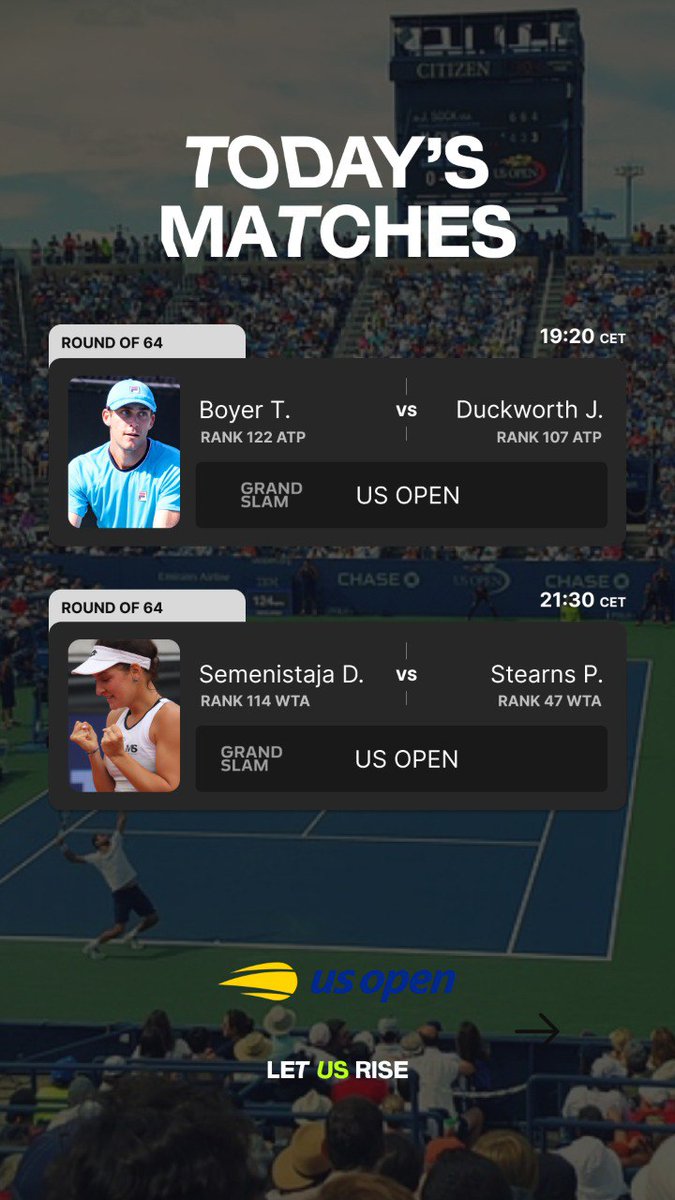
For the first time, two players who financed their careers through @FANtiumOfficial are competing in the first round of a Grand Slam at the US Open.
- Darja Semenistaja (23, WTA #114) – raised $100k, qualified
- Tristan Boyer (24, ATP #122) – raised $110k, received a wild card after strong results
Their funds went mainly into coaching and travel.
Good luck to both players – and to the investors sharing in their prize money journey.
Saw a talk this week on the trippiest thing: bacterial cultures on skin induce immune responses. At Michael Fischbach's lab, they demonstrated immunizing mice against tetanus by just dabbing an engineered version of a harmless staph culture on its head. Unlike intramuscular vaccination, the antibody levels don't seem to demonstrate any waning, even after a year.
This is both scientifically very interesting (can vaccines just be... creams?), and an amazing reminder of how much we still don't know. We could have discovered this decades ago, but somehow never noticed until now.
HAHA, wow
Wormhole put in a last minute counter-bid against LayerZero to acquire Stargate, which the LayerZero team originally launched. This while in the middle of $STG holders voting on the LayerZero buyout.
Have we entered a protocol M&A bull market?
This is gonna be fun.