the national security questions around Jensen’s actions are serious. so is the betrayal of his family.
but the moralized schadenfreude that’s turned into a feeding frenzy of casual racism, misogyny, and gleeful cruelty is so gross
quite a performance from the moral high ground
How to turn slop into gold. Super concrete steps from awesome @poteto on making coding agents trustworthy:
1. Clean up the code your agents learn from.
Your codebase is one of their biggest inputs. Agents copy whatever looks like an established pattern, including workarounds, deprecated code, and yesterday’s questionable decisions. Clean those up, or watch them reproduce.
2. Turn corrections into enforceable checks.
Every time you correct an agent, ask: can this become a lint rule, a type constraint, a test, or a better API? Put the correction somewhere the system can enforce it. A growing AGENTS.md still requires the agent to follow every instruction.
3. Remove opportunities for predictable mistakes.
Her team @spacexai restricts React’s useEffect to framework internals because agents repeatedly misuse it in product code. They also enforce import boundaries between application processes. These constraints eliminate whole categories of mistakes that would otherwise keep coming back in review.
4. Give agents a reliable way to run and inspect the product.
Provide debugging tools, reusable CLIs, and a “feature map” describing the application from the user’s perspective. Now “that thing in the left sidebar” has a shared meaning, and each agent can reuse the tools for checking it.
5. Review evidence of behavior.
Have agents produce screenshots, videos, and state diagrams. These help you check what the product actually does and how closely that matches your intent. A convincing explanation of a fix is easy to generate; seeing the fix work is considerably more useful.
6. Spend serious effort on verification.
Her team uses runtime verification and is experimenting with property-based UI testing and formal methods, including TLA+ model checking. Lauren says most of her token usage goes toward verification. Agents make some previously expensive testing work much more practical.
7. Automate once that loop is reliable.
Her team now has agents exercise new releases, find bugs, open fixes, and merge them automatically. Getting to that level of trust took her about six months of investing in the environment.
The results she reports: 11,000 pull requests shipped by her team in a month, a revert rate around 0.5%, and improvements in startup, typing, and switching chats.
And what about infamous “software factory”?
if your coding loop produces slop, automating it produces more slop, faster, with a larger token bill.
Start by making good code the easiest thing for an agent to produce. Then scale it.
As always, content at @aiDotEngineer is gold 🏆
Friday was my last day at Anthropic.
Two years ago, when Claude Code was a small internal tool, I asked it to build an RL env. I steered it for tens of hours but never manually wrote a line of code. It worked, I was hooked, and I joined the team.
When we first launched, most people approved every permission prompt by hand and mostly used Claude to answer questions and write tests.
Today, the default is trusting Claude's judgment to auto-approve. Claude does large migrations and builds new products.
Helping build Claude Code into an industry-defining product has been the journey of a lifetime.
Thank you to the incredible team behind Claude Code, Cowork, and Tag. These products are the sum of thousands of great ideas from you. I'll miss working with you all.
Thank you to our users for embracing a new way of working. Your constant feedback shaped so much of what we shipped and your stories made the work so meaningful.
Excited to see what you all make next!
You don’t need to have everything figured out before you start. You just need the conviction to go build.
If you’re making something people want, we’d love to hear from you.
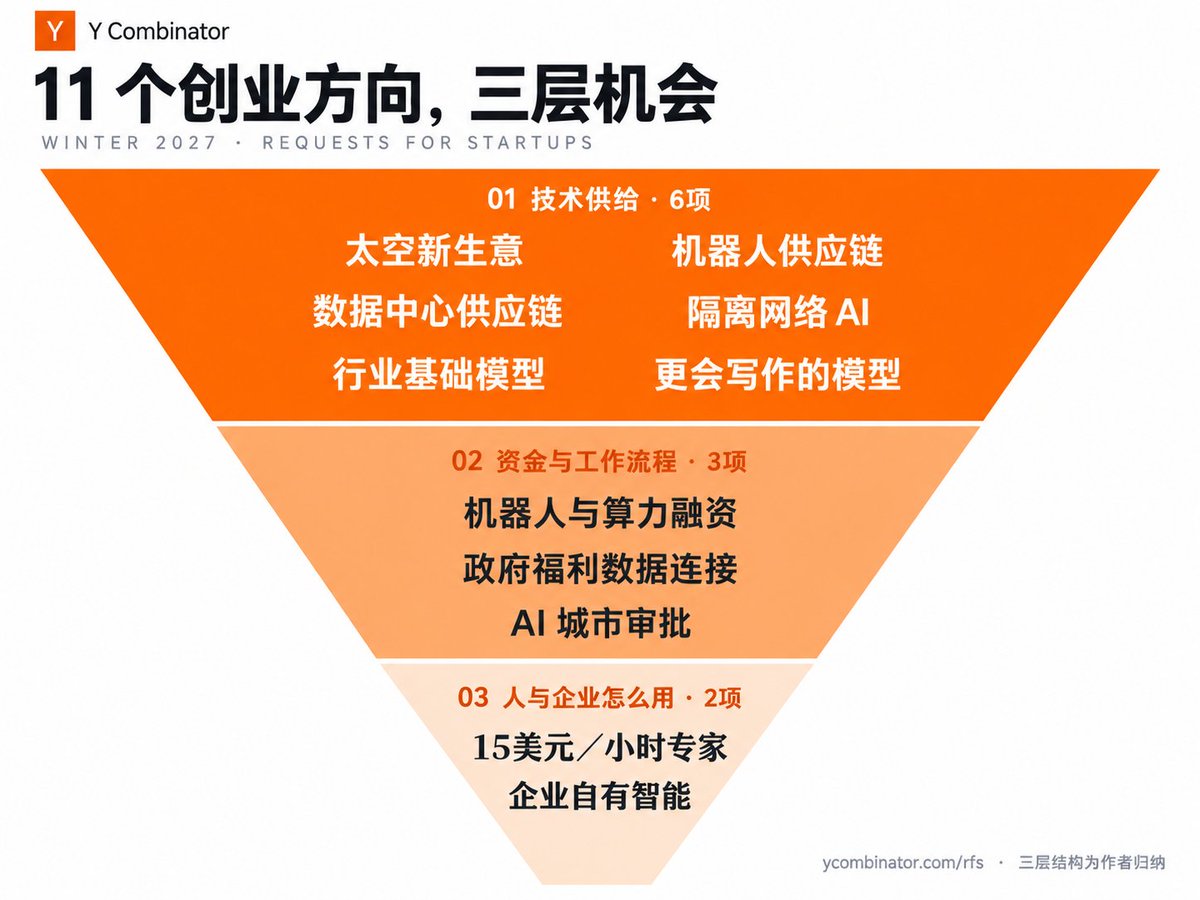
Apply to YC W27 by Nov 2: https://t.co/OnqI05W53Z
国内的竞赛班出研究员,美国的奥赛圈出了 CEO。 Decagon 的 CEO Jesse 在 X 上翻出量化公司 HRT 那一届的实习生合影。
照片里的那个小圈子,后来走出了 Scale AI 的 Alexandr Wang、Cognition 的 Scott Wu、Hyperliquid 的 Jeff Yan、Decagon 的 Jesse Zhang、Perplexity 联创 Johnny Ho、Pika 联创 Demi Guo,以及 Cognition 联创 Steven Hao、Andrew He 等人。
AGI vs super intelligence: agi can achieve white collar job, but math require super intelligence - @chijinML
Super intelligence is 100% of a human’s capabilities of all mental tasks - @AndrewDai@HYSTA