A reality check on the current “war with Russia is about to start” frenzy.
Russia is aggressive. It is waging a major war in Ukraine, conducting sabotage and other terror operations in Europe and yes, is testing NATO's red lines
Russia probably wants us to believe so - but there is no new intelligence assessment saying Russia is about to attack NATO.
There is quite a difference between THREAT and IMMINENT WAR. We should be able to understand both at the same time.
So where did the current panic come from?
European politicians and media created a perfect storm, (likely with the help of Russian assets) making deliberately strong statements, often for domestic political reasons.
Russian intimidation and hybrid warfare is designed to frighten, divide and pacify Europe.
Media/sm logic turns “NATO has plans for every contingency” into “NATO expects war any day now.”
The NATO Military Committee chairman said the Alliance has 4,000 pages of plans covering everything from minor incidents to Article 5.
That means NATO is doing its job. Not that war starts Tuesday.
Governments need parliamentary support for defence, Ukraine aid and larger EU/NATO budgets. Russia is a real threat, so politicians are not inventing the danger. But there is an obvious temptation to use the most dramatic formulations available. Everyone exaggerates.
Then Moscow adds more provocations and threats to the mix. And headlines strip away qualifications.
Then algorithms reward the most frightening interpretation.
Within minutes preparedness becomes prediction.
Estonia’s intelligence assessment remains the same: Russia is dangerous and its military capabilities may grow, but we don't see that Russia intends to attack Estonia or another NATO country in the coming months.
Believe me - we are watching very closely, literally. And we will not keep it to ourselves if we see something.
We prepare. All of Europe needs to stop panicking and continue doing the same, seriously and calmly. And increase serious military aid to Ukraine. This is what the fight is about today. To make us wobble. Don't.
Russia wants us uncertain, divided and sacred. Deterrence requires the opposite: strong defence, clear eyes and steady nerves. The one who stays calm wins the fight.
If European politicians don’t get a handle on this then between Russian and US destabilization efforts and the policies of current leaderships, all of Europe will be run by AFD and Le Pen aligned parties.
In democracies the first obligation of governments is to guarantee the safety and wellbeing of its citizens.
Ma tavaliselt lihtsalt ohkan kui loen eesti meedias poliitikuid, kes pidevalt seletavad kui halb kõik on ("kommentaariumi" rõvedustest rääkimata).
Aga erinevalt sellest provintslikusest pakatavast vaimustusest mida meedias kogeme iga kord kui mõni eestlane sooritab mõnel tundmatu spordialal pronksi, siis Eesti tippkoht aastast aastani PISA testidel näitab, et me riik on oma haridussüsteemiga midagi tõesti märkimisväärset saavutanud. Ja väärib uhkust ja meelespidamist.
Oluline on, et täna avaldet statistika pole ühekordne saavutus. Selle kordumine läbi aastate tuleneb põhiliselt õigesti valitud teest.
When people ask why, unlike so many of its fellow prisoners, did Estonia burst out of the prison gates of Soviet occupation guns blazing, it's because people knew ahead of time what needed to be done.
And planned for it.
-The Constitutional Convention, tasked with writing a wholly new Basic Law (the pre-occupation version was deemed unfit for modern purpose), was agreed to on the night of the declaration of independence and convened a mere three weeks later;
-A genius liberal economist and later godfather of much of Estonia's economic success, the late Siim Kallas was already planning for Estonia's own currency;
-Economic reforms -- privatization, price liberalisation, property restitution had been planned. All that was needed was to create the necessary laws and to implement.
Much else was in the works, in 1991 Estonians were just waiting for the starting gun of de facto independence.
Independence did not fall into Estonia's lap unexpectedly. Estonia knew what needed to be done.
Catch up on our most recent Community Lecture: "Why Your Brain Hates Losing" with Colin Camerer, on loss aversion and how different regions of the brain encode gains and losses.
Watch here: https://t.co/1Rq9FuXy3Y
This was SFI's fourth Community Lecture for 2026. You can watch lectures from this and previous years on SFI's YouTube channel.
Speaking openly to Putin cost me 10 years in prison. Real dissent costs a Russian businessman his freedom or his fortune. Melnichenko still has both.
So what did The Economist actually publish? Join today's NEST briefing with @Saleksashenko & @ArkadyOstrovsky to find out
The latest from Hank Bessembinder: "Returns to 'Do-Nothing' Portfolios." A noteworthy finding is that recent outperformance of the largest stocks is atypical and portfolios of the largest stocks performed quite poorly over the full sample. https://t.co/irMfd3lNho
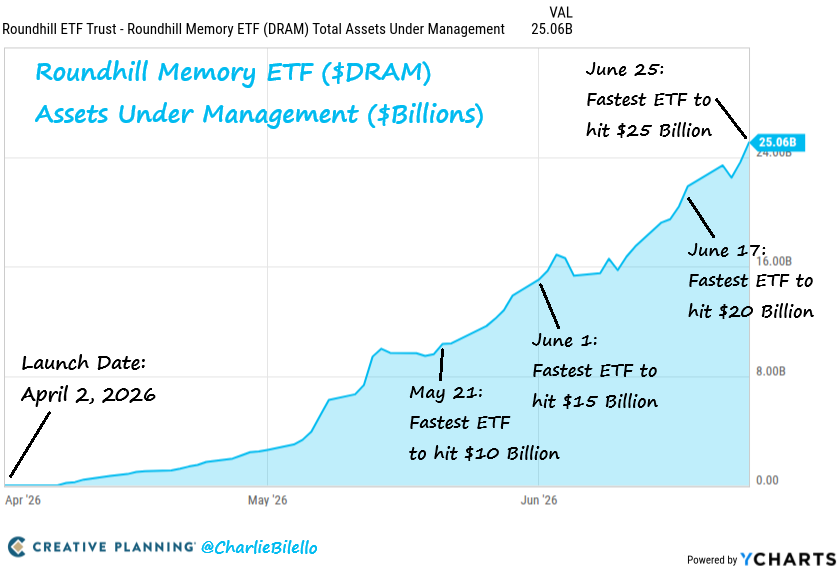
The Memory ETF is now the fastest ETF in history to hit $10 billion, $15 billion, $20 billion, and $25 billion in assets under management. Was launched less than 3 months ago. $DRAM
Video: https://t.co/Zv08iIKdd4
Indeed! And that is precisely what is NOT happening now. We haven't seen these levels of inequality since the Gilded Age and, to boot, those who enrich themselves thanks to what the whole economy offers them, do not want to pay taxes to fund it
“When there is a frenzy of activity in one area of the market there is very often an anti-bubble of discarded companies. In the dot com era these were companies with steady cash flow.”
— Nick Sleep 🗣️ (Nomad Letter Jun 2006)
Public tech companies love dismissing the cost of equity compensation. Yesterday's OSCR milestones is a case study on why dilution matters: we're now back above the valuation we had at our IPO - but the price is still 30% below it. That is all due to higher share count aka dilution since then.
It was incredibly tough to manage through the lean years of falling OSCR stock price and having to squeeze down on equity compensation as a result (employees of course look at equity compensation in today's dollar terms, not in share count, so you have to issue more shares just to make people think you're staying even). You have to do things like reducing vesting periods or stacking grants differently, or just outright cut. Most tech companies have probably never managed through something like that. Certainly private-going-public tech companies never have.
Well, at some point it's going to happen to everyone; and when it does, it is so tempting to dismiss increased net dilution due to annual equity comp as "not real" (you just don't really see/feel it anywhere right away). But then you look at valuation vs. price after several years, and you see it's very real. Of course, OSCR also illustrates the counterpoint: I'm extremely glad we got our convertibles done when we did & grateful to those investors, because without those we wouldn't be here now, ready for the individual market to be the future of healthcare.
It is however an excellent experience to manage through as a leadership team, and @mtbert knows extremely well how to manage through both the down cycles and the up cycles (which we're in now, thankfully!)
Moodsa aja börsifirmade reaalsus - majandustulemustest olulisem on kuulumine / mitte kuulumine indeksisse. See trend järjest süveneb. Balti börse see mõistagi ei puuduta. Index rebalancing is now the biggest event in markets https://t.co/nqUChogo5s
Many countries are debating some type of gas tax holiday but supply and demand still have to cross. If the market needs demand destruction and all countries suspend their tax, it won't change the short-term price. It's just a big transfer of $ from government to the oil industry.
Meanwhile, a new industry emerges to tackle the issue.
Once upon a time 12v car batteries were a major issue as recycling wasn’t available
Currently we sell 500 million a year, about 9 million metric tonnes.
Now they are considered one of the most recycled components on the planet with up to 99% of their components recycled, all this despite their toxic make up.
Wind turbines. Companies like https://t.co/lKJDs9Yyzo take these blades and transform them in to components to replace fossil fuel at ‘energy to waste’ plants that manufacture cement.
This will happen worldwide as the need arises.
Meanwhile, old farts like this would rather you stick to burning gas and coal. The good news is, the world ain’t listening anymore.
Curious how Jane Street made $40 billion last year with few negative days? Here’s one example:
- Between 1990-2000, there was only one exchange-listed product to trade natural gas: the NYMEX (now CME) physically-settled futures contract
- In 2000, ICE realized there was demand for a financially settled (swap) futures contract and introduced it
- CME countered and listed their own swap future
At this point, the products were primarily for institutional and sophisticated individuals with a commodities account. But as commodities boomed in the 2000s, exchanges created new contracts to increase access and appeal to retail traders.
- the NYSE introduced an ETF (UNG) that followed natural gas prices in 2007
- More ETFs followed that offered ability to bet on a price decline and to get 2x or 3x leverage
- CME introduced a mini contract that was 1/4th the size of the original
The next evolution was to appeal to the pure speculator by expanding the market to less regulated exchanges, widening access globally, increasing leverage, and creating daily bets.
- CME introduced the micro contract that is 1/10th the size of the original
- CME and ICE introduced contracts that expire each trading day
- Hyperliquid and Binance offer unregulated, on-chain, high leverage, perpetual nat gas contracts for non-US uses
- Kalshi offers same day binary contracts. Other prediction markets are moving forward as well.
Now add other iterations on settlement days for the contracts and options on everything listed above.
Note that all of these contracts settle (perps notwithstanding) against the original CME physical futures contract. But instead of one way to trade the product, there are dozens. This creates an opportunity to make markets across all of these surfaces and arbitrage among them. And that's what Jane Street and other similar HFT shops do (among many, many other things).
Nat gas for delivery at Henry Hub, Louisiana is just one product. Take all the ways to trade equities, currencies, commodities, crypto, interest rates, etc across all the different exchanges in all the jurisdictions and the opportunity of making $50 here and $1000 there adds up to an enormous, low-risk money making machine.
This opportunity originates from the large variety of ways people desire to trade random financial instruments and the various products designed for them. This creates a hugely profitable opportunity for the HFTs. They provide a valuable service of creating liquidity for those seeking to trade. Whether that trading is smart and profitable for the average punter on the other side is a different story.